Pages

Showing posts with label research terms. Show all posts

Saturday, April 19, 2014

Writing an Outstanding Family Story

Many family historians begin their search for ancestors in the same way. We start with names and dates of birth and death, relationship to us, and finally countries of origin. But most of us are not satisfied to stop with just the facts. A common trait of genealogists is the hunger for knowledge. We want to know what kind of lives our ancestors had in their countries of birth. Why did some decide to emigrate and others didn’t? What were their lives like in their new countries?

Royall Tyler Collection's original manuscript by John Adams (1735–1826), Wikimedia.

For some of us, these questions can be answered by family stories, diaries and journals, letters, bibles, and published histories.

Letter to Abigail Adams, wife of former President John Adams,
 written by Jefferson at Monticello...15 May 1817.
The Thomas Jefferson Papers, Series 1, General Correspondence,
The Library of Congress, Washington, D. C., Wikimedia

 But for many, our forebears were struggling to survive and may not have been able to read or write. Their individual stories have been lost to the progression of generations who followed them. However, for some families a combination of an auspicious historical time period, a wealth of letter-writing members, and some living relations with excellent memories come together, just waiting for a modern-day scribe to weave a history.

David Laskin is a best-selling author who turned his talents to writing the history of his Hakohen family line in his book, TheFamily: Three Journeys Into The Heartof The Twentieth Century.
Used by permission of publisher
Laskin explains that this surname has three different spellings depending upon the country that some family members were living in. In Russia, where the family story first starts, the name was “Kaganovich.” In America, where one branch of the family immigrated, the name is “Cohen.” In Israel, where another branch chose to live, the name in Hebrew is “Hakohen.”1

Laskin begins his chronicle with Shimon Dov Hakohen and his wife Beyle Shapiro who were born in the mid-1800s in the Russian Pale of Settlement.

"Map of Western Russia Showing the Jewish Pale of Settlement,” 1905, Herman Rosenthal;
J.G. Lipman; Vasili Rosenthal; L. Wygodsky; M. Mysh; Abraham Galante (1905)
 "Russia" in 
The Jewish Encyclopedia: Vol. 10, Philipson–Samoscz,
 New York, N.Y.: 
Funk & Wagnalls, pp. 531, Wikimedia.
By 1900, six children, ranging in age from 17 to 38 were born, and several had children of their own. The family members lived in two small towns between Vilna  and Minsk. Most of Laskin’s story is about the lives of the children of Shimon and Beyle whose lives coincided with the twentieth century.

Like many family chroniclers, Laskin didn’t become interested in the story of his family as a young man. But when he did, he was very fortunate that several members of the family were still living who had knowledge of the past, from hearing first-hand accounts from relatives now passed away, and who were willing to share what they knew. Another very lucky break was the fact that much correspondence among family members, going back to the early 1900s, survived.

The first part of Laskin’s book tells about life for Shimon and Beyle Hakohen, their children and their grandchildren in the Pale. We learn of the conditions of daily life in a small village in the early years of the 1900s with Jewish and Christian neighbors living along side each other. We read about everyday family life, marriages, births, work and economic conditions.

Laskin also tells us of the pogroms that came with regularity and how these devastating periods of slaughter of Jews out of ethnic hatred impacted the younger generation of Hakohens. This history of institutionalized persecution along with bleak economic prospects propeled two branches of third-generation Russian Hakohens out of the Pale forever, illustrating the “push factor” in emigration.
We know the reasons that pushed the young Hakohens to leave the Pale, but what were the “pull factors” or the motives behind where they chose to emigrate? Laskin gives an inspiring picture of Sonia and Chaim Kaganovich, grandchildren of Shimon Dov Hakohen and first cousins, who longed to be part of establishing a Jewish homeland.

Pioneers in Kibbutz Ein Harod , Settlements in Israel,
 between 1920 and 1925,

In Chapters 11 and 12, we read of their separate journeys to Palestine, their individual beginnings in the land and their coming together in marriage. What a powerful window of history Laskin opens for us as we glimpse the struggles of Jews and Arabs to live in the same land.
British Mandate for Palestine, Seblini, 29 January 2012, Wikimedia.
 We watch the pioneering Jews as they tackle often harsh climate conditions to turn barren land into thriving farms. This is a genealogist’s dream: to see into their emigrant ancestors’ daily lives in their new countries.

So far Laskin has introduced us to two branches of the Kaganovich family: one that stayed in the Pale and one that made a foothold in Palestine. But there is a third branch. Itel Kaganovich, the oldest granddaughter, who was born in 1886, had a talent for sewing and for fighting injustice. In Chapter 3, Laskin describes Itel’s journey from seamstress to revolutionary. The younger generation of Jews in the Pale were organizing against the system that condoned the cycle of mayhem against their people. Itel became part of the movement to such a degree that her life was in danger. The man she loved had left for America to escape the death sentence of having to serve in the Tsar’s army as a Jew. After her family was warned that she would be jailed, Itel sailed for America where she would be known as “Ida” and would become a phenomenal success.

"The Steerage" 1907 photograph by Alfred Stieglitz,
public domain, Wikimedia.

Laskin allows us to see the day-by-day struggle of Ida from a near penniless young seamstress
“…a sweatshop inspection in Chicago, Illinois”,
1903, Chicago Historical Society, Wikimedia.

 looking for work on the Lower East Side of New York to the owner of Maidenform Bra Company. So many genealogists have stories of family members who came to America with nothing but hopes and worked hard so that their children could have life a little easier. But very few actually strike it rich and end up owning a world famous company. Laskin shows us just how Ida put together her creative talent, a risk-taking nature, hard work, and a head for business. We get to go on Ida’s unforgettable journey along with her.

As Laskin tells the story of his family, he gives us his theory on the types of immigrants:

“Some immigrants forever grieve for their “real’ homes, the predawn smell of baking bread, the glaze of rain on cobblestone, the echo of bells in the alley. Others step off the boat, fill their lungs with the raw unfamiliar air, and get to work. They never look back because they never have a moment to spare or an urge to regret.”2 

David Laskin’s book is an example of the best kind of family history. Readers not only get the personal history of the family, but these individual stories are woven into local, regional and world history. Wouldn’t it be wonderful if Laskin taught a class in “How to write your Family Story” at a professional genealogy conference? While we wait for that to happen, pick up his book and read it for the exciting story that it is, but also study it as an example of excellent genealogy writing.

Notes

1David Laskin, The Family: Three Journeys into the Heart of the Twentieth Century (New York, New York: Viking, Penguin Group (USA) LLC, 2013), p. 1

2 Ibid., p. 55

Categories: research terms

Friday, May 24, 2013

Revelations Through Letters

We genealogists look at many different records in our search for information on our ancestors, including vital records, as well as court, land and military records. But some of the most intriguing documents, if you are lucky enough to find them, are first-person remembrances and interviews.

I used to think that only “famous” families had books written about them. But as I have pursued my own genealogy, I have found that ordinary families, too, have had a person or persons so interested in preserving their history that they have made a published record of their findings. The professional term for this historical record of a family is a genealogy.
I have not yet found any Spears genealogies pertaining to my line, but I have been fortunate to find interesting source material about my Johnson forebears. Sallie Atkins, whose husband’s DNA matches my brother’s, has been researching our shared Johnson, Shelton and Franklin cohorts for over thirty years.
Sallie introduced me to a collection of letters on our families between Hobart Oscar Franklin (b. 1915 Cabell County, WV) and Kenneth Charles Wilde (b. 1932).

Both men, who descend from the same Franklin ancestor, had spent years independently researching their family lines. Then in the 1980, they somehow came across each other (way before the internet made it easy to find people) and began corresponding for the next twenty years about the family lines they had in common. And what a boon for everyone who shares their ancestors! I have mentioned before in my blog post of September 19, 2011 of how you can really make leaps in your research through working with others.

 In their own research, they each had used a combination of first-person interviews with court and census records in their efforts to find out all they could about their early ancestors. Also, both men also were familiar with Fred Lambert, a family historian in the early years of this century who traveled all over West Virginia interviewing  people and recording their stories, and referred often to his work in their letters. During their correspondence, Wilde and Franklin were able to pool their information, check their theories, and see what their family sources had to say on the same topics.

Franklin had the advantage of being born earlier in the twentieth century. When he started delving into his family history, several living relatives, including his mother, Luverna McComas Franklin, (b. ca.1868 Lincoln County, WV) and aunt, Viola Franklin Midkiff (b. 1867), had been around long enough to either remember some of the early ancestors or to have heard stories from people who had actually known some of the forebears who had passed away before his birth. And lucky for us, they were willing to share this information! At least some were.

What were some of the themes that came up in the letters between the two family historians? As you might expect, one of the recurring subjects was tracking the migration patterns of the associated families. The Sheltons, Franklins, and Johnsons had moved across colonial Virginia through the counties of Lunenburg, Halifax, Pittsylvania, Amelia, Henry and Patrick Counties before going to Surry and Buncombe Counties, NC; they ended up in Cabell County, WV in the early 1800s. We genealogists always want to pinpoint the time and place that each of our ancestors lived and when, where and why they moved. 

Wilde and Franklin used the Virginia Court of Common Pleas records to track the migration of their ancestors by their court appearances. In colonial times, people went to court often to settle debts and to air other differences they had with neighbors (see my blog from January 28, 2013 for more details on the workings of American Colonial courts.) Wilde and Franklin also used County lists of Tithables, another type of court record, to place people and find out who their neighbors were.

The two researchers also used the US Federal Censuses, especially the 1790 and 1800 Virginia and North Carolina census documents, to aid them in placing ancestors and in tracing their movements during the decade between 1790 and 1800. Because of their meticulous study of the records, I was finally able to see how my families had crossed from Eastern Virginia to the southern part of the state and then into North Carolina.
County Map of Virginia, and North Carolina, 1860, Samuel Augustus Mitchell, Wikimedia, public domain.
A second recurring theme was the question of whether or not there were Native American ancestors in the family as was rumored over the years by various Franklin folk. When Hobart Franklin asked his father about this, he was met with stern silence. This is what he wrote to Wilde about the subject of ethnicity of the family: “I am so ignorant about our Indian ancestors. It was such a hush-hush in our family. Dad wouldn’t talk about his people…” (p. 559). But his Aunt Viola and mother both agreed that there was Indian blood in their family.

For his part, Kenneth Wilde wrote that he experienced the same “refusal to talk” or acknowledge the fact of Indian ethnicity in his branch of the Franklins.

Another aspect of the Native American heritage stories that Wilde and Franklin bounced back and forth was trying to “flush out” the details of a possible ancestor, Mary Franklin, (also known as Glumdalclitch, although no one knows why she was called this) who supposedly was all or part Native American and who may have married a Franklin or had a father who was a Franklin, according to which testimony you looked at. 

This quest to find out about a particular individual, in this case Mary Franklin, shows how family genealogy leads researchers to study history.  In a query to The Franklin Fireplace in April 1979, Wilde wrote that Mary “may have been one of the Cherokee women prisoners who were captured by General John Sevier of Tenn on a Cherokee Expedition sometime prior to 7/28/1781.” Perhaps this is the query that Hobart Franklin answered that began the long correspondence. As the two batted their information and theories on Mary Franklin back and forth through their letters, they were able to put together testimony they had gathered separately from different members of their families.

Another theme that recurs throughout the correspondence is the effort to untangle family relationships, as in “Who’s your daddy?”
Any genealogist who has been researching for any length of time recognizes this question. Franklin and Wilde were trying to find out who fathered the two sons of Mary Franklin, the Indian woman introduced above. They relied on family testimony as these births occurred in the late eighteenth century, too early for birth records. Also, they could find no marriage records for Mary, and they wondered if perhaps she never married. 

One of Mary's sons, William Duckworth Franklin Shelton (known as “Duck”, b. ca. 1798), was said to be fathered by Roderick Shelton as noted by the two researchers. But they found no documentation (and, to my knowledge, none has been found since) to confirm this contention. According to Hobart Franklin, some indirect evidence of Roderick’s possible parental relationship to Duck is that Roderick cared for and supported him. But Duck, according to Wilde, called himself “Franklin” after his mother.

Franklin and Wilde had both heard that Mary Franklin had a second son, George “Rock” Franklin (b. ca. 1801). Wilde said that Rock always contended that his father was Solomon Stanton. Again, no documentation has been found to corroborate this theory.

So, what have I learned from the discovery of the correspondence between Kenneth Wilde and Hobart Franklin? For years I have been reading stories about the Sheltons, Johnsons, and Franklins on rootsweb, genforum and other places on the web. But most of the writers of these stories list no sources. One of these stories was about Mary Franklin (Glumdalclitch) and her children. With the Wilde/Franklin Letters, I now know where these stories, that were showing up all over the internet, came from.

After seeing how the two researchers used their letters to try out theories, to check the accuracy of each other’s family stories and generally to further their life’s work, I am even more convinced of the value of being part of a community of genealogists.

  Genealogies, first person interviews and letters are wonderful additions to a genealogist’s record collection. Look for genealogies, manuscripts, and letters about your family lines. Search in the libraries in the counties where your people lived; use the on-line catalogs. And if you’re young enough to have older family members still living, don’t miss the opportunity to ask them to share their stories. Be sure to record them. And after you collect a whole lot of oral testimonies, you might consider combining this information with the results of your other research to write a genealogy of your family.

Marshall University, 2006, Youngamerican (talk), Creative Commons unported license
As I missed out on interviewing many living witnesses since I was born in 1945 and didn’t become interested in researching my family history until the late 1990s, I will be eternally grateful for the written legacy of Fred Lambert. He spent years traveling around West Virginia interviewing people about their families. He cared enough to preserve his findings about his and my ancestors by leaving his research to Morrow Library at Marshall University  in Huntington, WV. And of course I owe a huge debt of gratitude to Hobart Oscar Franklin and Kenneth Charles Wilde.

Categories: document types, research terms

Tuesday, March 12, 2013

A Research Assistant at Your Side: The FamilySearch Research Wiki


How would you like to have a robot with a genealogical brain at your side and by your computer when you start researching a geographic area that is new to you? The folks at FamilySearch have made quite a lot of progress towards such a scenario.

How do you usually conduct your internet searches as you hunt for people/records in particular geographic areas? I usually start with google , FamilySearch main page, books.google, and FamilySearch catalog in about that order. But this is not really a strategy; it’s more of a “shot in the dark” approach where I throw out my question and hope I find an answer somewhere. There is another way that will give us more structure to our searches and that may well produce some surprisingly fruitful results.

So what is this “other way”? It’s no big secret. It’s been here for sometime – the Research Wiki by FamilySearch. The purpose of this Wiki is to provide some structure to geographic searches. But recently it has been revised and improved.  I used the Research Wiki a couple of times in the past year but then, out of habit, I slipped back into my scatter-shot way of searching the web.

But fortunately, Lisa Alzo, a renowned genealogy researcher, in her Legacy webinar “Best Internet Sources for East European Genealogy” ,  reminded her audience about the Wiki and demonstrated how helpful it is. 

For more background on this Wiki, check out the posting on Legacy  by Marian Pierre-Louise, another well-known genealogist and one of my favorite webinar presenters.

I decided to return to the Research Wiki to help me as I searched Patrick County, VA for signs of the Shelton family, a cohort or FAN (see paragraph 5) of my Johnson line.
Here are the steps to follow:
  1. Go to FamilySearch.org on the internet.
  2. At the top of the page, click on “Learn.”
  3. Under the large map, you will see “Research Wiki” on the left.  Click on this.
  4. In the search box, type the place you are researching.  In this case, I typed “Patrick County, VA.”
  5. A results page will come up next. I clicked on the second result “Patrick County, Virginia Genealogy.”

Clicking on this page brought up a page with many topics. The first topic on the page was: Main article: PatrickCounty, Virginia which gave a general introduction to the history of the county and resources available to help you in your research.

When I returned to the main page, I saw that the next topic was Patrick County, Virginia  Genealogy Message Boards. I clicked on Patrick County, Virginia Genealogy by Genforum just to be sure I had put a message there. And there it was at the top of the list, dated 11/07/12. But unfortunately, there were no responses yet.

I went back again to the main page and looked at the third topic, Patrick County, Virginia Genealogy Books and Articles. As I looked down the list, this caught my eye:

[Shelton] Shelton, David. Autobiographical Sketches of the Life and Adventures of David Shelton. 1890s.FHL Book 921.73 A1 no. 615 Book Storage 0238073.

And here is where the amazing find happened!! I clicked on the selection and up came a page from the FamilySearch Catalog which showed that the document was on microfilm. So I thought I would need to order the film and wait for several weeks. But to my surprise, the folks at FamilySearch have indeed been busy digitizing records as I have been hearing in the genealogy community. Under Notes, this link was posted: To view a digital version of this item click here. With one simple click, a screen appeared showing a handwritten journal by David Shelton! I have never seen a piece of personal, family correspondence from the nineteenth century before. Here is an excerpt:


So the next time you are researching an ancestor in a geographic area that is new to you, be sure to start with the Family Search Research Wiki. Not only will you find a thorough introduction to many records and where they are located for your target area but you never know what hidden treasures are waiting for you.


Categories: genealogy education, genealogy tools, research terms

Tuesday, August 21, 2012

Chicago Trip Preparation Part III – Organizing my Itinerary and Reviewing my Research


It is six weeks before my research trip to Chicago – time to assemble my trip binder. I have been collecting notes (operating times, addresses, ckecklists, maps) on various research sites that I plan to visit and putting them into a manila folder. My next step is to organize the notes by day of visit.

First I get a 3-ring binder and some dividers. Then I take my trip calendar, see my post from June 24, 2012, where I have made a rough outline of my destinations by day of the week. I make a divider for each day and place them in the binder. Now I’m ready to tackle my bulging folder. I separate the notes and rearrange them according to the sites I will be visiting. Then I punch holes in the sheets and place them in the binder. It’s a quick way to bring order to my chaos.

While I am in this trip preparation mode, I decide to take a look at a webinar by Marian Pierre-Louis, “Ten Brick Wall Tips for Beginners” that I bought on a CD from Legacy Family Tree.com. One of my main goals for this trip is to try to gain more information on one of my brick walls. I haven’t been able to find much information on my great grandmother’s parents – John Kearney and Mary Duffy Kearney. Maybe some of Ms. Pierre-Louis’ tips could help me.

In fact, the webinar is full of helpful ideas. And it was the very first tip that helped me push my research forward, and put me in a better position to learn more from my trip to Chicago. Ms. Pierre-Louis cautioned her audience to review their research. She said that she knows people will say “Oh, I do that.” But she encouraged everyone to regularly review all their findings on their brick wall challenge.
 I believe the key here is “regularly.” As we find new information, it is important to re-look at our accumulated notes. Sometimes the new facts may give us a different perspective or idea. And, Ms. Pierre-Louis says this review can help us reorganize our information that may provide us a new research route. Well, I was inspired!

I started reviewing my documents on the Kearney/Carney family. A challenge I had been working on was to find where this family lived in Chicago. I knew that their daughter, Mary Carney/Kearney Kries Lauer, lived in West/North Chicago after her marriage in 1895. But before that date, I had no idea where she had lived with her parents. I have been unable to find a birth record for Mary where I might find a residence for her parents listed.


I looked again at the baptismal record for Patrick William Kearney – the infant son of John Kearney and Mary Duffy Kearney who was born 8 Dec 1877 and died in 1879. We know that documents can have many clues besides the obvious. I saw the sponsors’ names on the baptismal record – James Devine and Julia Cosgrove. I had noticed these names before. In fact, I had done a long search on the Cosgrove family, trying to link the Kearneys and the Cosgroves. But something new struck me. What were their addresses? If they were friends of the Kearney family, they must have lived close by.
On Patrick William Kearney’s death record, his parents’ residence is given as “Halsted at Hastings,” a South Chicago address. This is a big clue, but I wanted more evidence. If James Devine and Julia Cosgrove also lived in South Chicago, I could be pretty sure that I had placed my great, great grandparents in 1875. This is where the online Chicago City Directories might offer me some answers.
An important thing to remember when using the directories to search for addresses is that in 1909 the streets in Chicago were renumbered. If you want to plot pre-1909 addresses on maps.google.com or mapquest.com, you have to use a conversion tool to update the old addresses. 

In the 1875 directory, I found James Devine living at 80 (549 – post 1909) Barber St, also a South Chicago address near Halsted at Hastings.  Julia Cosgrove lived with her husband, Matthew, at 308 (703 – post 1909) S. Desplaines, also a South Chicago address but at some distance from the Kearney home.

Now that I had two addresses suggesting the South Chicago status of John Kearney and Mary Duffy Kearney, I wondered if there were any other friends of the family that might give me more confirmation. I remembered researching Catherine Sweeney Brookins Dinan, a friend of Mary Duffy Kearney and later a friend of her daughter, Mary Kearney Kries Lauer. Catherine had been a baptismal sponsor of Mary Kearney Kries Lauer’s first child, Henrietta Kries. I searched the 1875 City Directory for George Brookins, the first husband of Catherine, and saw that the couple also lived in South Chicago at 716 W. 18th St., near the Kearney/Duffy home.

By this point, I had strong evidence that John Kearney and Mary Duffy were South Chicagoans. This knowledge would save me time in my research in Chicago. And I would never have come to this conclusion if I hadn’t followed Marian Pierre-Louis’ Brick Wall Tip # 1 – look over your accumulated research on your brick wall(s) regularly and you will increase your chances of solving the case(s).

Categories: genealogy education, genealogy tools, research terms

Sunday, June 24, 2012

First Steps to Prepare for a Research Trip to Chicago


The first thing I do when planning a research trip is to identify the sites (libraries, courthouses, cemeteries, etc.) I want to visit. My first step in creating a schedule of visitation is to consult the websites of each venue to find out the days open and operating hours. Instead of merely making a list of sites and operating times, I put the information on a calendar. To find a calendar that is fillable, I went to Microsoft office templates. I like the visual picture this gives me, and it serves as the first step in planning my itinerary.

 Then I want to check google maps to further block out my trip – I used this tool to see which sites are close to each other, which places are outliers and might require more travel time, etc. I can then pencil in the order in which I might visit certain sites.

My next step is to fill out a Repository Checklist for each site that I plan to visit. I found this gem of a tool, created by Brenda Leyndyke, on her blog, “Journey to the Past,” which anyone is permitted to use. For each site I jot down basic information (parking information, telephone number, types of holdings etc.) on my checklist. Here is an example of my checklist for the Newberry Library:
RESEARCH  REPOSITORY CHECKLIST

REPOSITORY:  The Newberry Library


Address/Directions

60 West Walton St, Chicago, IL 60610
312-943-9090


Admission Cost
none


Contact Information


Reference and Genealogy Services Section

  • Autumn Mather, Reference Services Librarian, Reference Team Leader
    mathera@newberry.org, (312) 255-3675
  • Grace Dumelle, Genealogy and Local History Library Assistant
    dumelleg@newberry.org, (312) 255-3530


Food

(see attached sheet)


Holidays Closed

Labor Day: Saturday, Sept 1 and Monday, Sept 3


Hours

Monday, Reading Rooms closed; Tuesday – Friday, open 9-5; Saturday – open 9-1
Tour the library Saturdays 10:30 am and Thursdays 3:00 pm


Parking
(See attached sheet)


Parking Costs
(See attached sheet)


Photocopy Costs
Each exposure $.40. Manuscript collections $1.00 per folder.


Photocopy Policy
Newberry staff makes all photocopies. 30 pgs only from any given volume or manuscript collection. Can’t be photocopied: newspapers, telephone directories, materials that don’t fit in confines of copier (11 by 7 maximum)


Research Restrictions
Lockers are available on the first floor to store items not allowed in Reading Rooms. (See attached sheet)


Special Information
Must obtain a Reader’s Card before using services (see attached sheet)


Website

Used by permission of Brenda Leyndyke from her blog, “Journey to the Past” 10/2011

  If you keep these checklists by day of visit in a 3-ring binder, you will easily be able to locate pertinent details for the day’s travels. As you enjoy your breakfast, you will be very happy to have all the necessary information at your fingertips to get you where you want to be.

My next step in getting ready to visit Chicago was to search google.com for books on how/where to conduct genealogical research in this city. I found two on amazon.com that looked especially helpful and were available in inexpensive used copies in good condition.

The first book is Finding Your Chicago Ancestors by Grace DuMelle.  Ms. Dumelle is a librarian at the Newberry Library, specializing in genealogy and Chicago history. Part I of the book is organized around nine questions that you might ask yourself about your target ancestor’s life from place of birth to family members to addresses and date of death. Then for each question, Ms. DuMelle suggests types of records that might hold the answers. I’ve really taken to heart her advice on p. 15: “All of the sources for genealogical research mentioned so far are fallible.” So often, we find different dates for the same event in an ancestor’s life on different documents. This just means we have more work to do.

The second part of Finding Your Chicago Ancestors is called “Practical Advice”, and my favorite section is Chapter 14: “What to Expect at Chicago-Area Research Facilities.” Not only does Ms. DuMelle mention the top sites to research but she provides you a dress rehearsal before your visit: photographs of each facility and descriptions of holdings and services. Since the book was published in 2005, you will want to check each facility website for any changes or additions.

The second book that I found very useful is Chicago &Cook County: A Guide to Research by  Loretto Dennis Szucs who among her other qualifications worked at the National Archives -- Great Lakes Region. The main organizational rubric is by record type or record repository. Since I am researching my Irish Catholic Carney/Kearney line in Chicago, I found a particular list very helpful: “Chicago Catholic Parishes to 1875” pgs. 139-140 in Section 11 “Church and Religious Records.”

From http://www.explorechicago.org
Because Chicago was known for its neighborhoods in the nineteenth and twentieth centuries (and still is today), it’s helpful to know the area(s) where your ancestors lived. For example, I have been told that the South Chicago Irish and the North Chicago Irish remained on their own side of the Madison Street boundary. Section 12 of Ms. Szucs book “Communities and Neighborhoods in Chicago” provides a good introduction to this subject.

So let’s go over the first steps in planning a successful research trip. Once you have mapped out the operating days and hours of the sites you plan to visit, you can start formulating an itinerary for your trip. I suggest putting a Research Repositories Checklist for each site you plan to visit as the first thing in your trip binder. The next step is reading up on the cities or towns you plan to visit. I began with the internet and found two great books on Chicago on amazon.com. Of course, a visit to the website of each research site is a must to find the most up-to-date information.

Categories: genealogy education, genealogy tools, genealogy professional, research terms

Thursday, June 14, 2012

Using Research Logs and other Charts to Track Your Sources


In my post from June 1, 2012, I briefly mentioned research logs and where to find them on the web. But these had to be printed and filled in by hand. Just yesterday I found an on-screen fillable and savable research log created by the folks at Brigham State University. I had seen the same form on the site of the 1997 Ancestors TV series but it was not savable. However, this site has several very useful forms for conducting research that I will discuss in this post.

One step in my preparation for an upcoming research trip to Chicago (third week of Sept, 2012) is to have a research log showing the sources that I have consulted so far and what I have discovered. The log will also show the questions that still need answers.

At the Ancestors TV site, I found a Research Questions log that serves as a lead-in to the research log. It is a brainstorming tool to help you focus on the areas you want to explore in an ancestor’s life, the questions you are seeking answers to in your search, and the possible sources that might have this information.

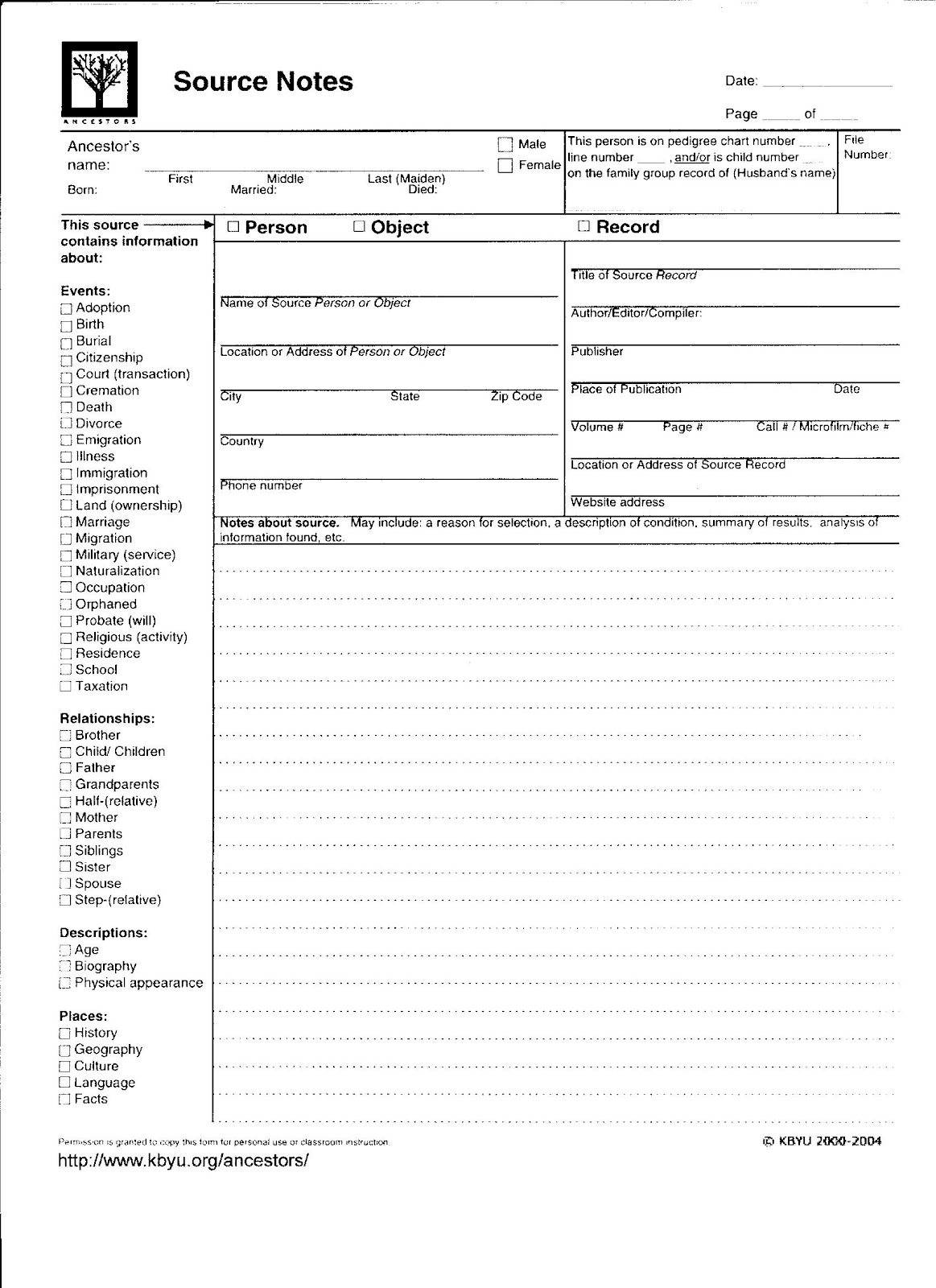
A third research chart that appears on the Ancestor TV site is Source Notes This chart makes it easy to document each source that you find and provides lots of space to record the information found.


You can be sure that I am going to make several copies of these forms to use in my upcoming trip to Chicago. When I locate my first source at the Newberry Library or other research site, I can pull out my Source Notes form to record the information. Use of this form will prevent me from jotting down notes on random sheets of paper. With these three forms, the researcher can achieve an organizational level that will guarantee a more successful search.

Categories: genealogy education, research terms