Pages

Showing posts with label genealogy professional. Show all posts

Tuesday, August 25, 2015

Destination: Greece

Well, the time for our departure to Greece is coming closer. Now we’re getting out the checklists to be sure we have everything we need for a comfortable trip, including medicines, electronics, and travel clothes. But what helped us reach this point where we feel nearly ready to head for Athens?

By Gilberto Gaudio from Rome, Italy (Athens (Greece))
 [CC BY-SA 2.0 (http://creativecommons.org/
licenses/by-sa/2.0)], via Wikimedia Commons

First of all, this is not just a tourist trip but also a heritage journey. Thomas MacEntee explains what heritage travel is in his web article “You Can Go Home Again.” I am taking this trip in part to visit the home village of my Greek great grandfather, Peter Flesouras. He was born in a small village in the middle of the Peloponnese: Pigadakia, Tripoli, Arcadia, just a small dot in the mountains where he and his family herded sheep and goats. Pigadakia is 15 miles (24.3 Km) south of Tripoli.

"PeloponnesosMap". Licensed under Public Domain
 via Wikimedia Commons - https://commons.wikimedia.org/
wiki/File:PeloponnesosMap.png#/media/File:PeloponnesosMap.png

My first step in preparation for the heritage part of the trip (as I described in my Feb 6, 2015 post) was to find and hire a heritage guide to search for existing Flessouras records and possible living relatives. Through connections on the Facebook Hellenic Genealogy Resources group, I was introduced to Marina Harami, and we have been working together for several months. It has been frustrating for her because the economic situation  in the country has hit most sectors including the registry offices, church offices and other research centers. Staff has been reduced or put on really limited schedules, which makes it very hard to reach anyone and to try to locate information. But she has persevered, and we may have some success yet.

For my part, I have contacted Americans with the surname Flessouras on Facebook. Since this is a rare Greek surname and all the people of this name hale from the same area of Arcadia, we probably are related, but we don’t yet know how. Some of these Americans of the Flessouras name have relatives in Greece, and I have arranged to meet two of them.

Along with planning for the heritage side of our trip, we are also preparing for the tourist part. If you are considering a trip to Greece and are looking for travel guides, my husband and I have found three in print and on-line that we recommend. First, is Rick Steves’ Greece Athens & The Peloponnese.

Rick Steves at the Mountain Hostel, Gimmelwald,
 
Switzerland, 20 July 2007, Andrew Bossi, Wikimedia.

 My readers may remember how much we relied on Mr. Steves’ book on Eastern Europe to guide us through the Czech Republic and to help make our trip more rewarding and memorable. We especially like the walking tours, complete with “concise and simple” “black-and-white” (p. 495) maps, to introduce each destination. My husband describes Steves’ books as full of practical, everyday necessary information.


One of my husband’s favorite books is Insight Guides Greece with its stunning color photographs of natural beauty, icons, and monuments. He says this guide has the best photographs and maps and comprehensive coverage of culture, history and geography.

The third guide that I found very engaging on the subject of the Greek islands is by D. Haitalis: Discover the Greek Islands. This book delivers with stunning photographs, that make you want to fly tomorrow. It also has a brief history and sightseeing section for each island accompanied by small maps. For more detailed information on the islands, I would pair this book with the Insight Guide referred to above.

Just by luck and the grace of google, I came across Max Barrett’s  (online) Greece Guides. What a treasure trove of information! Mr. Barrett arranges his site as a virtual book with chapters ranging from “Matt’s Essential Greece Info” and “Honeymoon in Greece” to “Travel Agents & Tours.”  This is where we found one of the best discoveries in our travel planning: Fantasy Travel.

Many of you may be familiar with working with travel agents and arranging tours. Throughout most of our travel, we have created our own itineraries as we are doing for the Peloponnese. But for the island part of the trip, we decided to work with a tour company. The first step in working with Fantasy Travel was to figure out which islands we wanted to visit and in what order on what dates. After looking through our travel guides, Bert and I came up with this itinerary.

First we will visit Naxos:
"Naxos8" by Ildebrando - Own work. Licensed under
 Public Domain via Wikimedia Commons - https://commons.
wikimedia.org/wiki/File:Naxos8.jpg#/media/File:Naxos8.jpg
How could one miss the island described by in the Insight Guide as:
"the largest, loftiest and most magnificent of the Cyclades, replete with high, windswept ridges, long beaches, remote villages, ancient ruins, medieval monasteries or towers, and a fascinating history." (p. 249)

Next on our island tour will be Santorini or Thira as it is known in Greece. In his book Greece Athens & the Peloponnese, Rick Steves calls Santorini  "one of the Mediterranean's most dramatic islands..." and goes on to say  "...this unique place has captured visitors' imaginations for millennia...." and is "...one of Greece's most scenic spots." (p. 429)

Santorini Scene by Understandingmedia13 (Own work) [CC BY-SA 3.0
 (http://creativecommons.org/licenses/by-sa/3.0)], via Wikimedia Commons.

 I am excited  because the island is what was left from a volcanic eruption around 1630 B.C. (p. 450) For fans of Pompeii, one can visit the city of Akrotiri that was buried under ash and was unearthed in 1967.

The final island we will visit is Rhodes.
Acropolis of Lindos on Rhodes by Norbert Nagel, 
Mörfelden-Walldorf, Germany (Own work)
 [CC BY-SA 3.0 (http://creativecommons.org/licenses/
by-sa/3.0)], via Wikimedia Commons


I found great information about Rhodes and all the islands in Frommer's Greek Islands, our last print pick.
What does Rhodes have to offer? Here's what Frommer's has to say:

"A location at the intersection of the East and West propelled the island into the thick of both commerce and conflicts. The scars left by its rich and turbulent history have become its treasures. Hellenistic Greeks, Romans, Crusader Knights, Turks, Italians -- all invaders who brought some destruction but also left behind fascinating artifacts." (p. 332)

 In addition to detailed descriptions of the islands, the book also contains 60 pages on exploring Athens.

Once we had our schedule of islands to visit, we simply e-mailed this to Fantasy Travel. They arranged our rental car and all hotels on the three islands we are visiting.  Then they set up connections by ferry and air from one island to the other. Someone from Fantasy Travel will be meeting us at the airport. What royal treatment! It makes me feel like this:

HM Queen Elizabeth II arrives in Perth, Australia for CHOGM,
 taken by Andrew Taylor, Oct 26, 2011, Creative Commons, flickr.com.

Traveling for heritage and/or tourist reasons can be made easier and more productive with the help of excellent heritage guides, travel books, tour companies and websites. I’ll have a lot more to share when I return from Greece.

Categories: genealogy tools, genealogy professional

Saturday, April 4, 2015

Tracking the Hanneman Family: Uncovering Local Resources in Pennsylvania

Questions, Oberazzi,  December 9, 2006, Flickr.com
Is it Henrietta Hausman or Henrietta Hanneman? What is the correct spelling of a target ancestor’s name is a question that faces many researchers. In this case, the person of interest bearing the mystery birth surname is “Henrietta Hausman or Hanneman Williams Kreis” who was born in Pennsylvania and became the second wife of my great grandfather, Henry Kreis. To answer this question, I needed to investigate Pennsylvania genealogy resources.

Map of Pennsylvania, National Atlas, public domain, Wikimedia.
In my Oct 19, 2011 post, I introduced my readers to Henrietta.

Received from granddaughter of Henrietta

At that time, I had a theory (this was early on in my research of this family) that “Hanneman” might be a variant or misspelling of “Hausmann.” The main reason for this belief was the close relationship between Henrietta and her father-in-law, John Kreis, that continued long after her marriage to his son ended in divorce. John had married two Hausman women; first Mary Hausman and after she died, Margarethe Hausman. Because of marriage patterns at that time and people having smaller marriage pools, it is probable that these two women were related. Furthermore, if these two Kreis wives were related to Henrietta, it would explain why she would include John Kreis in her household for twenty years.

Another reason in favor of the Hausman spelling is that the 1900 Chicago, Cook, IL US Census  gives Nettie’s (Henrietta) brothers’ surnames as “Housman” which could be a misspelling or an Americanization of “Hausman.”

I decided that I must delve deeper into family records in order to make a strong case for the true surname of my great grandfather’s second wife.

In my earlier research on the Hanneman/Hausman family, the seminal document I found was the 1880 Newark, Essex, NJ US Census. This showed Henrietta in her birth family with her parents, Fred and Emma Hannaman (spelling variant of “Hanneman” in this census) and her siblings.


In this early research phase on the Hannemans, I had concentrated on Henrietta, her brothers Charles and Frederick (as she lived with them in Chicago in 1900) and her twin, Louisa. Somehow brother Henry had slipped past my scrutiny. In these sibling searches, I found no indication of where in Pennsylvania any of them were born. Also, I found no Hausman/Houseman connection.

Months went by. In December of 2014, I decided to do some more research on the Hanneman/Hausman question. I returned again to the sibling list and realized I had ignored Henry.  He was listed as age 12 in the 1880 Newark, Essex, NJ US Census. I went to Family Search and searched “Henry Hanneman.” Well, that search turned out to be gold! The 1870 Texas, Wayne, Pennsylvania US Census came up.
1870 Census questions:  1870 Questionnaire,
Census.gov › History › Image Gallery.
The household of “FredK and Emma Hannaman” appeared with two children: Gusta, female age ten and Henry, age one. I had not seen this census record before. This one document gave me three new pieces of information:

    Carbondale, Pa., between 1870 and 1879,
    Fowler & Bailey, Boston Public Library, Flickr.com.
  1. The birth place in Pennsylvania of Henry (and perhaps the other children): Texas, Wayne, PA (Texas township is near Honesdale and Carbondale, all of which are close to Wilkes-Barre and mentioned in different family documents.)


“An old bird-eye map of Wilkes-Barre,
 Pennsylvania, United States”, 
1889, Fowler, Downs & Moyer, 
 g3824w.pm008720, public domain, Wikimedia.


This corresponds with what Joan Van Hise Dirner, a granddaughter of Henry Kreis (and my cousin, now deceased) told me about her Hanneman family origins in this country. Joan heard a family story that the Hannemans were in Wilkes-Barre, Pennsylvania at one time before they came to New Jersey.

2. The name of another child of Frederick and Emma: Gusta.

3.The city/district in Germany where Frederick Sr. was born: Hanover.

This Wayne County, PA census record also told me that the family surname, as far back as 1870, was “Hannaman”, a spelling variant of “Hanneman.” It looked more and more like “Hanneman” was the family surname.

After this lucky break from Henry, I did more research and found him (in the 1910 , 1920 and 1930 Wilkes-Barre, Luzerne, PA US Censuses) showing that, unlike his siblings, he returned to Wilkes-Barre as an adult and lived there the rest of his life.

Map of Luzerne County, PA, US with township and municipal
 boundaries from US Census website 
by User:Ruhrfisch, April 2006, Wikimedia.  

In the 1910 Wilkes-Barre Census, I found that Henry’s brother, Frederick, was living in his household and the surname for all was “Hanneman.”

Invigorated and re-energized by my luck with Henry, I wanted to know more about the Hanneman family. I started my search anew. In ancestry.com under “New York, Passenger Lists, 1820-1957,” I found a listing for Heinrich Hanemann and his brother Friedrich, arriving in the US on 13 April 1866. This document was the oldest and closest to the old country that I had yet seen and thus the strongest evidence that the surname was indeed “Hanneman.”

Having done so much on-line research, I decided I also needed to consult some local sources. Since I live at quite a distance from Pennsylvania, I decided to follow my own advice from my Oct 19, 2011 post:

 “… when you are doing out of state research, someone actually living in that area can be very helpful.  That person can visit archives or other record depositories to search for information. An in-person search is much faster than ordering records by mail. Not all records have been digitized or are available on the computer. And a local person may know of places to research in the area that you have not thought of.”

Now that I had decided to go local, how did I find a researcher? A quote from my March 12, 2013  post gave me just the information I needed:

“…the next time you are researching an ancestor in a geographic area that is new to you, be sure to start with the Family Search Research Wiki. Not only will you find a thorough introduction to many records and where they are located for your target area, but you never know what hidden treasures are waiting for you.”

Family Search resources, Diane Cordell, June 25, 2012, Flickr.com

First I went to the Pennsylvania State Wiki at FamilySearch.org. Half-way down the page is a map showing all of the counties. To see a wiki on any of the counties, you simply click on the county name. In my case, I clicked on “Wayne” as that is where Wilkes Barre is located. Below is a diagram of the county:

Map of Wayne County, Pennsylvania, United States, 
modified by User:Ruhrfisch in April 2006
 from US Census website, Wikimedia.

On the left side of the Pennsylvania State Wiki page, you will find a menu bar which lists major topics of interest, including church records, court records, history, and newspapers among others. But I was looking for local professional help. The topic “Repositories” caught my attention, and the subheading  “Societies” seemed a likely place to check.

Wayne County Historical Society, used by permission
The first institution listed is the Wayne County HistoricalSociety, located in Honesdale, the birth place of Henrietta’s brother Henry Hanneman. On the side bar of the first page of this website, you can click on “Genealogy,” and you will find the Professional Research Package. For a $40 fee, you can purchase two hours of research. The website lists many of the sources available at the Society. I discovered that the site makes it easy to order research services on-line when I made my request for two hours of research on the Hannemans. During an e-mail conversation with the researcher, I attached documents I had already found and a history I had written on the family. Unfortunately, the researcher could find no additional records of the family’s time in Wayne County.

Sysiphus, oil on canvas, 40 x 40, 2014,
 Milan Rynt, 15 September 2014, Wikimedia 

As you can see from this post, living far from a state where your ancestors once lived is not an insurmountable obstacle to research. Local societies often offer on-site services for a fee. And an easy place to locate these local institutions is the Family Search Research Wiki.

A lesson I re-learned again while doing this research (Hanneman or Hausman?) is to always check records for each of the siblings in a family. You never know what you might find. In this case, Henry Hanneman’s records, a brother of Henrietta, brought me information I had not found from my research on his brothers and sisters: his birth place in Pennsylvania and most likely the birth place of his siblings.

In conclusion, in order to answer the question, is it “Henrietta Hanneman” or “Henrietta Hausman,” I searched for documents on-line and enlisted the help of local researchers in Pennsylvania. Hanneman (or some variant such as “Hannaman, Hanaman etc.) appears on every record except the one census document which listed the family as “Housman.”  From all the records I have accumulated, the evidence strongly suggests that “Hanneman” is Henrietta’s correct surname.

category: genealogy professional

Friday, February 6, 2015

Wanted: Greek Research Guidance

Irish United Nations Veterans Association house and
 memorial garden (Arbour Hill), 
William Murphy, 2011, Creative Commons, flickr.com.
This is the story of how one resource can open the door to many research tools. It all started because of my Greek ancestors. My husband and I will be headed to Athens in the fall of 2015 for our next family history trip.

Athens. Panorama from Acropolis towards
 northeast and Mount Lycabettus,
Tomisti,
2011, Wikimedia.
After traveling to the Czech Republic and Switzerland in 2013, I have some experience in getting prepared to make the most of my time in Europe. In my blog post of Oct 30, 2013, I discussed how I found my wonderful Czech heritage guide, Marie Zahn. The unforgettable trip with Marie to my grandfather’s ancestral village coupled with the genealogical information that she located before we arrived resulted in a very successful visit. This experience lead me to look for a guide in Greece.
But this quest proved much harder than I thought. I explored the subject of heritage guides in Greece in different google searches (trying to use just the right combination of words,) but nothing solid turned up. I e-mailed Rick Steves’ travel advisory site staffers, (a great site for travel information) but they had no leads either. 

Used by permission of publisher
On one of my google searches, I put “Greek genealogy resources” and a listing for a “Greek Family Research Toolkit” from Family Tree Magazine popped up. A copy of this issue is available at Family Tree Magazine's online store.

As I looked down the list of web sites in the tool kit, I saw this intriguing entry: Hellenic Genealogy Resources Facebook Group.

Facebook logo, 2013,
 Facebook, Inc., Wikimedia.


Now I had already searched Facebook groups under “Greek,” but I had not thought to look under “Hellenic.” The link in the Family Tree list (from 2012) was no longer active but now I had the name. I excitedly opened Facebook and entered the name I hoped to fine.

And there it was – the Hellenic Genealogy Resources Group!  (You must be in Facebook to see the group.) I saw that it was a closed group, so I clicked on “join” and the next time I checked, I saw a  welcome message from the administrator of the group, Dawna Stevens.

Listen, Ky, 2008, Creative Commons, flickr.com.
Having found the group, I could hardly wait to make contact.  In my “hello and thank you for letting me join message,” I asked if anyone knew of a Greek heritage guide. By the next day, Dawna Stevens had given me two possible candidates. This kind of treatment, of being heard, is something so wonderful to encounter when you are searching for information.
 I will write another post as I explore a research partnership with these new Greek contacts.

Another Facebook group I found in the Family Tree Magazine “Greek Family Research Toolkit” is Hellenic Genealogy Geek. I was intrigued by the term “Geek” – these must be very determined, focused researchers. Only a few weeks after joining this group, I received an e-mail announcing the “First NationalHellenic American Genealogy Conference” to be held in New York on Saturday April 25, 2015. This isn’t the first time that I have wished to live closer to New York City! The conference is co-sponsored by the Hellenic American Chamber ofCommerce and HellenicGenealogyGeek.com. The conference syllabus promises an exciting, information-packed day. Not only are there some intriguing presentations, but the conference is free!

The conference opens with Peter C. Moskos speaking on “Greek Americans: Struggle and Success” which is the title of a book by the same title he co-authored with Charles C. Moskos.

A presentation by Dr. Louis Katsos, titled the “History of Hellenic Lands,” focuses on how research in Greek records is impacted by “geography, boundary changes and village name changes.” Herein lie the sand traps that befuddle many a genealogist!

Bunker, Michael Coghlan, 2009,
Creative Commons, flickr.com.


In the afternoon, Peter W. Dickson, a contributor to Greek Americans, will be speaking on “Using DNA in Greek Family History Research.” How DNA can help in family history research is one of my favorite topics!

I found another lead in the Greek Family Research Toolkit -- a link to Lica Catsakis’ website, Greek Genealogy - FamilyHistory, How to find Your Greek Ancestors. Dr. Catsakis is the author of Family History Research in Greece. This is a description of the book that appears on her website:

“Eleven Chapters: Beginning your Research, Sources for Genealogical Research, Greek History, More about Greece, Greek Migration, Locating Places in Greece (with details about various gazetteers – geographical dictionaries), Churches and Religious Denominations (with addresses of dioceses, and Patriarchate), Research by Mail (with form letters for civil and church archives in Greek and their English translation, and Family questionnaire for relatives to fill in information about common ancestors), Learn about Names, The Language (with basics about grammar and a list of words you will see in Greek records), Numbers and Units of Time. 
Two Appendices: Glossary (of Greek and English words); and Greek Given Names their Variations, their English Equivalents, and Name-days.
Pictures of ancestors and of the land, Maps, and photocopies of samples of Greek Records andCertificates.”

Isn’t it amazing how one resource, in this case Family History Magazine’s "Greek Family Research Toolkit," can lead one to discover all this:

  • Two Facebook groups on Greek Genealogy Research
  • Referrals to Greek Heritage guides
  • The Hellenic America Chamber of Commerce
  • The First National Hellenic American Genealogy Conference
  • A manual on how to do Greek Family Research by L. Catsakis
categories: genealogy tools, genealogy professional, genealogy groups

Wednesday, October 30, 2013

What a Heritage Guide Can Do for You

Most of us are familiar with tours and tour guides. Tours come in large and small sizes. I saw many while traveling in Europe this September. The hallmark of each was an energetic person holding an umbrella/flag high in the air, striding in front of a group of tourists.
David Vignoni,  Icon from
 Nuvola icon theme for KDE 3.x., Wikimedia.
I worried that if I ever was on such a tour, what would happen if I couldn’t keep up with the flying umbrella/flag? It wasn’t until planning this European genealogy trip that I learned about a different kind of tour guide – the ancestral or heritage guide.

The fact that I don’t speak Czech was the main impetus for my thinking about getting some help for my visit to the Czech Republic to find my grandfather’s ancestral home.

In my post from September 1, 2013, I wrote about how I found my personal guide to the Czech Republic, Ms. Marie Zahn of P.A.T.H. Finders International. Now let me describe our trip.

On Thursday, September 5, 2013 at 9:30 a.m., Marie picked up me and my husband, Bert, at the Best Western Kinsky Garden, our hotel in Prague. The Kinsky Hotel was a great choice for location, service and price, and we found it through Delta Vacations. Marie is a great guide to have in Prague as she is a native and very knowledgeable. 

Honza Groh, 7. 05. 2008, Memorial
of seven czech paratroupers…., Wikimedia.
As she drove us out of the city, Marie pointed out two of the main attractions we happened to drive by. The first was the Heydrich Terror Memorial, a tribute to two Czech heroes who assassinated a high-ranking Nazi in Prague. The second was “The Dancing House”, a building designed by two avant-garde architects, Vlado Milunić, a Croatian-Czech and Frank Gehry,  a Canadian-American, in 1992. The style is unusual in a city awash in medieval, Baroque and Art Nouveau architecture.
Maros M r a z, August 2004 Dancing House, Wikimedia.

After we left Prague, we soon were in the countryside. We saw large, cultivated fields interspersed with forested areas.
ŠJů,  31 August 2012, Nihošovice, Strakonice District, 
South Bohemian Region, Czech Republic, Wikimedia.

We asked Marie about the huge farms; she explained that after the fall of Communism, many farmers whose lands had been collectivized, regained their land. But as in America, it’s difficult nowadays for small farmers to make a living. Many sold their land to developers, and the result is that large, corporate farms abound where most people in agriculture now work.

We saw cars parked in the forest areas and Marie explained the Czech national pastime – mushroom picking.
Karelj, October 2008, Boletus badius, 
Czech Republic, Wikimedia.
It seems that Czechs of all ages love to go to the woods and search for mushrooms. And Marie told us a joke: on a mushroom hunt, a non-Czech asks, “Are any of these mushrooms poisonous?” The answer is: “All mushrooms are edible, but some only once.” I’m glad we were ancestor-hunting.

When we reached Naceradec, we first stopped at the Administrative Town Office
Pat in Naceradec in front of
Town Office and Church
Book by Eva Prochazkova
where we met Mrs. Svecova with whom Marie had set up this meeting prior to the trip. Mrs. Svecova presented me with  a book on the history of Naceradec. It has many beautiful photographs from different eras in the town’s life. And best of all, there is a summary in the back that is in English!

Our first stop was the Catholic church of Naceradec which Mrs. Svecova unlocked for us. My heart was filled with emotion as I stood before the very same building where my grandfather was baptized and attended services.
Entrance to Naceradec
Catholic Church, Sept 2013
Altar Naceradec Catholic Church,
Sept 2013
Although I have toured many churches in different countries, I felt very different being in the church of my ancestors.
 While to most people, the altar and the decorated ceiling would be the sights to see in this church, to me, the baptismal fount where my grandfather was baptized was place that drew me.
Baptismal Fount Naceradec
Catholic Church, Sept 2013

Our second stop was the World War I memorial
WW I Memorial Naceradec Town
Square, Sept 2013

in the town square. This is a familiar site in many European towns but again, this was special to me as two people with my grandfather’s surname were etched onto the monument: Josef Holub and his son Rudolf. I don’t yet know how these Holub men are related to me, so I will be doing some research.
Close-up WWI Memorial Naceradec
Town Square, Sept 2013
The next to last stop was the town cemetery. We weren’t sure what we would find there except Mrs. Svecova had told Marie the number of the one Holub grave. Before we left for Europe, I had asked Marie if Czech cemeteries followed the same practice as some other European countries of only leasing graves for a certain period so that they can be used again. Marie responded that this is indeed the case in the Czech Republic as well.

We came upon the Holub grave
Grave Naceradec, Josef Hrolicka
 and Rudolf Holub
and I immediately noticed two things. First, two different families were buried in the plot and second, the plot looked somewhat neglected. The grave marker was made of glass and very hard to read in the sunlight with the reflection factor, but it looked like a Rudolf Holub was buried on one side. Now there were two Rudolf Holubs to investigate: one who died in WWI and one who was buried here in 1977.

Our last stop in Naceradec was the house where my grandfather was born. A Holub family lived there and was waiting to welcome us. The house was the last one in a small lane. We parked in front and Mrs. Holub (I have not used first names for privacy) came out to greet us with a warm smile. They had just returned from their daily visit to the hospital where Mr. Holub was under treatment. As I walked through the front door, I felt very emotional as this was the same threshold my grandfather and his family crossed in their daily lives so many years ago. We followed Mrs. Holub into the kitchen where Mr. Holub, despite his ill health, stood beaming. He offered us all a warm handshake and gestured towards the chairs around the kitchen table.

Mrs. Holub had graciously prepared a delicious Czech luncheon. First we had coffee and pastries.
Jonathunder,  29 November 2010, Home made poppy seed
 kolaches on a plate, Wikimedia.
My childhood memory of “kolache”, pastry filled with prune/apple/poppy seed, was reawakened – there were several on the dessert plate! Then we were presented with ham and cheese sandwiches, and each time one of our plates was empty, another sandwich appeared!
Makovec, 26 December 2012,
Cuisine of the Czech Republic, Wikimedia.
We spent the next few hours looking at photos from Mr. Holub’s life, and we saw his birth certificate. Marie translated as Mr. Holub told us the details of his birth. His mother, Antonie Holubuva, lived in Naceradec when she was pregnant with him. She did not marry his father but married another man from the town of Louny and moved there with him. Mr. Holub was actually born in Louny. Because he grew up in Louny, Mr. Holub unfortunately never met any of the Naceradec Holubs. 

Mr. Holub came to live in Naceradec in 1977 when a relative left him this house and he has been here ever since. He said that Holubs have always lived in this house. It will take some more research to find how we are related.

We noticed that Mr. Holub was looking tired so reluctantly we said our goodbyes and headed back to our hotel in Prague.

As I planned this post, I wondered what other companies might offer heritage tours in other European countries besides the Czech Republic. I did a quick search on google and found a few entries for heritage guides, mainly for non-English speaking countries. Please note that I have no experience with any company other than P.A.T.H. Finders International. FamilyTree Tours is the company of an American and a German and although the company “specializes in heritage tours to German-speaking countries, they are able to design and assist in trips to other European nations." (from FamilyTreeTours website.) Ancestral Attic offers heritage tours in Poland and other Eastern European countries while Polish Origins has services for Poland and the Ukraine.


Hiring Ms. Marie Zahn, of P.A.T.H. Finders International, turned out to be the best decision I made in planning this trip back to my Czech homeland. If you are planning a trip to Europe to learn more about your ancestors, I recommend that you consider hiring a guide to make your heritage tour the best it can be.

Categories: genealogy professional

Sunday, September 1, 2013

Checking out the Czechs – with a Personal Guide

My husband, Bert, and I have been planning a trip to Europe for about a year. One of the most indispensable tools in planning our trip has been Europe Through the Back Door 2013 by Rick Steves.

Used by permission of author

 Rick has guided us through packing light
and finding the best phone for use in Europe to how to make friends with local people and identifying the memorable sights to visit, and so much more. And all of this must-have information is written in an entertaining, easy-to-follow style. 

Earlier this year, my sister, Monique, made a fantastic discovery through lots of good research techniques. She located our maternal grandfather’s (Frank Holub) baptism certificate from the Czech Republic (see post of April 22, 2013 for more details.) This document provided us with a wealth of detail, including the place, Naceradec, Czech Republic,

Načeradec, Central Bohemian Region, the Czech Republic, 3 May 2009, cs:ŠJů, Wikimedia. 

where Frank and his family were living at his birth in 1903. The country was then known as Bohemia.

 Bert and I decided to begin our European trip by flying into Prague

View over Prague Old Town, Czech Republic, 15 May 2008, Petritap, Wikimedia.

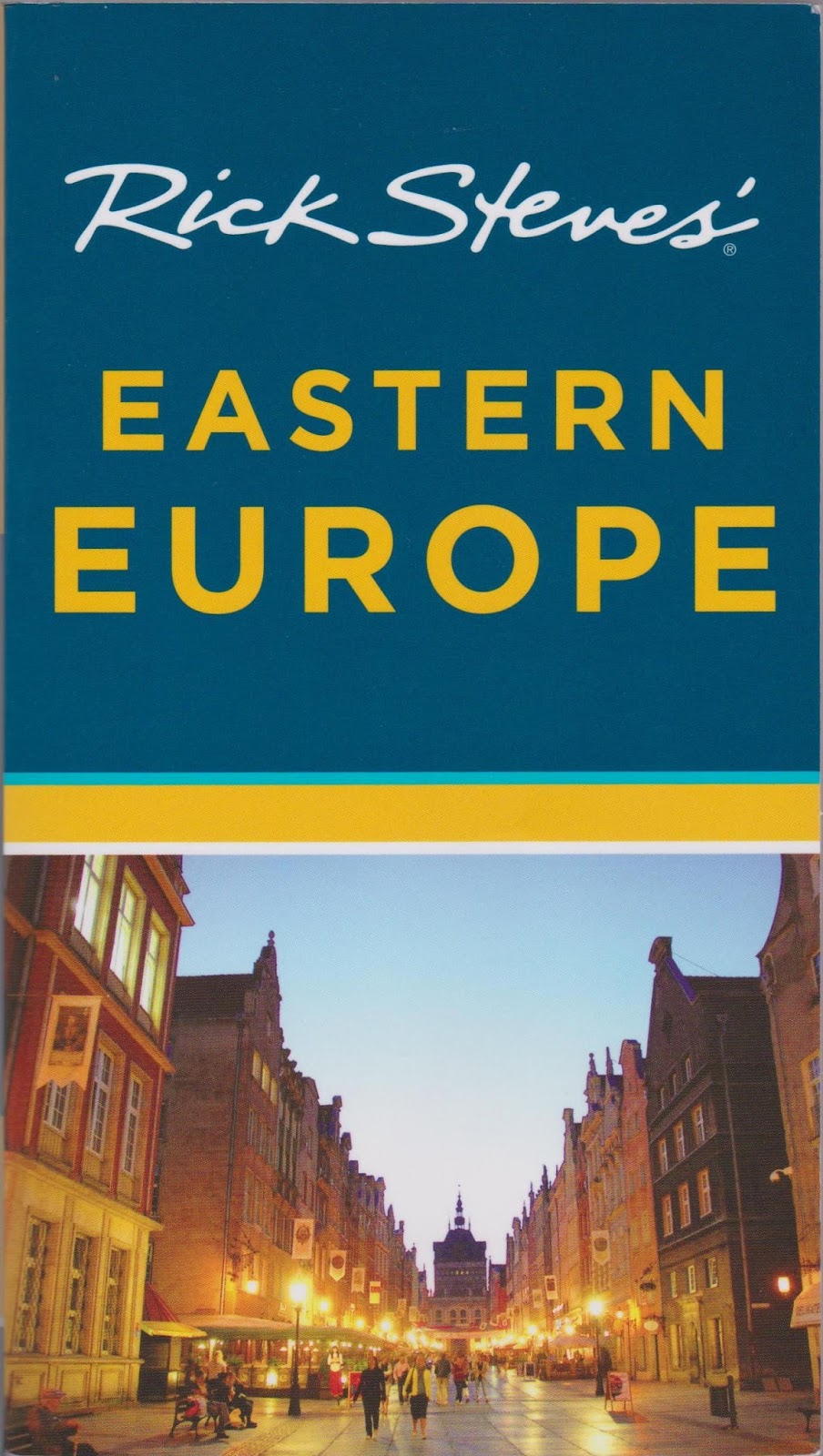
as Naceradec is just 39 miles or 64 kilometers  from the capital city. To help prepare for the visit, we checked out Rick Steves’ book, Eastern Europe.
Used by permission of author

 Although Steves does give some information about Prague in Europe Through the Back Door, we wanted a more in-depth picture.

I was excited about visiting Naceradec but had some concerns about not knowing the language. I was hoping to find a cemetery that might have some Holub graves and maybe the church where Frank Holub was baptized. But our time was limited and I didn’t know how much I could accomplish. Then, as sometimes happens in life and genealogy, what I needed appeared!! As I was reading Eastern Europe, I came across a section on p. 70 called “Tours in Prague.” You can imagine my joy when I read this passage:

“To get beyond the sights listed in most guidebooks, call Tom and Marie Zahn from P.A.T.H. Finders International. Tom is American, Marie is Czech….Their specialty is Personal Ancestral Tours & History (P.A.T.H.) – with sufficient notice, they can help Czech descendants find their ancestral homes, perhaps even a long-lost relative.” (p. 71)

In Steves’ book, you will find Tom’s and Marie’s web site: www.pathfinders.cz and an e-mail address: info@pathfinders.cz. I immediately sent a message:

Hello Tom and Marie,
My husband, Bert Schuster, and I are traveling to Europe this year. I am a family historian and very interested in visiting Naceradec where my grandfather, Frantisek (Frank) Holub was born 20 April 1903. I attached a copy of Frank's baptism that my sister received from a relative here in the US. This is a recent discovery and was very exciting.
The Holub family lived at house # XXX (not listed for privacy) in Naceradec at the time of Frank's birth. 
I am hoping to visit the cottage and to see if any Holubs are currently living in the area. 
We are interested in having you be our guides.
Pat

Here is Marie’s first response:

Dear Pat,
Thank you for contacting us.

We would be happy to help you visit Naceradec, try to identify the house No. XXX where Frantisek was born, visit the parish church he was baptized in and try to locate living relatives in the area....Thank you for sending the copy. Please let us know what date would you like to travel to Naceradec and how many people will be joining you. We will send you our proposal when we hear back from you. You can visit our site at www.pathfinders.cz for more information about our services. You can also visit www.pathways.cz for more travel information.
Do not hesitate to ask questions. We will reply as soon as possible.
Best regards from Prague
Marie


From there, we discussed fees and payment and arranged for us to send a deposit. Now the fun  part began. We waited to see what Marie was able to find.
And soon came Marie’s first report:

Pat,

The community your grandfather Frantisek was born does have its own parish church and it is the church where the child was baptized. Parishes also have cemeteries and therefore in Naceradec, it will also be possible to visit the cemetery. 

Part of making the local contacts is arranging for the church to be opened during your visit. We will try to arrange this so that you can see the church inside as well. 
I will be your guide - driver on Sept. 5th and I will come to your hotel at 9 AM to pick you up. Please let me know if this time meets with your approval. 
As for your question about the cemetery in Naceradec, burial traditions in the Czech Lands are similar to those of all parts of Central Europe. The lack of land available formed the burial traditions and cemeteries could stay relatively small. It is good to visit the cemeteries though since we can find a forgotten grave site. It would not be the first time it happened.
Best regards from Prague
Marie


In short order this amazing message came from Marie:

Dear Pat,
We are sending the results of the Local contacts in Naceradec.

We contacted the local office in Naceradec and spoke to Mrs. Svecova. She was very helpful and identified the house No. XXX in the present town. The house is still standing, did not change so much in past years and still is owned by family Holub. The present owner is Mr. XXX Holub who was born in 1934. I am trying to determine now, what is the relation between your and his ancestors…I hope a visit will be possible.
We have arranged for the church to be opened during your visit. Mrs. Svecova also asked that we stop at the local office before you leave the town.

Best regards from Prague
Marie


None of this information would have been easy to find on my own. The language barrier, time constraints and lack of local contacts would have made it unlikely for me to have found this wonderful news on my own. Again, I recommend working with genealogy professionals, (see post of November 5, 2011 for more details) such as Marie Zahn. I will report back in this blog on our trip with Marie to Naceradec.