Pages

Wednesday, February 22, 2012

Cemetery Savvy 1 -- How to Make the Most of Your Family Graveyard Visit

Entrance to Union Hill Cemetery taken by Bert Schuster, 2008
The first cemetery, I ever visited as a genealogist, was in Union Township, Lawrence County, OH about four years ago when I still thought I was a Spears. The story is worth telling because of several lessons that I learned.

Union Hill, like a lot of old cemeteries that you might visit in search of your ancestors, is very hard to find if you are not a local. I was lucky that I had been working with Ellen Gammon, a professional genealogist in Lawrence County, for several months before my trip. I introduced Ellen in my blog post of Oct 19, 2011. Before my husband, Bert, and I even left Georgia, Ellen sent us a detailed topographic map showing the location of Union Hill Cemetery. Because this cemetery, like so many others in rural parts of America, is so far off the beaten track, we could never have found it without this map.

 So, Cemetery Lesson # 1 -- to prevent frustrating and disappointing efforts to find remote family cemeteries, always try to find out as much as possible about the exact location before you begin your trip. Contact local libraries and county offices to inquire about maps. If you can find a US Geological Survey (USGS) map/webpage with longitude and latitude, you can use a Global Positioning System (GPS) device to help guide you. An example of this type of tool is the Union Hill USGS information webpage.

At-home preparation before your visit will pay off 1000%! You can do a Google search on the name of your cemetery. This may turn up maps, historical information, phone numbers, websites, and even, if you are very lucky, a list of people in the graveyeard. Findagrave and Interment.net are two websites that allow you to search for cemeteries across the US.
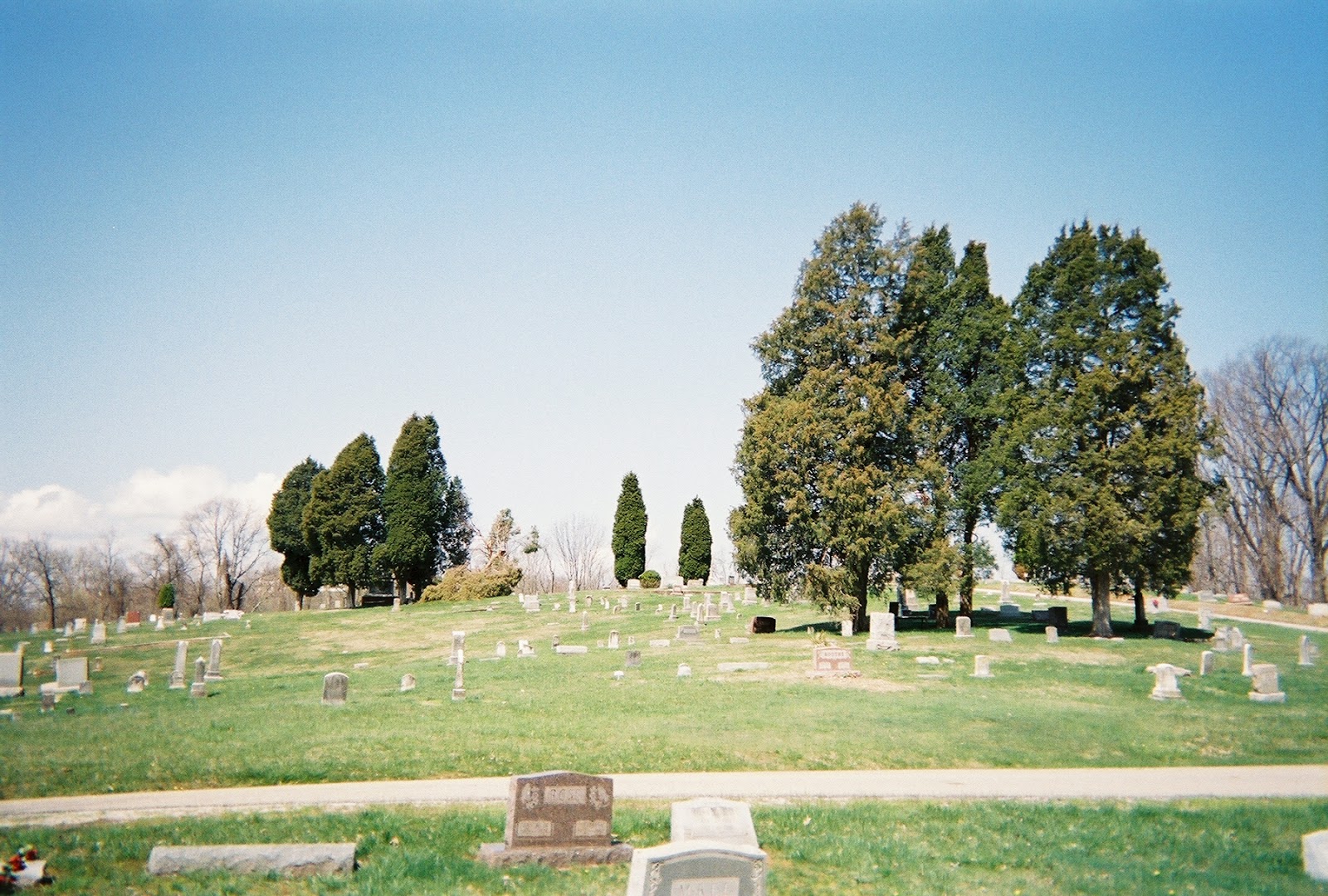
A hill view in Union Hill Cemetery taken by Bert Schuster, 2008
After trip preparations were complete, Bert and I hit the road. When we arrived at Union Hill, we found that we were the only ones there. The cemetery is located on several hills and is about 10 acres. There was no office. We had no map of the cemetery itself so we started walking up and down the hills, peering at gravestones.

Spears Plot taken by Bert Schuster, 2008
We hadn’t yet found any Spears graves when we saw a car drive up. I went up to say hello and the driver told me that there was a sexton living down the road who had a map of the cemetery! She even knew the man. When we said that we didn’t want to bother him, she said he was just sitting at home and would be glad to help us. Then she told my husband to follow her to the sexton’s house. Meanwhile I stayed behind to continue searching. By the time Bert returned with the map, I still hadn’t found the Spears plot. But sure enough, the map showed us right where it was!! 

Cemetery Lesson #2 – always talk to people you meet in a cemetery; especially in small, rural graveyards where the people who are visiting their loved ones are often locals who may have a wealth of information to share with you. They could even be related!

The third lesson came when Bert tried to take a picture of the Spears family plot. Our digital camera wouldn’t work! No problem, we thought. Bert would find a camera store in Ironton or a WalMart and pick up a new battery while I continued looking at the grave stones. What we didn’t count on was this is a small, non-urban area. No camera stores. WalMart carried regular batteries but not the special camera battery that we needed.
Cemetery Lesson #3 – always bring more than one camera with you. Disposable cameras cost very little and can mean that you actually bring home some photos if your real camera stops working. An extra memory card is also worth tucking in your camera case.

Once you are in the cemetery and actually locate an ancestor’s grave, new challenges may arise. You walk up to the grave with great anticipation. Is there a marker or stone? And, if you find a grave marker, what condition is it in? What material is it made from and if there are symbols carved on the stone, what do they mean? A brief, easy-to-follow guide to tombstone identification and cleaning is available from Everlife Memorials


Grave of David Spears, taken by Bert Schuster, 2008

An in-depth discussion of how to determine the type of stone and how to clean that stone is at The Association for GraveStone Studies. I wish that I had known about these information sites before I went to Union Hill Cemetery. I brought no cleaning supplies with me. My ancestor, David Spears' tombstone, was in poor condition.

Cemetery Lesson #4 – although you may want very much to “clean” a tombstone of the moss, lichen, dirt, and other materials that might be obstructing your view of the lettering beneath, remember to check to see the composition of the stone before you begin any debris removal procedure. And be sure to use the recommended cleaning substances and tools so as to minimize any damage to the stone.


Taken by Bert Schuster, 2008

Many of us have ancestors who lived in states far from where we live now. This makes regular maintanence visits difficult if not impossible. A tip that I learned from Union Hill Cemetery is to look for any signage that might be in the graveyard. Also don't forget to look at the target cemetery on-line for contact information.
You can send in a donation for cemetery upkeep.

Perhaps the most important lesson to learn when planning a cemetery visit is to be sure that you bring along a friend. Another person is good for safety purposes (in rural and in urban cemeteries) and as another pair of eyes/hands to help you as you travel the grounds searching for the graves of your ancestors.


Using a little cemetery savvy when you set out to find your ancestors’ graves will go a long way in helping you reach your goals and making sure that you leave the graveyard in the same or better condition than you found it.

Categories: research terms

Wednesday, February 1, 2012

Can’t Find the Answer? Derive It!

Budget makers often talk of “backing into a number". In other words, you don’t start with the number; you derive it or calculate it from the data you have.

This same thinking process can be used with genealogical research. You may have a piece of information but not the whole story. You may need to derive part of the story that is missing by looking at the data you can find and drawing a conclusion.

My great, great grandfather, Johannes Ulrich Kreis, called “John” in America, was born in Switzerland. This information came from several records, including census documents from 1910, 1920 and 1930, his naturalization card, and his death certificate.

Like most genealogists, now that I had the country he was from, I wanted to know more – where in Switzerland was he born?  After looking for months over the records I already had and scouring the internet for any ones I had missed, I still was no closer to finding John’s birth town.

This is the point where I decided to try “deriving” the answer from existing data. I went to FamilySearch.org and put in the name “Johannes Ulrich Kreis” as I was hoping to find some European records. I was surprised to find pages and pages of men with this name, born between the 1700s and 1900s. What was most interesting was that all the persons were from the same district of Switzerland – Thurgau -- see upper right hand corner of country bordering on Lake Konstanz (Constance) in map below:

From Nations Online Project http://www.nationsonline.org/oneworld/index.html

Now I had something to go on. I had narrowed the field. Suddenly my search for John Kreis’s birth town had become more focused – there was some evidence that he was born in Thurgau. I could focus my efforts on one district in Switzerland instead of laboring on all the districts which would be overwhelming and so time consuming!

But I found that I could narrow the target (John’s possible birth place) even more. As I looked over the search results, I saw that several towns or villages kept reappearing in the list: Arbon, Egnach, Ermatingen, Neukirch an der Thur, Sitterdorf, Weinfelden and Zihlschlacht.

Now I had some data that was narrow enough to actually do something with. I needed to see if any living Kreises were to be found in those seven most commonly occuring towns. This is where the old fashioned telephone directory, now on-line, comes in handy. I first went to Numberway which is a “free…guide to telephone directories on the web.”  It is “the easy way to find phone numbers all around the world.” When I selected “Switzerland” on the Numberway search page, I was directed to the official Swisscom White Pages. In the search window, I put “Thurgau, Switzerland” and searched for Kreis as the last name. I searched by several first names in until I had quite a number of people to contact. To narrow the field, I filtered by town/village, looking only at the seven towns of interest.

Now, here is where I have some special help that may not be readily available to many genealogists. My husband, Bert, is German and is totally bi-lingual in German and English. What good luck for me that my Kreis line is from German-speaking Switzerland! Instead of me calling the Kreis men on the list and hoping they can speak English, Bert will call in German!

I created a script that Bert could use to begin his conversations. He then translated the script into German. In order to capture main points in the conversations, I created a “recording form”.

Now the preparations are ready and Bert can begin calling. As we collect some data, I will be able to write a post about our experience. And just maybe I might be able to dervive some answers to my Kreis family history puzzle.

Categories: research terms


Saturday, January 21, 2012

Learning Genealogy via the Internet

I have always loved learning. The first time I stepped across the kindergarten room threshold at John Palmer Elementary School in Chicago, IL, I knew I had found paradise.

And of course you know the old saying about teachers. Genealogy offers so much opportunity for learning.
But sometimes we all get frustrated by the dead ends and brick walls we face.


We wish we could have a helping hand, maybe in the form of Mr. Henry Louis Gates, Jr. , the renowned Harvard scholar and genealogist.

I was reading Eastman’s Online Genealogy Newsletter for January 4, 2012. Henry Louis Gates Jr.’s new series Finding Your Roots was showcased. I have thoroughly enjoyed Gates’ previous series, “Who Do You Think You Are?” on PBS, and learned about different sources that genealogists used on the show to trace the ancestry of several famous people.

I have also wished that I could afford to hire a team of genealogists to help me in my search for my ancestors. Some people have complained that the show makes it look too easy to find family history records. A Mr. Carl H. Bloss posted this comment on the Eastman’s Online Genealogy Newsletter:

“It is hoped this new series will portray genealogy differently than WDYTYA. It's nice ... (to) use more famous people to investigate. But things become unrealistic ... not showing the true skills needed. Just how much does it cost to get this searching done? Where do I have to go to find the answers? Who can help me if I'm stuck...” Carl

I agree with Mr. Bloss that it would be wonderful if Mr. Gates could have a companion piece to his series that would be just about the actual research methods, that would walk us through the entire process each researcher followed to find the answers that often shocked but always pleased the people whose families were the subject of the study.

But we don’t have to wait for outside help in our genealogical pursuits. There are so many avenues offered today, many available on the internet, that can assist us in sharpening our research skills.

In this post, I am going to concentrate on one format of online learning that is tailor-made to help us increase our genealogy skills. This is the webinar which the wiki site describes as “…a Web-based Seminar, a presentation, lecture, workshop or seminar that is transmitted over the Web.”  A great feature of the webinar is that you can watch in real time or tune in at a later time that is more convenient for you. Many of these webinars are free but some are available only for a fee. Where can you find these events?

I use Legacy Family Tree software to organize my family history. I became aware of Legacy webinars through a newsletter, Legacy News, that Legacy sends its customers. One of the upcoming webinars on the Legacy schedule is one you won’t want to miss. Thomas MacEntree, creator of geneabloggers.com, will be presenting  “Are you Ready for the 1940 U.S. Census Images?” on Wednesday, February 29, 2012.

DearMyrtle, one of the premier genealogy blogs written by Pat (Player) Richley-Erickson under her pen name "Myrtle",  has a specialized blog which functions as a webinar clearinghouse where she summarizes current offerings from many sites.

Another great resource for genealogy webinars is Family Tree Magazine whose offerings are a mixture of free and fee-based. I definitely want to look at this recorded webinar by Maureen A. Taylor, Photo Detective who “has been solving family historians' photo mysteries for years. In celebration of National Photo Month, she offers advice for identifying family photos in this free webinar.”

The Learning Center at FamilySearch offers free short courses, although not technically “webinars” but videos, on many different countries, in different languages, and on different genealogical skill levels. One intriguing title is: “5 Minute Genealogy Episode 1: Find a Record in Five Minutes” .

With this cornucopia of knowledge just waiting on the internet, we can all increase our skills and advance our research at our leisure.

Categories: genealogy education