|
| Fort Dearborn & Chicago in 1831.jpg, probably engraved from a sketch by Juliette Kinzie, wikimedia |
As mentioned in a previous post, this James Carney was a merchant, grocer, and finally a brewer in the
1830s-1850s in Chicago. He belonged to a stellar group of early businessmen who
laid the economic foundations for the young city. But who was this Irish
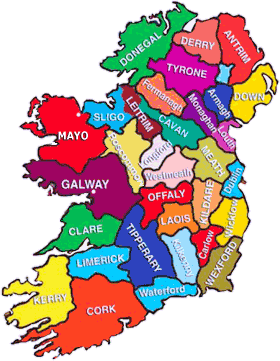
Chicagoan? Where did he come from in Ireland? Or did he come from Northern Ireland? On the map below, Northern Ireland is at the top right and the rest of the country is Ireland.
Where did he learn the trading, marketing, operating, brewing skills that brought him such success in Chicago? With whom did he associate in Chicago? This became my challenge – learning as much as I could about James’ life in Chicago from available records and maybe getting some clues as to where in Ireland James Carney was born and lived until his emigration to America. In a later post I will explore possible connections between James and John Carney, my great great grandfather.
 |
| https://upload.wikimedia.org/wikipedia/ commons/archive/d/d7/20070313214912%21Ireland.svg |
Where did he learn the trading, marketing, operating, brewing skills that brought him such success in Chicago? With whom did he associate in Chicago? This became my challenge – learning as much as I could about James’ life in Chicago from available records and maybe getting some clues as to where in Ireland James Carney was born and lived until his emigration to America. In a later post I will explore possible connections between James and John Carney, my great great grandfather.
If you have done any research on your Irish American
ancestors, you have probably faced this obstacle: a minimal number of records
both here and across the Atlantic. If you’re lucky, you might have a family
bible, oral histories, photos, or maybe an heirloom or two. In my case I had
none of the above about James Carney. Despite the scarcity of official records,
the fact that James participated in local politics and joined in some social
groups earned him a mention or two in some local histories of Chicago. Let’s
start there.
James Carney was an early Irish immigrant and successful
merchant who recognized that participation in local politics could be an entry
into acceptance as an “American.” In 1840 he ran for alderman of Chicago’s second ward and was elected as
noted on p. 102 in M.L. Ahern’s Political History of Chicago: 1837-1887.
In addition to his work as a businessman and his political service, James also showed a passion for the independence of his birth country. In the 1844 Chicago City Directory, reprinted in 1902 by Ellis and Fergus, he is listed as the treasurer for The Chicago Repeal Association. This group’s mission, as was of the original group in Ireland, was to advocate for the repeal of the 1800 Acts of Union that joined England and Ireland into United Kingdom of Great Britain.
James was also active in the intellectual life of his
Catholic parish of Old St. Mary’s. The photo below is the third structure of the church which was built on Madison and Wabash in 1842.
The 1844 City Directory lists him as the treasurer of the Catholic Library Society (p. 68) I could find no information about this society after a google search and an inquiry to the Archdiocese ofChicago. But the name of the society, the fact that it met in the basement of Old St. Mary’s Church, and the time of its existence (1840s) provide some clues. At this time in Chicago’s early history, public libraries were non-existent. It wasn’t until after the Great Fire of1871 that a public library system was created. Religious, civic-minded businessmen with an interest in both local, national and world affairs would require a comfortable and private place to read/discuss both Catholic and secular newspapers, magazines, and books.
 |
| St. Mary's Cathedral of Chicago, from Robert N. Dennis collection of stereoscopic views.jpg; NY Public Library, digital ID G90F170_001F |
The 1844 City Directory lists him as the treasurer of the Catholic Library Society (p. 68) I could find no information about this society after a google search and an inquiry to the Archdiocese ofChicago. But the name of the society, the fact that it met in the basement of Old St. Mary’s Church, and the time of its existence (1840s) provide some clues. At this time in Chicago’s early history, public libraries were non-existent. It wasn’t until after the Great Fire of1871 that a public library system was created. Religious, civic-minded businessmen with an interest in both local, national and world affairs would require a comfortable and private place to read/discuss both Catholic and secular newspapers, magazines, and books.
We now have some knowledge of James Carney’s business,
civic, and social footprint in early Chicago, but where did he come from in
Ireland? To begin to answer this question, we need to re-visit that research
technique called “cluster genealogy” that I discussed in my blog post Immigrants
to America tended to travel from the old country in groups of people known to each other. This historical phenomenon is known as "network migration." (p. 83-84.) Once in America, they lived near the same people and others from their country of origin. Since
we don’t know where James Carney lived in Ireland, maybe we can find out some
answers from the people he lived with, worked with, and worshiped with. Who
were James Carney’s associates?
The 1850 Chicago, Cook, IL federal census
provides a detailed look at James Carney’s household; we see who worked for him
in the brewery and lived in his household: Patrick Timoney, Daniel McElroy,
John O’Neill and Mary McGillen. But how long had these families been in
community? Let's start with US records.
The earliest documents in Chicago of James Carney and allied
families are in the marriage records from Old St. Mary’s Catholic Church in its second structure at Michigan and Madison.
As early as 1836, James Carney and several Timoney family members are witnesses
for weddings:
 |
| Chicago History Museum, ICHi-37096. J.H. Murphy, photographer |
- 10-01-1836 Marriage of Joseph Brown & Elsie Donnelly; Witnesses: Patrick Kelly, James Carney p. 8
- 07-06-1837 Marriage of Denis McCarty & Marguerite McCloghart; Witnesses: Francis M. Crogha, Esther Timoney p. 9
- 12-26-1837 Marriage of Lawrence Dorsey &Jane Strickland; Witnesses: William Dorsey, Catherine Timoney p. 10
- 09-18-1839 Marriage of James Summer & Elleanor Summers; Witnesses: Patrick Duffy, Catherine Timoney p. 13
A researcher, who wishes to be anonymous, on the O’Neill and McGillen lines, found baptism records at St. Mary of the Assumption, (Old St. Mary’s on Wabash,) that reveal more connections among the families:
- 1 Jan 1850 - Marriage of John O'Neill and Ann McGillen; Witnesses: Daniel McElroy & Bridget Carney
- 15 Dec 1850 - Baptism of James Edward O'Neill; Sponsors: Daniel McElroy & Mary Timoney
- 12 Nov 1852 - Baptism of Mary Anne (Mollie) Victoria O'Neill; Sponsors: James Carney & Ann Carney
- 19 May 1854 - Baptism of Alice (Sr. Cornelia) O'Neill; Sponsors: Patrick Timoney & Margaret O'Kane
A pivotal point in the web of familial relationships is James Carney’s kinship to the McGillen line; he was the grand uncle of Edward McGillen, a fact that I found in a 1909 history of Chicago:
“Edward McGillen…came to Chicago (from Ireland) in the early 1830s when he was only eight years old. He was brought here by a grand uncle, James Carney, who was a merchant and traded with the Indians in Fort Dearborn days of Chicago history.” p. 712.
A geographic anchoring for Edward McGillen comes from a death certificate for his son, John McGillen, dated 01 March 1924 in Chicago, IL., stating that he was born in Fermanagh County, Northern Ireland.
 |
| Wikimedia, GNU Free Documentation License, Fermanagh_Ulster.png 2007 (Fermanagh is in red, NI in bright green) |
Thus we have established a family foothold in Ulster for James Carney’s grandnephew, our first placing of a cohort across the ocean.
The aforementioned researcher also shared with me that some of her McGillen ancestors lived in Leitrim County, Ireland in the townland of Kiltyclogher near the Fermanagh border. In the 1911 Ireland Census, a Bessie McGillen, age 74, is listed as mother of Patrick McGillen, age 39. Bessie’s birthdate puts the family in County Leitrim prior to 1837.
 |
| By Island_of_Ireland_location_map.svg: Maximilian Dörrbecker (Chumwa)derivative work: Rannpháirtí anaithnid (talk)derivative work: Mabuska (Island_of_Ireland_location_map.svg) [CC BY-SA 3.0 (https://creativecommons. org/licenses/by-sa/3.0)], via Wikimedia Commons (County Leitrim is dark green) |
What about the rest of the cohort families: McElroy, O’Neill, and Timoney? Did they originally hail from Northern Ireland, around Fermanagh near Leitrim or Tyrone? Dr. Tyrone Bowes has created a tool that was just right for me to use to begin my search. He made a geographical distribution of surnames in Ireland/Northern Ireland and plotted them on a map, and it is available for purchase on the website.
To spread out this large map and see the names of your target families jump out at you is truly an awesome experience. Three names (McCarney, McElroy, and O’Neill) appear in the Northern Irish county of Tyrone (bordering on Fermanagh to the north) and the name Timoney is shown just across the northwestern border of Fermanagh with County Donegal.
With this information from Bowes site to orient me, I moved on to
Griffith’s Valuation which is like a census in that it recorded where people lived and what property
they owned in mid-nineteenth century Ireland. This record is arranged according
to the levels of administrative units in Ireland/Northern Ireland: townland
(village,) civil parish, religious parish, Poor Law Union (based on neighboring
townlands around a central market town,) barony, and county. A civil parish
often included more than one barony or county. The website Ask About Ireland provides
free access to those who want to search Griffith’s Valuation.
Where to begin my search in the database? I thought the best place would be the important clue we have: County Leitrim, near Kiltyclogher by the Fermanagh border, where the McGillens once lived. From here we might see if any of the families were in nearby Fermanagh also.
When we look name distribution in County Leitrim near Kiltyclogher and the
Fermanagh border, we see an interesting picture. Members of the Carney family
are found in two townlands in Leitrim County in the barony of Drumhaire. The
first townland is Manorhamilton, in the Civil Parish of Cloonclare, which is 7
miles from the second townland of Cashel, in the Civil Parish of Killanummery.
Members of the three of the four associated families all lived in the same
barony between 5-9 miles of one of these townlands. One family lived in the
barony of Roscloger which is only 6 miles from Manorhamilton. This can be shown
more clearly on the map below.
 |
| Map data @Google 2018 |
When we turn to the locations of Carney and associated
families in County Fermanagh, we also find an intriguing picture. Carney family
members settled in the townlands of Culky and Laragh, about five miles from the
large market townland of Enniskillen. The other families all lived within 8-13
miles of Culky. As can be seen on the map below, Enniskillen is about 15 miles
from the County Leitrim border.
 |
| Map data @Google 2018 |
The results of my search were no surprise; members of the five different families were scattered in, around and between the townlands of Kiltyclogher (County Leitrim, bordering Fermanagh) and Enniskillen in County Fermanagh near the Leitrim border.
I started this project with two goals:
- To find out if the four families that lived in the Carney household in Chicago in the 1850 Federal Census might be known to each other before they came to the US
- To find out where in Ireland/Northern Ireland James Carney was born and lived before his emigration to America.
I am very happy with how far I have come in my effort to
find the homeplace of James Carney and his associated families in Northern
Ireland. I have used Irish records to show that the five families did indeed
live near each other in Northern Ireland along both sides of the border of
County Leitrim near Kiltyclogher and up to Enniskillen in County Fermanagh.
However, more research is needed to try to identify more exactly the Carney
townland/village. In a subsequent post, I will explore the possible connections between James Carney and my great great grandfather, John Carney.
Labels: Irish, immigrants, Chicago, Ireland, Northern Ireland, Carney/Kearney, Chicago city directories, cluster genealogy, cohort, collateral families
Labels: Irish, immigrants, Chicago, Ireland, Northern Ireland, Carney/Kearney, Chicago city directories, cluster genealogy, cohort, collateral families