Pages

Wednesday, October 30, 2013

What a Heritage Guide Can Do for You

Most of us are familiar with tours and tour guides. Tours come in large and small sizes. I saw many while traveling in Europe this September. The hallmark of each was an energetic person holding an umbrella/flag high in the air, striding in front of a group of tourists.
David Vignoni,  Icon from
 Nuvola icon theme for KDE 3.x., Wikimedia.
I worried that if I ever was on such a tour, what would happen if I couldn’t keep up with the flying umbrella/flag? It wasn’t until planning this European genealogy trip that I learned about a different kind of tour guide – the ancestral or heritage guide.

The fact that I don’t speak Czech was the main impetus for my thinking about getting some help for my visit to the Czech Republic to find my grandfather’s ancestral home.

In my post from September 1, 2013, I wrote about how I found my personal guide to the Czech Republic, Ms. Marie Zahn of P.A.T.H. Finders International. Now let me describe our trip.

On Thursday, September 5, 2013 at 9:30 a.m., Marie picked up me and my husband, Bert, at the Best Western Kinsky Garden, our hotel in Prague. The Kinsky Hotel was a great choice for location, service and price, and we found it through Delta Vacations. Marie is a great guide to have in Prague as she is a native and very knowledgeable. 

Honza Groh, 7. 05. 2008, Memorial
of seven czech paratroupers…., Wikimedia.
As she drove us out of the city, Marie pointed out two of the main attractions we happened to drive by. The first was the Heydrich Terror Memorial, a tribute to two Czech heroes who assassinated a high-ranking Nazi in Prague. The second was “The Dancing House”, a building designed by two avant-garde architects, Vlado Milunić, a Croatian-Czech and Frank Gehry,  a Canadian-American, in 1992. The style is unusual in a city awash in medieval, Baroque and Art Nouveau architecture.
Maros M r a z, August 2004 Dancing House, Wikimedia.

After we left Prague, we soon were in the countryside. We saw large, cultivated fields interspersed with forested areas.
ŠJů,  31 August 2012, Nihošovice, Strakonice District, 
South Bohemian Region, Czech Republic, Wikimedia.

We asked Marie about the huge farms; she explained that after the fall of Communism, many farmers whose lands had been collectivized, regained their land. But as in America, it’s difficult nowadays for small farmers to make a living. Many sold their land to developers, and the result is that large, corporate farms abound where most people in agriculture now work.

We saw cars parked in the forest areas and Marie explained the Czech national pastime – mushroom picking.
Karelj, October 2008, Boletus badius, 
Czech Republic, Wikimedia.
It seems that Czechs of all ages love to go to the woods and search for mushrooms. And Marie told us a joke: on a mushroom hunt, a non-Czech asks, “Are any of these mushrooms poisonous?” The answer is: “All mushrooms are edible, but some only once.” I’m glad we were ancestor-hunting.

When we reached Naceradec, we first stopped at the Administrative Town Office
Pat in Naceradec in front of
Town Office and Church
Book by Eva Prochazkova
where we met Mrs. Svecova with whom Marie had set up this meeting prior to the trip. Mrs. Svecova presented me with  a book on the history of Naceradec. It has many beautiful photographs from different eras in the town’s life. And best of all, there is a summary in the back that is in English!

Our first stop was the Catholic church of Naceradec which Mrs. Svecova unlocked for us. My heart was filled with emotion as I stood before the very same building where my grandfather was baptized and attended services.
Entrance to Naceradec
Catholic Church, Sept 2013
Altar Naceradec Catholic Church,
Sept 2013
Although I have toured many churches in different countries, I felt very different being in the church of my ancestors.
 While to most people, the altar and the decorated ceiling would be the sights to see in this church, to me, the baptismal fount where my grandfather was baptized was place that drew me.
Baptismal Fount Naceradec
Catholic Church, Sept 2013

Our second stop was the World War I memorial
WW I Memorial Naceradec Town
Square, Sept 2013

in the town square. This is a familiar site in many European towns but again, this was special to me as two people with my grandfather’s surname were etched onto the monument: Josef Holub and his son Rudolf. I don’t yet know how these Holub men are related to me, so I will be doing some research.
Close-up WWI Memorial Naceradec
Town Square, Sept 2013
The next to last stop was the town cemetery. We weren’t sure what we would find there except Mrs. Svecova had told Marie the number of the one Holub grave. Before we left for Europe, I had asked Marie if Czech cemeteries followed the same practice as some other European countries of only leasing graves for a certain period so that they can be used again. Marie responded that this is indeed the case in the Czech Republic as well.

We came upon the Holub grave
Grave Naceradec, Josef Hrolicka
 and Rudolf Holub
and I immediately noticed two things. First, two different families were buried in the plot and second, the plot looked somewhat neglected. The grave marker was made of glass and very hard to read in the sunlight with the reflection factor, but it looked like a Rudolf Holub was buried on one side. Now there were two Rudolf Holubs to investigate: one who died in WWI and one who was buried here in 1977.

Our last stop in Naceradec was the house where my grandfather was born. A Holub family lived there and was waiting to welcome us. The house was the last one in a small lane. We parked in front and Mrs. Holub (I have not used first names for privacy) came out to greet us with a warm smile. They had just returned from their daily visit to the hospital where Mr. Holub was under treatment. As I walked through the front door, I felt very emotional as this was the same threshold my grandfather and his family crossed in their daily lives so many years ago. We followed Mrs. Holub into the kitchen where Mr. Holub, despite his ill health, stood beaming. He offered us all a warm handshake and gestured towards the chairs around the kitchen table.

Mrs. Holub had graciously prepared a delicious Czech luncheon. First we had coffee and pastries.
Jonathunder,  29 November 2010, Home made poppy seed
 kolaches on a plate, Wikimedia.
My childhood memory of “kolache”, pastry filled with prune/apple/poppy seed, was reawakened – there were several on the dessert plate! Then we were presented with ham and cheese sandwiches, and each time one of our plates was empty, another sandwich appeared!
Makovec, 26 December 2012,
Cuisine of the Czech Republic, Wikimedia.
We spent the next few hours looking at photos from Mr. Holub’s life, and we saw his birth certificate. Marie translated as Mr. Holub told us the details of his birth. His mother, Antonie Holubuva, lived in Naceradec when she was pregnant with him. She did not marry his father but married another man from the town of Louny and moved there with him. Mr. Holub was actually born in Louny. Because he grew up in Louny, Mr. Holub unfortunately never met any of the Naceradec Holubs. 

Mr. Holub came to live in Naceradec in 1977 when a relative left him this house and he has been here ever since. He said that Holubs have always lived in this house. It will take some more research to find how we are related.

We noticed that Mr. Holub was looking tired so reluctantly we said our goodbyes and headed back to our hotel in Prague.

As I planned this post, I wondered what other companies might offer heritage tours in other European countries besides the Czech Republic. I did a quick search on google and found a few entries for heritage guides, mainly for non-English speaking countries. Please note that I have no experience with any company other than P.A.T.H. Finders International. FamilyTree Tours is the company of an American and a German and although the company “specializes in heritage tours to German-speaking countries, they are able to design and assist in trips to other European nations." (from FamilyTreeTours website.) Ancestral Attic offers heritage tours in Poland and other Eastern European countries while Polish Origins has services for Poland and the Ukraine.


Hiring Ms. Marie Zahn, of P.A.T.H. Finders International, turned out to be the best decision I made in planning this trip back to my Czech homeland. If you are planning a trip to Europe to learn more about your ancestors, I recommend that you consider hiring a guide to make your heritage tour the best it can be.

Categories: genealogy professional

Sunday, September 1, 2013

Checking out the Czechs – with a Personal Guide

My husband, Bert, and I have been planning a trip to Europe for about a year. One of the most indispensable tools in planning our trip has been Europe Through the Back Door 2013 by Rick Steves.

Used by permission of author

 Rick has guided us through packing light
and finding the best phone for use in Europe to how to make friends with local people and identifying the memorable sights to visit, and so much more. And all of this must-have information is written in an entertaining, easy-to-follow style. 

Earlier this year, my sister, Monique, made a fantastic discovery through lots of good research techniques. She located our maternal grandfather’s (Frank Holub) baptism certificate from the Czech Republic (see post of April 22, 2013 for more details.) This document provided us with a wealth of detail, including the place, Naceradec, Czech Republic,

Načeradec, Central Bohemian Region, the Czech Republic, 3 May 2009, cs:ŠJů, Wikimedia. 

where Frank and his family were living at his birth in 1903. The country was then known as Bohemia.

 Bert and I decided to begin our European trip by flying into Prague

View over Prague Old Town, Czech Republic, 15 May 2008, Petritap, Wikimedia.

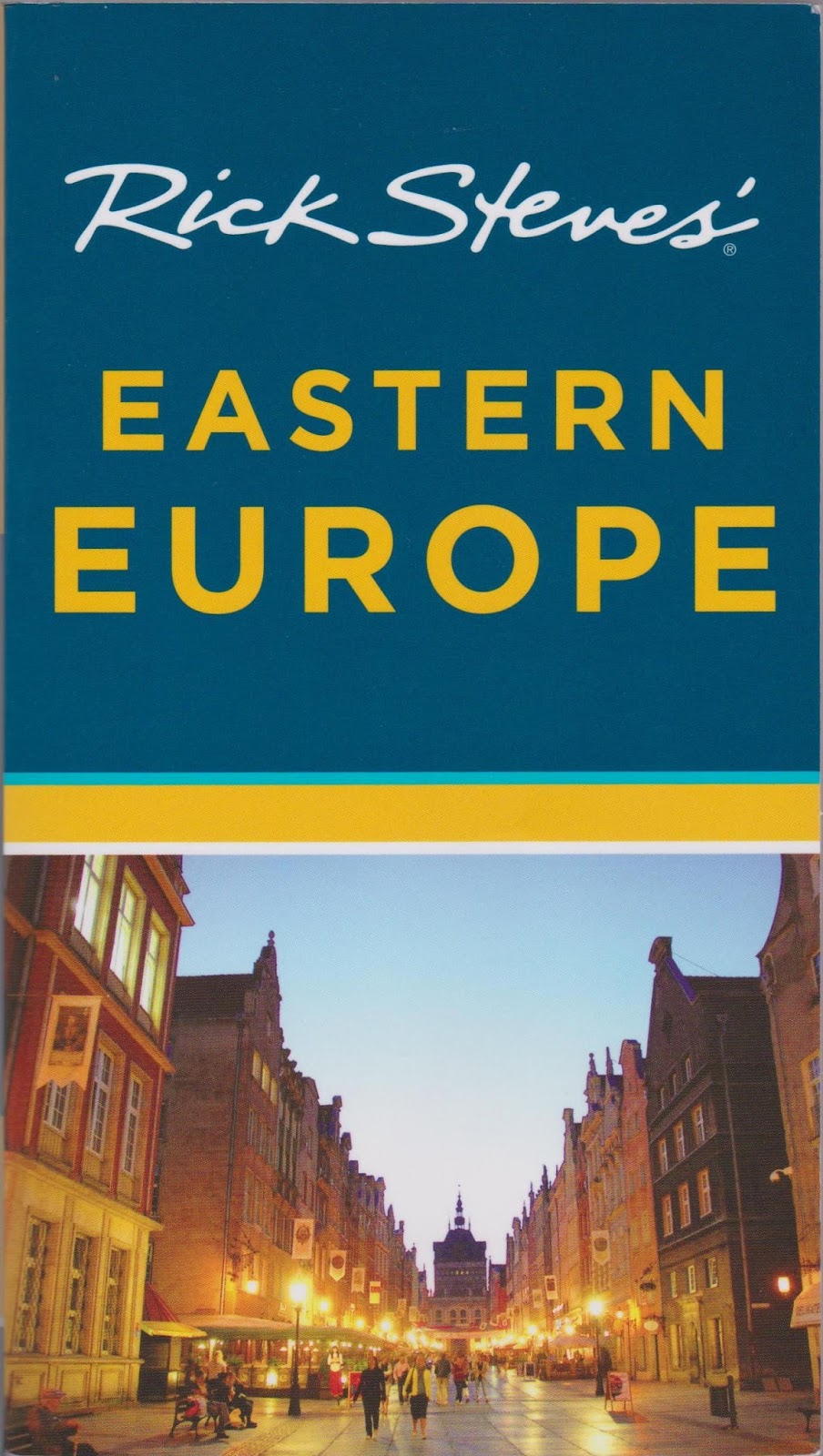
as Naceradec is just 39 miles or 64 kilometers  from the capital city. To help prepare for the visit, we checked out Rick Steves’ book, Eastern Europe.
Used by permission of author

 Although Steves does give some information about Prague in Europe Through the Back Door, we wanted a more in-depth picture.

I was excited about visiting Naceradec but had some concerns about not knowing the language. I was hoping to find a cemetery that might have some Holub graves and maybe the church where Frank Holub was baptized. But our time was limited and I didn’t know how much I could accomplish. Then, as sometimes happens in life and genealogy, what I needed appeared!! As I was reading Eastern Europe, I came across a section on p. 70 called “Tours in Prague.” You can imagine my joy when I read this passage:

“To get beyond the sights listed in most guidebooks, call Tom and Marie Zahn from P.A.T.H. Finders International. Tom is American, Marie is Czech….Their specialty is Personal Ancestral Tours & History (P.A.T.H.) – with sufficient notice, they can help Czech descendants find their ancestral homes, perhaps even a long-lost relative.” (p. 71)

In Steves’ book, you will find Tom’s and Marie’s web site: www.pathfinders.cz and an e-mail address: info@pathfinders.cz. I immediately sent a message:

Hello Tom and Marie,
My husband, Bert Schuster, and I are traveling to Europe this year. I am a family historian and very interested in visiting Naceradec where my grandfather, Frantisek (Frank) Holub was born 20 April 1903. I attached a copy of Frank's baptism that my sister received from a relative here in the US. This is a recent discovery and was very exciting.
The Holub family lived at house # XXX (not listed for privacy) in Naceradec at the time of Frank's birth. 
I am hoping to visit the cottage and to see if any Holubs are currently living in the area. 
We are interested in having you be our guides.
Pat

Here is Marie’s first response:

Dear Pat,
Thank you for contacting us.

We would be happy to help you visit Naceradec, try to identify the house No. XXX where Frantisek was born, visit the parish church he was baptized in and try to locate living relatives in the area....Thank you for sending the copy. Please let us know what date would you like to travel to Naceradec and how many people will be joining you. We will send you our proposal when we hear back from you. You can visit our site at www.pathfinders.cz for more information about our services. You can also visit www.pathways.cz for more travel information.
Do not hesitate to ask questions. We will reply as soon as possible.
Best regards from Prague
Marie


From there, we discussed fees and payment and arranged for us to send a deposit. Now the fun  part began. We waited to see what Marie was able to find.
And soon came Marie’s first report:

Pat,

The community your grandfather Frantisek was born does have its own parish church and it is the church where the child was baptized. Parishes also have cemeteries and therefore in Naceradec, it will also be possible to visit the cemetery. 

Part of making the local contacts is arranging for the church to be opened during your visit. We will try to arrange this so that you can see the church inside as well. 
I will be your guide - driver on Sept. 5th and I will come to your hotel at 9 AM to pick you up. Please let me know if this time meets with your approval. 
As for your question about the cemetery in Naceradec, burial traditions in the Czech Lands are similar to those of all parts of Central Europe. The lack of land available formed the burial traditions and cemeteries could stay relatively small. It is good to visit the cemeteries though since we can find a forgotten grave site. It would not be the first time it happened.
Best regards from Prague
Marie


In short order this amazing message came from Marie:

Dear Pat,
We are sending the results of the Local contacts in Naceradec.

We contacted the local office in Naceradec and spoke to Mrs. Svecova. She was very helpful and identified the house No. XXX in the present town. The house is still standing, did not change so much in past years and still is owned by family Holub. The present owner is Mr. XXX Holub who was born in 1934. I am trying to determine now, what is the relation between your and his ancestors…I hope a visit will be possible.
We have arranged for the church to be opened during your visit. Mrs. Svecova also asked that we stop at the local office before you leave the town.

Best regards from Prague
Marie


None of this information would have been easy to find on my own. The language barrier, time constraints and lack of local contacts would have made it unlikely for me to have found this wonderful news on my own. Again, I recommend working with genealogy professionals, (see post of November 5, 2011 for more details) such as Marie Zahn. I will report back in this blog on our trip with Marie to Naceradec.


Sunday, August 18, 2013

A Trunk full of Treasures

How often do genealogists dream of finding a trunk in a relative’s attic, filled with family documents and photos?
 I had the opportunity last month to meet someone (distantly related to me through the Shelton/Franklin lines) who had such a trunk, although in this case, it was a suitcase.

About six months ago, I saw in the rootsweb.archives, a message about the Sheltons that mentioned an “Alice Lockman” who had a family bible! 
Now that got my attention. I decided to try to find Mrs. Lockman by using some tools available to all of us for free on the internet – the whitepages, anywho or pipl.

When I contacted Alice by telephone, I was so pleased to find out that she is a genealogist who has been studying the Sheltons and related families for many years (she is in her 80s.) Sometime during our talk, Alice mentioned that the family bible had somehow gotten lost, but that she had a “suitcase” full of 30 years of research.  This was the first time in my family history research that I had run across the proverbial “trunk” or, in this case, “suitcase” full of documents. I cannot tell you how excited I felt. We had a lively conversation about some of the family stories including  about Glumdalclitch (see my post of May 24,2013.)

After several more telephone conversations, I asked Alice if I might come to visit her and look at her research, and she was excited to share her discoveries. I learned something very important at this time – many times we might feel hesitant to ask someone we don’t know well if we could look at their research. We fear rejection. But we overlook a human characteristic, highly developed in genealogists:  the desire to show what we have done.

From http://www.vupointsolutions.com/
I prepared my tools for the trip across several states to look in Alice Lockman’s suitcase. My husband was coming along to help with this task. First, I packed my VuPoint portable scanner in case I need to make copies of documents or photos at Alice’s home. I also packed my digital camera (see my post of Oct 9, 2012 to help in making copies if we had a lot to do. I wanted to be sure that I didn’t overstay my visit and wanted to be respectful of Alice’s time and health.

When we arrived at Alice’s home, she and her daughter welcomed us and we chatted awhile. I was excited to get down to the business of finding family history. Remember that I had not experienced this before -- going through a researcher’s life-time collection of documents. I knew my time was limited so I wanted to make the most of it:

Pat Spears photographed by Bert Schuster, May 2013

I noticed that the collection was actually individual papers and many, many personal letters in their envelopes. 
I wasn’t in a library or an archives, but in a home. So there was no “finding aid” of table of contents. Although I’m a researcher and a born organizer, I saw that this was a big task. Well, I just jumped in. I decided to concentrate on the letters. And this was fortuitous as I found some information that was new to me and vital for my family research.

As I looked at the first few letters, I learned about another researcher of the Sheltons/Franklins/Johnsons, in addition to Hobart Franklin and Kenneth Charles Wilde (see my post from May 24, 2013), one who had corresponded with Alice. This researcher was Richard Gosnell, who was related to the Sheltons through his great grandmother. I found the familiar discussion about Glumdalclitch’s son William Duckworth Shelton Franklin in the correspondence but with a new twist. This passage demonstrates what happens when two researchers "talk" with each other about family stories and try to coax out the "facts" from all the lore:

March 11, 1982, Richard Gosnell to Alice Lockman, p. 1
Here is the above passage transcribed for easier reading:

"In the short time that I have had to review the data, I do have a few questions. First, on the family of Roderick and Sarah Briggs Shelton, I noticed that your brother, Charles, listed a son William. I also noticed that a son William was listed on the interview with "Bud" Shelton....At first I thought that this was a reference to Roderick's son, William Duckworth Franklin by Glumdalclitch, but now I'm wondering if Roderick and Sarah also had a son named William."

In the same letter, I found that Richard was also corresponding with Kenneth Wilde: 
March 11, 1982, Richard Gosnell to Alice Lockman, p. 1

I made another very interesting discovery in the Lockman-Gosnell letters, something that has enriched my knowledge of the way my people lived in Madison County, NC in the early 1800s.
Map of Madison County, North Carolina, June 2007, taken from US Census website and modified by User:Ruhrfisch.

 In Richard’s letter of March 11, 1982, he introduces Alice to a fascinating piece of US history (the scan was not legible so I have transcribed the section below):

“If you could locate a copy of the book, ‘The Child thatToileth Not’  (go to the bottom of this page to access the full text) by Thomas Robinson Dawley Jr. (Princeton University Press 1912), I’m sure that you would be interested in reading it….Dawley was appointed as a special investigator by the U.S. Labor Dept to investigate child labor conditions in southern textile mills and to compare the lives of the children in the mills as contrasted to their former lives in the mountains where so many of them came from. Much of Dawley’s investigation was in Madison County, particularly the (Shelton) Laurel section.” (March 11, 1982, Richard Gosnell to Alice Lockman, p. 2)

There was controversy over the report as Dawley describes in the preface, and it was not published by the government. Because he praised the mills as saving children from the hunger and soul-killing toil of the farm, some people familiar with factory conditions thought he was in the pay of the textile industry. But after much effort, Dawley got his findings published privately. Regardless of the controversy, Dawley’s book gives us a rare glimpse into the lives of both adults and children who lived in the late 1800s in North Carolina. These words from the book paint a sad picture of the life of farm children:

“I seemed to hear the cries of their children from their dismal abodes. My thoughts reverted to their half starved bodies and miserable diet of crude corn meal and fat pork, and I could see their begrimed faces and partially clothed bodies draped in filthy rags.” (The Child that Toileth Not, p. IX)

In the early 1900s, a photographer and social reformer, Lewis W. Hine took photographs of mill workers and farm families in many states, including North Carolina and Virginia.
County Map of Virginia, and North Carolina, 1860, Samuel Augustus Mitchell, Wikimedia.

His work provides a companion to Dawley’s photos that appear in his report. In the photo below, Hines shows child laborers in a North Carolina cotton mill:

Some of the sweepers in a cotton mill. North Carolina, 11/1908, National Child Labor Committee Photographs taken by Lewis Hine, U.S. National Archives and Records Administration.

Next, we see a female child worker in a North Carolina textile mill:

Two young girls working at the Loray Mill in Gastonia, NC. November 1908, National Child Labor Committee Photographs taken by Lewis Hine, Library of Congress.

 Another Lewis Hine photograph of a farm family in VA from the early 1900s, provides a glimpse into what Mr. Dawley saw during his research.


Part of the family of R.D. Thomas. He and a boy of 15 are working in the Century Cotton Mill, South Boston, Va., 1911 June, National Child Labor Committee Photographs taken by Lewis Hine, Library of Congress.

Perhaps the most astonishing thing I found in Dawley’s book, from a family historian’s point of view, was a reference he made to the Sheltons. Richard Gosnell remarked upon this story in his letter to Alice. Here is Dawley’s description of how Shelton Laurel got its name:


Walking Bear, ca. 1850s-1860s, Antoine-Louis Barye,
 in public domain, Wikimedia.

“My host (Jemerson Tweed) was well informed respecting the early settlement of the country. He said that the first settler in those parts was a famous hunter who came over the mountains in Tennessee from Virginia. He had a pack of dogs almost as famous as himself. As long as there was a bear anywhere in the country, he was sure to get it. The name of this bear-hunter was Shelton. He made his last stand on one of three tributaries to the Laurel River which became the Shelton-Laurel, and which in turn gave its name to that entire section of country, notorious for its feuds, fights and killing scrapes.” (The Child that Toileth Not, p. 170)

But Jemerson Tweed had more to say about the Sheltons, and Dawley faithfully recorded his words:

Cumberland Gap, Oct. 2005, Aaron/ConspiracyofHappiness,

“The Sheltons were said to be a tall, hardy race from England, who preferred hunting and fighting, to settling down in one place, and pursuing the peaceful occupation of farming. The name may be traced down through the Virginia Mountains into Kentucky and Tennessee, and it is said that wherever the Sheltons are found to this day, they are known for their fighting proclivities. On the upper Shelton-Laurel in the vicinity of where the original Shelton made his last stand, it is estimated that more than two-thirds of the families bear the name of Shelton.” (The Child that Toileth Not, p. 170)

Oh, how we genealogists love oral testimonies! Of course, we have no proof of the accuracy of Mr. Tweed’s reminiscences or of his motives for sharing them, but it is such stories that inject life into the names, dates and place names that fill our family history sheets.


I am in debt to Alice Lockman for allowing me to read her correspondence with Richard Gosnell, to Richard Gosnell for his discovery of Thomas Robinson Dawley Jr.’s book, and to Mr. Dawley for his efforts to record for posterity the conditions of the lives of the pioneer families of North Carolina’s Shelton Laurel.


I leave you with the reminder that you never know what you will find in your research. For that reason, I recommend following every lead that you uncover.
The Detective's Barnstar, 25 February 2007,by  ChrisO, 
released to public domain by author, Wikimedia
 Even a brief mention of a name in an old message on genforum.com or rootsweb.com can lead to spectacular results if you invest the time and energy into following up.


Categories: document types, genealogy tools, genealogy community