Pages

Showing posts with label Ancestors TV series. Show all posts

Sunday, June 24, 2012

First Steps to Prepare for a Research Trip to Chicago


The first thing I do when planning a research trip is to identify the sites (libraries, courthouses, cemeteries, etc.) I want to visit. My first step in creating a schedule of visitation is to consult the websites of each venue to find out the days open and operating hours. Instead of merely making a list of sites and operating times, I put the information on a calendar. To find a calendar that is fillable, I went to Microsoft office templates. I like the visual picture this gives me, and it serves as the first step in planning my itinerary.

 Then I want to check google maps to further block out my trip – I used this tool to see which sites are close to each other, which places are outliers and might require more travel time, etc. I can then pencil in the order in which I might visit certain sites.

My next step is to fill out a Repository Checklist for each site that I plan to visit. I found this gem of a tool, created by Brenda Leyndyke, on her blog, “Journey to the Past,” which anyone is permitted to use. For each site I jot down basic information (parking information, telephone number, types of holdings etc.) on my checklist. Here is an example of my checklist for the Newberry Library:
RESEARCH  REPOSITORY CHECKLIST

REPOSITORY:  The Newberry Library


Address/Directions

60 West Walton St, Chicago, IL 60610
312-943-9090


Admission Cost
none


Contact Information


Reference and Genealogy Services Section

  • Autumn Mather, Reference Services Librarian, Reference Team Leader
    mathera@newberry.org, (312) 255-3675
  • Grace Dumelle, Genealogy and Local History Library Assistant
    dumelleg@newberry.org, (312) 255-3530


Food

(see attached sheet)


Holidays Closed

Labor Day: Saturday, Sept 1 and Monday, Sept 3


Hours

Monday, Reading Rooms closed; Tuesday – Friday, open 9-5; Saturday – open 9-1
Tour the library Saturdays 10:30 am and Thursdays 3:00 pm


Parking
(See attached sheet)


Parking Costs
(See attached sheet)


Photocopy Costs
Each exposure $.40. Manuscript collections $1.00 per folder.


Photocopy Policy
Newberry staff makes all photocopies. 30 pgs only from any given volume or manuscript collection. Can’t be photocopied: newspapers, telephone directories, materials that don’t fit in confines of copier (11 by 7 maximum)


Research Restrictions
Lockers are available on the first floor to store items not allowed in Reading Rooms. (See attached sheet)


Special Information
Must obtain a Reader’s Card before using services (see attached sheet)


Website

Used by permission of Brenda Leyndyke from her blog, “Journey to the Past” 10/2011

  If you keep these checklists by day of visit in a 3-ring binder, you will easily be able to locate pertinent details for the day’s travels. As you enjoy your breakfast, you will be very happy to have all the necessary information at your fingertips to get you where you want to be.

My next step in getting ready to visit Chicago was to search google.com for books on how/where to conduct genealogical research in this city. I found two on amazon.com that looked especially helpful and were available in inexpensive used copies in good condition.

The first book is Finding Your Chicago Ancestors by Grace DuMelle.  Ms. Dumelle is a librarian at the Newberry Library, specializing in genealogy and Chicago history. Part I of the book is organized around nine questions that you might ask yourself about your target ancestor’s life from place of birth to family members to addresses and date of death. Then for each question, Ms. DuMelle suggests types of records that might hold the answers. I’ve really taken to heart her advice on p. 15: “All of the sources for genealogical research mentioned so far are fallible.” So often, we find different dates for the same event in an ancestor’s life on different documents. This just means we have more work to do.

The second part of Finding Your Chicago Ancestors is called “Practical Advice”, and my favorite section is Chapter 14: “What to Expect at Chicago-Area Research Facilities.” Not only does Ms. DuMelle mention the top sites to research but she provides you a dress rehearsal before your visit: photographs of each facility and descriptions of holdings and services. Since the book was published in 2005, you will want to check each facility website for any changes or additions.

The second book that I found very useful is Chicago &Cook County: A Guide to Research by  Loretto Dennis Szucs who among her other qualifications worked at the National Archives -- Great Lakes Region. The main organizational rubric is by record type or record repository. Since I am researching my Irish Catholic Carney/Kearney line in Chicago, I found a particular list very helpful: “Chicago Catholic Parishes to 1875” pgs. 139-140 in Section 11 “Church and Religious Records.”

From http://www.explorechicago.org
Because Chicago was known for its neighborhoods in the nineteenth and twentieth centuries (and still is today), it’s helpful to know the area(s) where your ancestors lived. For example, I have been told that the South Chicago Irish and the North Chicago Irish remained on their own side of the Madison Street boundary. Section 12 of Ms. Szucs book “Communities and Neighborhoods in Chicago” provides a good introduction to this subject.

So let’s go over the first steps in planning a successful research trip. Once you have mapped out the operating days and hours of the sites you plan to visit, you can start formulating an itinerary for your trip. I suggest putting a Research Repositories Checklist for each site you plan to visit as the first thing in your trip binder. The next step is reading up on the cities or towns you plan to visit. I began with the internet and found two great books on Chicago on amazon.com. Of course, a visit to the website of each research site is a must to find the most up-to-date information.

Categories: genealogy education, genealogy tools, genealogy professional, research terms

Thursday, June 14, 2012

Using Research Logs and other Charts to Track Your Sources


In my post from June 1, 2012, I briefly mentioned research logs and where to find them on the web. But these had to be printed and filled in by hand. Just yesterday I found an on-screen fillable and savable research log created by the folks at Brigham State University. I had seen the same form on the site of the 1997 Ancestors TV series but it was not savable. However, this site has several very useful forms for conducting research that I will discuss in this post.

One step in my preparation for an upcoming research trip to Chicago (third week of Sept, 2012) is to have a research log showing the sources that I have consulted so far and what I have discovered. The log will also show the questions that still need answers.

At the Ancestors TV site, I found a Research Questions log that serves as a lead-in to the research log. It is a brainstorming tool to help you focus on the areas you want to explore in an ancestor’s life, the questions you are seeking answers to in your search, and the possible sources that might have this information.

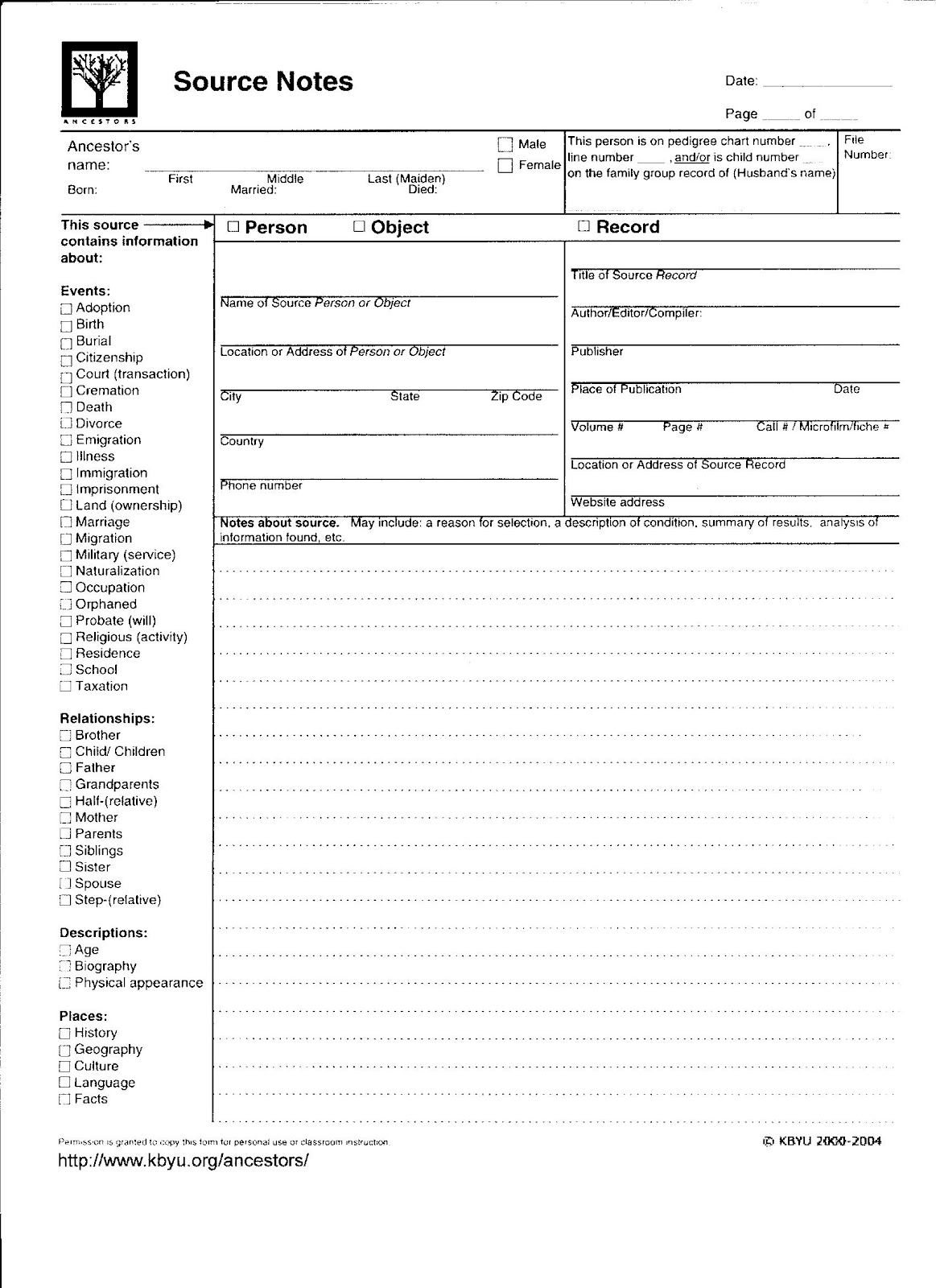
A third research chart that appears on the Ancestor TV site is Source Notes This chart makes it easy to document each source that you find and provides lots of space to record the information found.


You can be sure that I am going to make several copies of these forms to use in my upcoming trip to Chicago. When I locate my first source at the Newberry Library or other research site, I can pull out my Source Notes form to record the information. Use of this form will prevent me from jotting down notes on random sheets of paper. With these three forms, the researcher can achieve an organizational level that will guarantee a more successful search.

Categories: genealogy education, research terms