Pages

Showing posts with label Irish. Show all posts

Saturday, September 19, 2020

Irish on the Move

 Hello to all my readers! I wanted to wish you health, safety and well-being during these times of the pandemic and economic disruption. I have not been writing on my blog during the last year (July 2019 – August 2020) but I have been working on my Carney/Kearney and Duffy lines, trying to locate where they may have lived in Ireland. From this research, I have discovered several sources and information that may be helpful to others on this journey.

As preparation for my research into possible ancestral home places in Ireland, I studied the map of Ireland and started reading Irish history.
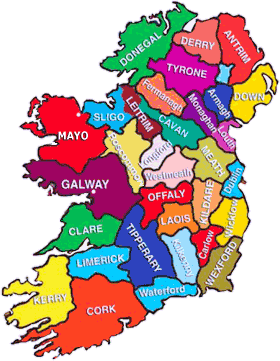
Ireland_map.gif, Created by George McFinnigan, 26 February 2006, Wikimedia.

I realized that I didn’t know anything about the movement of people within Ireland over the years. This knowledge would be critical in my quest to trace my lines in the country.

In my experience, when American scholars write about Irish history, they focus on their coming here and especially concentrate on the Great famine of 1845-1849. And this is to be expected as the American public wants to know about this time period because, according to the Library of Congress:

 “Between 1820 and 1860, the Irish constituted over one third of all immigrants to the United States. In the 1840s, they comprised nearly half of all immigrants to this nation.”1 


On board an emigrant ship - the breakfast bell immigrants on ship deck, 
1884, LC-USZ62-60319 (b&w film copy neg.) 
Library of Congress Prints and Photographs.

Also, humans are ethnocentric and naturally like to tell their stories from their point of view as this cover of Harper’s magazine shows: the people of Ireland are beseeching America for help:

Nast, Thomas, Artist. The Herald of relief from America / 
Th. Nast. Ireland, 1880. Photograph

With this said, when you want to find where in Ireland your ancestors came from, you need another focus. You want to learn about movement of people within Ireland rather than from Ireland. In other words, you are looking for internal migration. A basic question comes to mind: What factors caused people in Ireland to move to different parts of the country? The answer is the same for all humans throughout history. People move to gain better access to food and/or to escape war and violence.

A key contributing factor to the difficulty the Irish peasant faced in growing sufficient food over several centuries was the practice of various English monarchs (before them the Anglo-Saxons) of  making large land grants in Ireland, called plantations, to favored followers. 

Wikimedia Commons contributors, "File:Flight of the Earls.jpg," 
Wikimedia Commons, the free media repository,  
title=File:Flight_of_the_Earls.jpg&oldid=444543400
 (accessed September 19, 2020).

In some cases, the government sought a policy of replacement/displacement where English farmers were brought in (or “planted”)  to help in “Making Ireland British.” These newcomers pushed out the native Irish who often had to move to less fertile, more boggy land. In other cases and other times, the landowners remained in England and hired landlords in Ireland and overseers to supervise their Irish tenants. These middlemen, driven by a desire for high profits, would regularly raise the rent so that poorer tenants were displaced by those with more ability to pay.

Thus we see the causes of internal migration in Ireland, and we can find eye-witness accounts to this movement in the travelogues of Arthur Young who toured Ireland from 1776 to 1779. 

Portrait of Arthur Young (1741-1820) British economist 
and man of letters, by John Russell, 1794, 
National Portrait Gallery, Wikimedia.org

Young was interested in how people lived in the countryside, how they made a living from the land. He noticed that the Irish tenant farmer had no qualms about how much his labor was worth and would “vote with his feet” when he believed that his landlord was not paying a proper or market rate:

“Whole families in that country will move from one place to another with freedom, fixing according to the demand for their labour, and the encouragement they receive to settle.”2   

Now that we have outlined the reasons for the internal migration in Ireland, we need to understand some patterns or geographic directions of this movement in order for this information to help us see how our ancestors may have moved through the country at different times over centuries. I turned to a seminal work on Irish migration by Patrick Fitzgerald and Brian Lambkin, Migration in Irish History, 1607-2007


Migration in Irish History, 1607-2007 by Patrick Fitzgerald,
goodreads.com, spring.com, google images

Fitzgerald divides the period from 1607 to 2007 into fifty year chunks and for each he discusses what happened in each of the three types of migration: immigration, internal migration and emigration.

For our purposes, we need just an idea of the general direction of movement within the country or internal migration. One of the fundamental patterns of internal migration is most countries, including Ireland, since the Industrial Revolution is people moving from rural areas to larger towns and cities. From the early 1800s onward tenant farmers saw new opportunities in factories and in the service sectors that grew up to meet the needs of the more prosperous urban inhabitants.

Underwood & Underwood, P. (1903) Modern Looms for fine texture hosiery
 in a factory at Balbriggan, Ireland. Ireland, 1903. [Photograph]
 Retrieved from the Library of Congress, https://www.loc.gov/item/2020681993/.

 An important note for genealogists about this pull of the city is that country migrants would mostly travel to the nearest town or city and would usually remain in the same county. (end note: Fitzgerald p. 138 and 155.) How will this knowledge affect my research in Ireland? To start with, let’s see what I have accomplished so far.

Before I began thinking about the movement of people within Ireland, I was concentrating all my efforts in Ulster and adjoinng counties for reasons that I discussed in  my post of August 13, 2018, I noted how I used Dr. Tyrone Bowes’ surname distribution map, Griffith’sValuation and the 1911 Irish Census to place Carney and cohort families in the Irish counties of Leitrim  and Fermanagh. I was now ready to look more widely at Irish counties.

I was scouring the internet for Irish genealogical sources during the early days of the Coronavirus Pandemic, when I came across the National Archives of Ireland (NAI.)

CC BY 3.0, https://en.wikipedia.org/w/index.php?curid=23958509) 

  Because the building was closed to the public due to the virus, the Archives was offering a special opportunity:  researchers could send them an inquiry for free (as of my checking on the site on September 11, 2020, the Archives is now open on a limited basis.) I was so excited. This was a chance to canvas all the counties of Ireland. I submitted a list of individuals that had immigrated from Ireland and ended up in Chicago by the mid-1800s who were associated with my great, great grandparents, John Carney/Kearney and Mary Duffy.

Some weeks later, I was excited to hear back from the NAI with this information:

Civil marriage record from www.rootsireland.ie , found by NAI, April 2020.

This one record contains so much new information. In addition to identifying a couple of the same names and similar ages to my great great grandparents, the record presents a whole new county to research -- Sligo. I will take up the analysis of this new information in my next post. 


Map of the Baronies of Ireland in 1846. 
Source data: Ordnance Survey of Ireland: Baronies 2011 
(OSI), author: XrysD, 21 July 2018.

As tantalizing as it is to think this couple from Sligo are my ancestors, as every genealogist knows, this could be just a coincidence. In the response to my inquiry, NAI staffer suggested that:

 “We should not jump to conclusions that this is definitely your ancestors but rather should seek to prove or disprove this record.”

A second suggestion from the NAI was to look at US records. Oh, how hard I have tried to find some! I will discuss what US sources I have rigorously studied over the past twenty years in my next post as well.

In conclusion, Americans who study their Irish roots often encounter source material focused on the Great Famine of 1845-1849 and its effect on immigration to America. But if you wish to investigate where your Irish ancestors came from in the centuries before and up to the Famine, you need to focus on internal migration in Ireland over the centuries.

1https://www.loc.gov/classroom-materials/immigration/irish/irish-catholic-immigration-to-america/#:~:text=Between%201820%20and%201860%2C%20the,all%20immigrants%20to%20this%20nation.

2Young, Arthur, 1741-1820, John Parker Anderson, and Arthur Wollaston Hutton. Arthur Young's Tour In Ireland (1776-1779). London: G. Bell & Sons, 1892. Vol. 2, p. 119.


Monday, August 13, 2018

Locating an Ancestral Homeland in Ireland

In an early Chicago history from 1912, Josiah Seymour Currey mentions James Carney as one of the earliest Irish settlers in the muddy, swampy area that was to become Chicago. He joined with other intrepid and enterprising people (including Native Americans, French Canadians, the offspring of the unions between French and Native Americans, and Americans from other established cities and towns) to build a village that would become a great metropolis in a few decades.

Fort Dearborn & Chicago in 1831.jpg,
probably engraved from a sketch by Juliette Kinzie, wikimedia

James Carney is listed in the Robert Fergus’ Chicago Directory, 1830 as having a “grocery and provision store, 133 Lake Street.” p. 9 A Patrick Timoney is listed as a laborer, boarding with James Carney. p. 33.

As mentioned in a previous post, this James Carney was a merchant, grocer, and finally a brewer in the 1830s-1850s in Chicago. He belonged to a stellar group of early businessmen who laid the economic foundations for the young city. But who was this Irish Chicagoan? Where did he come from in Ireland? Or did he come from Northern Ireland? On the map below, Northern Ireland is at the top right and the rest of the country is Ireland.

https://upload.wikimedia.org/wikipedia/
commons/archive/d/d7/20070313214912%21Ireland.svg

Where did he learn the trading, marketing, operating, brewing skills that brought him such success in Chicago? With whom did he associate in Chicago? This became my challenge – learning as much as I could about James’ life in Chicago from available records and maybe getting some clues as to where in Ireland James Carney was born and lived until his emigration to America. In a later post I will explore possible connections between James and John Carney, my great great grandfather.

If you have done any research on your Irish American ancestors, you have probably faced this obstacle: a minimal number of records both here and across the Atlantic. If you’re lucky, you might have a family bible, oral histories, photos, or maybe an heirloom or two. In my case I had none of the above about James Carney. Despite the scarcity of official records, the fact that James participated in local politics and joined in some social groups earned him a mention or two in some local histories of Chicago. Let’s start there.

James Carney was an early Irish immigrant and successful merchant who recognized that participation in local politics could be an entry into acceptance as an “American.” In 1840 he ran for alderman of Chicago’s second ward and was elected as noted  on p. 102 in M.L. Ahern’s Political History of Chicago: 1837-1887.

In addition to his work as a businessman and his political service, James also showed a passion for the independence of his birth country. In the 1844 Chicago City Directory, reprinted in 1902 by Ellis and Fergus, he is listed as the treasurer for The Chicago Repeal Association. This group’s mission, as was of the original group in Ireland, was to advocate for the repeal of the 1800 Acts of Union that joined England and Ireland into United Kingdom of Great Britain.

James was also active in the intellectual life of his Catholic parish of Old St. Mary’s. The photo below is the third structure of the church which was built on Madison and Wabash in 1842.

St. Mary's Cathedral of Chicago, from Robert N.
Dennis collection of stereoscopic views.jpg;
NY Public Library, digital ID G90F170_001F

The 1844 City Directory lists him as the treasurer of the Catholic Library Society (p. 68) I could find no information about this society after a google search and an inquiry to the Archdiocese ofChicago. But the name of the society, the fact that it met in the basement of Old St. Mary’s Church, and the time of its existence (1840s) provide some clues. At this time in Chicago’s early history, public libraries were non-existent. It wasn’t until after the Great Fire of1871 that a public library system was created. Religious, civic-minded businessmen with an interest in both local, national and world affairs would require a comfortable and private place to read/discuss both Catholic and secular newspapers, magazines, and books.

We now have some knowledge of James Carney’s business, civic, and social footprint in early Chicago, but where did he come from in Ireland? To begin to answer this question, we need to re-visit that research technique called “cluster genealogy” that I discussed in my blog post  Immigrants to America tended to travel from the old country in groups of people known to each other. This historical phenomenon is known as "network migration."  (p. 83-84.) Once in America, they lived near the same people and others from their country of origin. Since we don’t know where James Carney lived in Ireland, maybe we can find out some answers from the people he lived with, worked with, and worshiped with. Who were James Carney’s associates? 

The 1850 Chicago, Cook, IL federal census provides a detailed look at James Carney’s household; we see who worked for him in the brewery and lived in his household: Patrick Timoney, Daniel McElroy, John O’Neill and Mary McGillen. But how long had these families been in community? Let's start with US records.

The earliest documents in Chicago of James Carney and allied families are in the marriage records from Old St. Mary’s Catholic Church in its second structure at Michigan and Madison.

Chicago History Museum, ICHi-37096.
J.H. Murphy, photographer
As early as 1836, James Carney and several Timoney family members are witnesses for weddings:

  • 10-01-1836 Marriage of Joseph Brown & Elsie Donnelly; Witnesses: Patrick Kelly, James Carney p. 8
  • 07-06-1837 Marriage of Denis McCarty & Marguerite McCloghart; Witnesses: Francis M. Crogha, Esther Timoney p. 9
  • 12-26-1837 Marriage of Lawrence Dorsey &Jane Strickland; Witnesses: William Dorsey, Catherine Timoney p. 10
  • 09-18-1839 Marriage of James Summer & Elleanor Summers; Witnesses: Patrick Duffy, Catherine Timoney p. 13

A researcher, who wishes to be anonymous, on the O’Neill and McGillen lines, found baptism records at St. Mary of the Assumption, (Old St. Mary’s on Wabash,) that reveal more connections among the families:
  • 1 Jan 1850 - Marriage of John O'Neill and Ann McGillen; Witnesses: Daniel McElroy & Bridget Carney
  • 15 Dec 1850 - Baptism of James Edward O'Neill; Sponsors: Daniel McElroy & Mary Timoney
  • 12 Nov 1852 - Baptism of Mary Anne (Mollie) Victoria O'Neill; Sponsors: James Carney & Ann Carney
  • 19 May 1854 - Baptism of Alice (Sr. Cornelia) O'Neill; Sponsors: Patrick Timoney & Margaret O'Kane

A pivotal point in the web of familial relationships is James Carney’s kinship to the McGillen line; he was the grand uncle of Edward McGillen, a fact that I found in a 1909 history of Chicago:
“Edward McGillen…came to Chicago (from Ireland) in the early 1830s when he was only eight years old. He was brought here by a grand uncle, James Carney, who was a merchant and traded with the Indians in Fort Dearborn days of Chicago history.” p. 712.

A geographic anchoring for Edward McGillen comes from a death certificate for his son, John McGillen, dated 01 March 1924 in Chicago, IL., stating that he was born in Fermanagh County, Northern Ireland.

Wikimedia, GNU Free Documentation
License, Fermanagh_Ulster.png 2007
(Fermanagh is in red, NI in bright green)


Thus we have established a family foothold in Ulster for James Carney’s grandnephew, our first placing of a cohort across the ocean.

The aforementioned researcher also shared with me that some of her McGillen ancestors lived in Leitrim County, Ireland in the townland of Kiltyclogher near the Fermanagh border. In the 1911 Ireland Census, a Bessie McGillen, age 74, is listed as mother of Patrick McGillen, age 39. Bessie’s birthdate puts the family in County Leitrim prior to 1837.

By Island_of_Ireland_location_map.svg:
Maximilian Dörrbecker (Chumwa)derivative work:
Rannpháirtí anaithnid (talk)derivative work: Mabuska
 (Island_of_Ireland_location_map.svg)
 [CC BY-SA 3.0  (https://creativecommons.
org/licenses/by-sa/3.0)],
via Wikimedia Commons
(County Leitrim is dark green)

What about the rest of the cohort families: McElroy, O’Neill, and Timoney? Did they originally hail from Northern Ireland, around Fermanagh near Leitrim or Tyrone? Dr. Tyrone Bowes has created a tool that was just right for me to use to begin my search. He made a geographical distribution of surnames in Ireland/Northern Ireland and plotted them on a map, and it is available for purchase on the website. 

To spread out this large map and see the names of your target families jump out at you is truly an awesome experience. Three names (McCarney, McElroy, and O’Neill) appear in the Northern Irish county of Tyrone (bordering on Fermanagh to the north) and the name Timoney is shown just across the northwestern border of Fermanagh with County Donegal.

With this information from Bowes site to orient me, I moved on to Griffith’s Valuation which is like a census in that it recorded where people lived and what property they owned in mid-nineteenth century Ireland. This record is arranged according to the levels of administrative units in Ireland/Northern Ireland: townland (village,) civil parish, religious parish, Poor Law Union (based on neighboring townlands around a central market town,) barony, and county. A civil parish often included more than one barony or county. The website Ask About Ireland provides free access to those who want to search Griffith’s Valuation. 

Where to begin my search in the database? I thought the best place would be the important clue we have: County Leitrim, near Kiltyclogher by the Fermanagh border, where the McGillens once lived. From here we might see if any of the families were in nearby Fermanagh also.

When we look name distribution in County Leitrim near Kiltyclogher and the Fermanagh border, we see an interesting picture. Members of the Carney family are found in two townlands in Leitrim County in the barony of Drumhaire. The first townland is Manorhamilton, in the Civil Parish of Cloonclare, which is 7 miles from the second townland of Cashel, in the Civil Parish of Killanummery. Members of the three of the four associated families all lived in the same barony between 5-9 miles of one of these townlands. One family lived in the barony of Roscloger which is only 6 miles from Manorhamilton. This can be shown more clearly on the map below. 

Map data @Google 2018

When we turn to the locations of Carney and associated families in County Fermanagh, we also find an intriguing picture. Carney family members settled in the townlands of Culky and Laragh, about five miles from the large market townland of Enniskillen. The other families all lived within 8-13 miles of Culky. As can be seen on the map below, Enniskillen is about 15 miles from the County Leitrim border.

Map data @Google 2018


The results of my search were no surprise; members of the five different families were scattered in, around and between the townlands of Kiltyclogher (County Leitrim, bordering Fermanagh) and Enniskillen in County Fermanagh near the Leitrim border.

I started this project with two goals:

  • To find out if the four families that lived in the Carney household in Chicago in the 1850 Federal Census might be known to each other before they came to the US
  • To find out where in Ireland/Northern Ireland James Carney was born and lived before his emigration to America.
I am very happy with how far I have come in my effort to find the homeplace of James Carney and his associated families in Northern Ireland. I have used Irish records to show that the five families did indeed live near each other in Northern Ireland along both sides of the border of County Leitrim near Kiltyclogher and up to Enniskillen in County Fermanagh. However, more research is needed to try to identify more exactly the Carney townland/village. In a subsequent post, I will explore the possible connections between James Carney and my great great grandfather, John Carney.


Labels: Irish, immigrants, Chicago, Ireland, Northern Ireland, Carney/Kearney, Chicago city directories, cluster genealogy, cohort, collateral families

Monday, July 6, 2015

Grave Disturbance in Early Chicago Cemeteries

It always amazes me what a rich resource we have in the genealogy community-- the people who generously share the information they work so hard to find. I am continually on the lookout for information on my Irish Chicago ancestors. Any records of these people from the nineteenth century are a godsend!

A few years back, I heard about the removal of many of the early Irish interred in the late 1800s in the Old Catholic Cemetery in north Chicago to the new Calvary Cemetery. I can’t remember which part of the genealogy community clued me into this resource. Did I hear this from the Chicago Genealogy group on Facebook or the Cook County message board or from one of my dear genealogy friends and mentors? I’m not sure of the origin of this record description, but I do remember accessing some names of the “removed” and writing them down.


As we often do with research, I put this list away and forgot about it.
 
Recently I have been researching my Carney/Duffy family again and re-discovered this Old Catholic Cemetery Removal list of names.  What a potential goldmine this was. Since recording the names, I have identified more cohort families. I wanted to take a fresh look at the source of this list with the benefit of my additional knowledge. Some questions came to mind:
  1. Where exactly was the Old Catholic Cemetery?
  2. When was it founded?
  3. Why were the bodies removed?
  4. What other persons of interest to me might be listed in addition to those I had listed?
I began investigating. First, I needed to return to the source from which I had copied the names. This was an article “Index to Part I of Removals to Calvary Cemetery,” published in the Chicago Genealogist, the journal of the Chicago Genealogical Society , Vol. 32 No. 2 Winter 1999-2000.  I was very fortunate that a digitized copy of this article was now on the Internet, courtesy of the Newberry Library. (Note that in the digitized list of volumes, there is no table of contents. For that, you need to go to the Chicago Genealogical Society.)

Newberry Library, TonyTheTiger, 2007, 
CC-BY-SA-3
 (http://creativecommons.org/licenses/by-sa/
2.5-2.0-1.0), Wikimedia Commons.
To continue my search at the Newberry site home page, I clicked on the menu tab “Research.” Then I followed these steps: When the menu drops down; click on “Digital Resources and Publications.” Scroll down the page until you see “Chicago Genealogist” and click on it.  When the next page comes up, click again on Chicago Genealogist. In the search box, I typed “Vol 31 No 2.” The next step is to click on the dropdown menu next to “view” and highlight “complete print version.” Then a PDF  of the complete journal contents appears, and you can search the Table of Contents for articles of interest.

As I scanned the Table of Contents, I saw “Old Catholic Cemetery” Records by Helen Sclair. In this article Ms. Sclair answered my first two questions:
Q: Where exactly was the Old Catholic Cemetery and when was it founded?

Ms. Sclair: “In 1843, a cemetery complex was begun near Clark Street and North Avenue. The city of Chicago opened 60 acres for the  ‘City Cemetery’, north of North Avenue and east of Green Bay Road (now Clark Street). The Catholic Church consecrated one block: Dearborn, east to State Street, and North Avenue, south to approximately Burton. Eventually both of these cemeteries would expand, the City’s to 120 acres and the Catholics’ to 5+ city blocks.” (p. 51)

I also learned that from 1858 people began making efforts to stop any more burials and any further expansion of these cemeteries. I presumed that this was because the city was growing and needed the land. A second reason could be that this burial area was very close to Lake Michigan which could cause water issues. But I wanted to make sure that I was on the right track. That’s where my third question came in: Why were the bodies removed? Professor Pamela Bannos answers this question in her website: “Hidden Truths: The Chicago City Cemetery and Lincoln Park”:

One of the most important reasons to move the cemeteries, according to Bannos, was that the land near Lake Michigan was below the water table.

By United States Geological Survey
 [Public domain],
via Wikimedia Commons
 A concern at the time was that bacteria from decaying bodies could contaminate the city’s drinking water. Also when graves were dug, water would often times fill the burial pit. Another reason was that the citizens of the fast growing city decided that building a park (Lincoln Park) for the living could be more advantageous than using the land for housing the departed.

The Miriam and Ira D. Wallach Division of Art, Prints and Photographs:
Photography Collection, 
The New York Public Library. "Lincoln Park, Chicago." 
The New York Public Library Digital Collections.

Professor Bannos provides more historical background and maps of the old Catholic Cemetery on the section of her site “Mapping theCemeteries: Catholic Cemetery.” 

Now if asked “How does your country handle the deceased?” many of us would answer that there is great respect for the dead in our culture as evidenced by our funeral system and manicured cemeteries. But if we look a little deeper we find, at least in the instance of the early Chicago cemeteries, that concern for the departed sometimes gives way to the desires and needs of the living. On her site, Professor Bannos provides an eye-opening chronology of what happened to the remains of those buried in these early Chicago graveyards. She does this by presenting news articles from the time period. 
  
An article from the Chicago Daily Tribune issue of August 15, 1876 “Sad Scenes in a Cemetery”, truly captures the disregard given to the interred in the Old Catholic Cemetery as they are removed “…with a degree of recklessness almost criminal in its disrespect for the dead the laborers employed in the exhumation have scattered the remains of the late lamented all through the field.”

The whole removal process seemed slipshod from the first. Was it known exactly how many bodies were in the cemetery and exactly where they were buried? Was it a case of disrespect, indifference, lack of time, or poor records or a mixture of all three that caused many bodies to be left in their watery graves? What is known is that over the years and even up until this decade, bodies keep appearing when digging is done in the area. These occurrences Bannos has chronicled through more Tribune articles in the section "Hidden Truths: Catholic Cemetery." 

Now that I had learned about the history of the Old Catholic Cemetery, I wanted to return to the list of names of those who were fortunate enough to actually be removed and reburied in Calvary Cemetery. As I looked down the list, I saw the usual suspects: Carney/Kearney, Duffy, Cosgrave (Cosgrove), Devine, McKenna, Ryan, Sweeney, and Ward. This was another indication that these people were part of a community. 

This confirmation of the relationship of these families went along with the new information that I had recently found from studying pre-Chicago Fire maps, the 1870 Chicago Directory and Census and the 1870Chicago Illinois US Census. These records showed that members of the Carney, Duffy, Cosgrove, Devine, Sweeney and Ward families lived near each other on the Near North Side streets of Ohio, Illinois and Indiana.

By OpenStreetMap and edited by w:User:TonyTheTigerOpenStreetMap contributors
 [CC BY-SA 2.0 (http://creativecommons.org/licenses/by-sa/2.0) via Wikimedia Commons

On a final note, to get a great narrative and summary of Professor Bannos’ project, “Hidden Truths: The Chicago City Cemetery and Lincoln Park,” check out the article by Jessica Curry “What Lies BeneathLincoln Park” in Chicago Life Magazine.

Categories: genealogy community, genealogy tools


Tuesday, September 30, 2014

Academic Journals: A Powerhouse of Research

Most genealogy researchers are very familiar with the journals of genealogy societies: local, regional and national. An example of a local society journal is the ChicagoGenealogist, a publication of the Chicago Genealogical Society. The Western New York Genealogical SocietyJournal, published by said society , covers eight counties. A national organization, such as the NationalGenealogical Society, will have a national journal -- the National Genealogical Society Quarterly.

Many genealogical journals, including the ones above, are classified as academic or scholarly journals. When a writer submits an article to an academic journal, he or she can expect to have the piece peer-reviewed. Because of the rigorous standards that writers in academic journals must adhere to, the quality of the research is very high.

Hartwell Hall, east side, DanielPenfield,
 31 May 2010, Wikimedia.

Peer-reviewed journals follow some established patterns.The Department of Sociology at the College of Brockport posted an article, Reading Journal Articles, on the college website, which outlines the framework that makes up a report of research in an academic journal. The parts of this framework look very similar to the parts of a good research plan; the basic elements of research are all here:

First, the scholarly article begins with an Abstract or summary of the research question: What is the reason for this study? What are the topics/questions being investigated?

Second, comes the Introduction:“What is already known about this topic and what is left to discover?” 

Third, is the Literature Review: “The review of literature is meant to discuss previous work on the topic, point out what questions remain, and relate the research presented in the rest of the article to the existing literature.” 

The fourth part of a journal article is the Methods and Data: What did the author find and how did he/she find it? 

The fifth section is Analysis and Results: What analytic techniques does the author use to tease out information from the data? How does the author interpret the findings?  

The final step in the reporting on research is the Discussion and Conclusion:  How do the findings connect with other data? What other questions can be asked based on the new information? Has this research added any new knowledge to this topic that would be valuable to others?

Many genealogical societies publish scholarly journals that contain information very helpful to family researchers. But academic journals in a variety of disciplines often contain articles of great interest to genealogists.

in the stacks, Anna Creech, April 14, 2005, 
Creative Commons, flickr.com

Where might one look to find these publications? Scholarly journals have long resided in college and other libraries. But in this age of the internet, digital copies are now available for many journals.

Used by permission JSTOR
According to Wikipedia, in 1995 Princeton University led an effort to digitize ten journals at seven libraries in order to save storage space. The project was called JSTOR, “pronounced JAY-stor; short for Journal Storage.” Today JSTOR offers “more than 1900 journal titles” from over 900 publishers. 

To get an idea of the breadth of the journal offerings at JSTOR:
Go to the webpage and follow these steps:

In the upper right of the screen (next to JSTOR logo), click “About.”
On the menu bar at the top of the screen, hold the mouse on “For Publishers” to access a drop-down menu.
Click on “JSTOR Publishers & Content Providers.”

This gives you an A-Z list of the more than 900 content providers whose journals are in the database. You can also find journals arranged by content area: Browse by Subject.

I did a quick search and found these intriguing organizations sure to get a genealogist’s interest up:

Eighteenth-Century Ireland Society
Economic History Society
Georgia Historical Society
Presbyterian Historical Society

University of Arizona Vertical Logo,
 https://brand.arizona.edu/guide/identity,
19 September 2014, Wikimedia.
Now that we know about JSTOR and its treasures, how can we access the journals? For faculty, staff and students of one of the 8,400 institutions that belong to JSTOR world-wide (including many colleges and universities, museums and public libraries), unlimited access is free. If you are an alumna or alumnus of one of these participating universities, you may also have free access. I was greatly pleased to see my alma mater, the University of Arizona, on the list!

How about for un-affiliated individuals? JSTOR has two ways you can gain access: JPASS (costs and has some limits) and Register and Read  (free but has limits.) JSTOR is also offering free access (some limits) to journals “published prior to 1923 in the United States and prior to 1870 elsewhere” through a program called Early Journal Content

Well, now that we know how to access journals at JSTOR and what kinds of journals we can expect to find, let’s look at the results of a search. One of my family lines is Irish, and they lived in Chicago from the 1850s. I want to learn as much about the lives of these people in the mid to late nineteenth century as I can. In JSTOR, I did a search on “Irish Chicago” and got over 2500 hits.

 But on page 5, I found this listing:


It is important to remember that although this article was not written for genealogists, it has great significance for anyone interested in American history:  life in large cities in the nineteenth century with an emphasis on the lives of immigrants. 

The ghetto, Chicago, Ill., Bird's-eye view of street scene, c1920, 
LC-USZ62-80739, Library of Congress Prints and
 Photographs Division Washington, D.C. 20540 USA.
Dr. Galenson conducted this study to shed more light on a question that has challenged experts in academia, government, and non-profits: does growing up in poverty in urban ghettos decrease children’s chances of becoming employable, responsible, engaged citizens? As he states in the introduction to the study:

“In recent years social scientists have become increasingly interested in the question of how members of ethnic and racial minorities are injured economically by living in segregated neighborhoods. A central concern has been that the poverty of these neighborhoods may be self-perpetuating.”  p. 261.

As Dr. Galenson noted, this concern with the adverse effects of poverty on immigrant children is not new:

“It was often expressed in the nineteenth century, with a particular focus on the problem of immigrant children who failed to attend school.” p. 261-262.

The purpose of this study was to “investigate the concern of (George Emerson, prominent Boston educator) and others in the nineteenth century that the children of immigrants who lived in ethnic ghettos were less likely to attend school than their peers who lived elsewhere.” p. 262.

1860 Census Questionnaire,
1860 Image Gallery,
US Census Bureau website.

Of great interest to genealogical researchers is the source Dr. Galenson used for his study: the 1860 Federal Census for Boston, MA and Chicago, IL. He looked at each of the wards in both Boston and Chicago and compared them by wealth and ethnicity – with a focus on Irish heads of household.

Many of us have perused census documents, but it is unlikely that we have done anything like what Dr. Galenson did with the data.  Among the information the 1860 Census asked for were the ages of the children living in the household and if they had attended school at any time during the last year, what ethnicity the people in the household were and if the family income was over or under $1,000 for the period.

Correlating this data for the different wards in Boston and Chicago allowed Dr. Galenson to see the effects of the wealth of a household, and if the household were Irish, on the chances of the children attending school. And what he discovered was startling:

“…in Boston the probability of school attendance was positively related to a ward’s wealth and negatively related to its proportion of Irish residents, but in Chicago the reverse was true.”  p. 270-271.

In other words, if you were a poor, Irish male child in Chicago in 1860, you had a better chance of attending school than a child of similar wealth and ethnicity in Boston.

The rest of Galenson’s study attempted to explain why this difference existed. He found that there was no Catholic School System in Boston, so the public schools in Boston were pretty much the only game in town – “…more than 85 percent of all children who attended school in Boston in 1855 and 1860 went to public schools.”  p. 271 In other words, the public schools had a monopoly on the market. Unless you were wealthy, your children had only one choice – the public school.

In Chicago, on the other hand, the public schools had competition from the Catholic Church. In fact, in 1860 nearly 36% of Chicago children attended private school (mainly Catholic.)  p. 275

Why would it make such a difference on school attendance if a child had the choice to attend a public or a Catholic school? Galenson found the answer in a condition that differed in each city. Boston had a public system that went back to 1635 while Chicago’s “…basis for a city school system was first established by an act of the Illinois legislature in 1837….” p. 283. Along with the much longer history of its public education system, Boston had more nativist sentiment among the administrators who ran the schools and the teachers who interacted with the students.
American citizens! We appeal to you in all calmness. Is it not time to pause? . . . 
A paper entitled the American patriot, Boston : Published by
 J.E. Farwell & Co., 1852, LC-DIG-ppmsca-07575,
 Library of Congress Prints and Photographs
 Division Washington, D.C. 20540 USA.
Chicago was different:

“In contrast to Boston, Chicago’s early public school system may have also had a different attitude toward immigrants. Chicago’s population was very heterogeneous from its earliest days, as the foreign-born made up 30 percent of its population in 1843 and more than 50 percent in 1850.”  p. 284. 

So what conclusion did Dr. Galenson make as to why Irish boys in 1860 Chicago attended school in greater numbers than their cohorts in Boston?

Irish children in 1860 Chicago had the choice of attending a Catholic School where their ethnicity, social class and religion were respected. On the other hand,  Irish school-age boys in 1860 Boston had only one choice of school -- the public school, where they encountered discrimination due to their poverty, their Irishness, and their Catholicism.   

I learned an incredible amount of history from this academic study – history, economic, sociology, education, immigration – all covered in this article whose author was comparing school attendance of Irish immigrant sons in 1860 Boston and Chicago. And only in JSTOR did I find this resource.

Categories: genealogy tools

Wednesday, July 9, 2014

The Rise of the Irish in Chicago

I have long lamented the fact that so little is written about the Irish in Chicago in the mid- nineteenth century. I have wondered what life was like in Chicago for my great, great grandparents, John Carney/Kearney and Mary Duffy in the 1870s and 1880s. But as so often happens in life, when you put something out there, suddenly help appears! I found a reference to Ellen Skerrett in a Chicago Tribune newspaper article by Ken O’Brien. He described Ellen as “a walking, talking book of Chicago history.”  When O’Brien further stated that Ellen had spent years researching the Chicago Irish, I was hooked! I had to find out more.  

As I read O’Brien’s article, I saw that while working on her Master’s degree at the University of Chicago in 1974, Ellen began studying the part that neighborhood Catholic parishes played in the lives of the immigrant Irish in Chicago in the nineteenth century. From that time on, she has been researching, writing and collaborating with other experts on the Irish American experience in Chicago to produce numerous books. In this post, I will discuss two of her contributions to the field:

“Nineteenth Century Chicago Irish: A Social and Political Portrait” (Charles Fanning, Ellen Skerrett, John Corrigan).  Loyola University Center for Urban Policy, 1980 [title abbreviation: NCCI]

Used by permission of Ellen Skerrett

Ellen, Skerrett, Editor, At the Crossroads:  Old Saint Patrick’s and the Chicago Irish. Loyola Press, 1997 [title abbreviation: ATC]

Used by permission of Ellen Skerrett
From these two works, I learned much about the attitude of US-born people in Chicago to the immigrant Irish, the poverty that plagued the new arrivals, the role the parish church played in bringing the newcomers into mainstream American life, and how the Irish used the Anglo-Saxon government structure to their advantage. The Irish faced the disadvantages of arriving in this urban setting with few skills other than subsistence farming and of following a religion that raised the suspicions of the native Protestant Chicagoans. Yet, as Ellen discusses in her ATC essay "Creating Sacred Space in an Early Chicago Neighborhood", the Catholic Church provided the Irish with a community that held them together, ministered to their needs and educated their children, thus helping the second generation move toward the middle class:

"...Irish Catholics in Chicago used the process of church-building to create a place for themselves -- and leave their imprint on the landscape." p 24 ATC

St. Patrick's Church, Adams & Desplaines Streets, Chicago
 (Cook County, Illinois, from the 
Historic American
 Buildings Survey
 (HABS),Wikimedia.
"For immigrants and their children, churches such as Saint Patrick's and Holy Name represented a crucial beginning in creating community, identity, and a sense of belonging in their new urban neighborhoods." p. 30 ATC 

"...creating sacred space in the city built community and laid the foundation for other important initiatives, especially parochial schools and social services." p. 34 ATC

The reaction of US-born Americans to the stream of Irish immigrants in the nineteenth century is a familiar one in American history and is still around today in the immigration debate.  Whether newcomers are welcomed or fiercely rejected by those already here depends on several factors. One is the economy. If it is booming and jobs are plentiful, then new workers are accepted. But when jobs are scarce, new arrivals are viewed as a threat. A second factor, discussed by Eileen Durkin, one of the essayists in ATC, in her piece "Saint Patrick's Day at Saint Patrick's Church", is the number of incoming persons:

“By 1843, they (the Irish immigrants) accounted for only 773 of Chicago’s 7,580  residents (about 10%) ….” p. 5 ATC 

These numbers didn’t raise much worry among the native born population.  But in 1845, the Great Famine struck Ireland, and it continued to devastate the land until 1850. Trying to escape starvation, the Irish came to America in huge numbers, and many settled in Chicago as Ms. Durkin writes:

“After the Famine, almost one in five (about 20%) Chicagoans were Irish-born.”  p. 7 ATC

On the Library of Congress website, I found an advertisement for a "short-lived nativist newspaper" -- American Citizen -- that was published in Boston in 1852. It shows the venom of the nativist position:

A paper entitled the American patriot, Boston : Published by
 J.E. Farwell & Co., 1852, LC-DIG-ppmsca-07575, 
Library of Congress website http://www.loc.gov/pictures/item/2008661538/
As illustrated above, another factor affecting the reception given to immigrants is the religion of the new arrivals. The large increase in mostly poor, low-skilled Irish Catholic immigrants caused fear and anger in the city. No longer were these Catholic newcomers unnoticed. An editorial in the Chicago Tribune in 1855, quoted by Lawrence J. McCaffrey in his essay "Preserving the Union, Shaping a New Image: Chicago's Irish Catholics and the Civil War", captured the sentiments of many “nativists” in Chicago:

“Who does not know that the most depraved, debased, worthless and irredeemable drunkards and sots which curse the community are Irish Catholics?” p. 53 ATC

But McCaffrey goes on to say that the Irish showed patriotism and bravery in the Civil War:
Col. Jas. A. Mulligan: Of the Illinois "Irish Brigade", 
New York: Currier & Ives, between 1860 and 1870,
 LC-DIG-ppmsca-08408
 (digital file from original print),
 Library of Congress website.

 “…the Chicago Times acknowledged the bravery and patriotism of Irish immigrants and noted that thousands of Irish Catholics had already rushed to the rescue of their adopted country, leaving ‘peaceful avocations’; to bring ‘terror and dismay’ to the Confederate foe.” p. 64 ATC

Poverty, its causes and effects can be very public: disease-ravaged slums teeming with families in overcrowded conditions with poor sanitation, abandoned children in the poor house, increasing numbers of the destitute, the hopelessness of lack of opportunity, domestic violence and drunkenness were not easy to overlook.

In the eyes of many of the Anglo-Saxon Protestants of Chicago, the poverty of the Irish and their foreign religion were a double threat to the public order. The fear that somehow the Pope might try to influence America’s government was still present when the Irish-American (4th generation Irish) John F. Kennedy  ran for President in 1960.

While local newspapers and some people running for office on an anti-immigrant, anti-Catholic platform decried the Irish, the Catholic Church in Chicago set about helping them. As Suellen Hoy describes in her essay "Walking Nuns: Chicago's Irish Sisters of Mercy", in 1846, the Sisters of Mercy arrived in Chicago and began their life-saving ministry, including building Mercy Hospital:

Mercy Hospital, Chicago Daily News, Inc., 
photographer, 1909, DN-0007384,
Chicago Daily News negatives collection, Chicago History Museum.

By 1849, “the Sisters of Mercy were already operating three schools, teaching Sunday School at Saint Patrick’s, running an employment bureau for Irish working women, volunteering at a free dispensary opened by Rush Medical College, and holding night classes for illiterate adults.”  Then “…when a cholera epidemic struck during the summer of 1849…a large number of Irish died….they [the Sisters] began nursing cholera victims.” p. 41 ATC


Sisters of Mercy, afunkydamsel, Taken on
 April 10, 2011, Flickr, Creative Commons.

The Irish turned to their parish churches for more than spiritual guidance, education for their children, and medical help. The parish became the foundation, the springboard for the Irish to infiltrate Chicago politics. It was in the parish that Irish politicians began building their power base, to take advantage of the Irishman’s desire to become American. Citizenship was an important step towards reaching the goal. And with citizenship came the right to vote. The influx of Irish voters guaranteed a majority voting the Irish ticket in Ward elections. And so control was gradually wrested away from the old Anglo-Saxon power elite. (pgs. 2-3 NCCI)  

But getting people to vote and getting into office was just the first part of the Irish-American politicos’strategy. The new Ward aldermen knew their way around the Anglo-Saxon system of government from all the years they and/or their parents had spent living in Ireland and dealing with British colonialism, a knowledge that the other immigrant groups to America lacked. (p. 2, NCCI) Using the boss system or machine politics, (and some would say abusing their political power), the aldermen provided relief to their communities:

“…the poor obtained food, coal, and jobs; Christmas turkeys and Easter hams found their way to empty tables; and the financial burden associated with baptisms, weddings, and wakes was lightened by contributions from the ward boss or his precinct captain.” (p. 14, NCCI)

As you can see, these two histories  ̶  one edited and one co-written by Ellen Skerrett  ̶  give us a clear picture of the life of the Irish in nineteenth century Chicago: their struggle to overcome prejudice, poverty, lack of a voice in the new land, and the role the Catholic Church played in both ameliorating the burdens of the first generation and moving the second generation into the American mainstream. But there is much more to discover in the two books.

Finley Peter Dunne, "Mr. Dooley", Artist: Ward, 
Leslie Matthew, aka SPY, Lithograph July 27, 1905,
 CCNY Art Collection, Flickr, public domain.
Another of the writers, Charles Fanning, presents the life story and career of Finley Peter Dunne, the creator of the Mr. Dooley columns in Chicago newspapers, in his essay "Mr. Dooley Reconsidered, Community Memory, Journalism and the Oral Tradition":


“Between 1893 and 1900, some three hundred Dooley pieces appeared ….Taken together, they form a coherent body of work, in which a vivid, detailed world comes into existence—a self-contained immigrant/ethnic culture with its own customs, ceremonies, ‘sacred sites,’ social pecking order, heroes, villains, and victims.” p. 72 ATC

As you can see, if you want a glimpse into what life was like for the Irish of Chicago in the mid-to-late nineteenth century, you will want to read Ellen Skerrett’s books. Since they are both out of print, you will need to use interlibrary loan, (ILL) or see if you can locate one on ebay.com, as I did.

Categories: genealogy tools