Pages

Showing posts with label cemetery. Show all posts

Monday, July 6, 2015

Grave Disturbance in Early Chicago Cemeteries

It always amazes me what a rich resource we have in the genealogy community-- the people who generously share the information they work so hard to find. I am continually on the lookout for information on my Irish Chicago ancestors. Any records of these people from the nineteenth century are a godsend!

A few years back, I heard about the removal of many of the early Irish interred in the late 1800s in the Old Catholic Cemetery in north Chicago to the new Calvary Cemetery. I can’t remember which part of the genealogy community clued me into this resource. Did I hear this from the Chicago Genealogy group on Facebook or the Cook County message board or from one of my dear genealogy friends and mentors? I’m not sure of the origin of this record description, but I do remember accessing some names of the “removed” and writing them down.


As we often do with research, I put this list away and forgot about it.
 
Recently I have been researching my Carney/Duffy family again and re-discovered this Old Catholic Cemetery Removal list of names.  What a potential goldmine this was. Since recording the names, I have identified more cohort families. I wanted to take a fresh look at the source of this list with the benefit of my additional knowledge. Some questions came to mind:
  1. Where exactly was the Old Catholic Cemetery?
  2. When was it founded?
  3. Why were the bodies removed?
  4. What other persons of interest to me might be listed in addition to those I had listed?
I began investigating. First, I needed to return to the source from which I had copied the names. This was an article “Index to Part I of Removals to Calvary Cemetery,” published in the Chicago Genealogist, the journal of the Chicago Genealogical Society , Vol. 32 No. 2 Winter 1999-2000.  I was very fortunate that a digitized copy of this article was now on the Internet, courtesy of the Newberry Library. (Note that in the digitized list of volumes, there is no table of contents. For that, you need to go to the Chicago Genealogical Society.)

Newberry Library, TonyTheTiger, 2007, 
CC-BY-SA-3
 (http://creativecommons.org/licenses/by-sa/
2.5-2.0-1.0), Wikimedia Commons.
To continue my search at the Newberry site home page, I clicked on the menu tab “Research.” Then I followed these steps: When the menu drops down; click on “Digital Resources and Publications.” Scroll down the page until you see “Chicago Genealogist” and click on it.  When the next page comes up, click again on Chicago Genealogist. In the search box, I typed “Vol 31 No 2.” The next step is to click on the dropdown menu next to “view” and highlight “complete print version.” Then a PDF  of the complete journal contents appears, and you can search the Table of Contents for articles of interest.

As I scanned the Table of Contents, I saw “Old Catholic Cemetery” Records by Helen Sclair. In this article Ms. Sclair answered my first two questions:
Q: Where exactly was the Old Catholic Cemetery and when was it founded?

Ms. Sclair: “In 1843, a cemetery complex was begun near Clark Street and North Avenue. The city of Chicago opened 60 acres for the  ‘City Cemetery’, north of North Avenue and east of Green Bay Road (now Clark Street). The Catholic Church consecrated one block: Dearborn, east to State Street, and North Avenue, south to approximately Burton. Eventually both of these cemeteries would expand, the City’s to 120 acres and the Catholics’ to 5+ city blocks.” (p. 51)

I also learned that from 1858 people began making efforts to stop any more burials and any further expansion of these cemeteries. I presumed that this was because the city was growing and needed the land. A second reason could be that this burial area was very close to Lake Michigan which could cause water issues. But I wanted to make sure that I was on the right track. That’s where my third question came in: Why were the bodies removed? Professor Pamela Bannos answers this question in her website: “Hidden Truths: The Chicago City Cemetery and Lincoln Park”:

One of the most important reasons to move the cemeteries, according to Bannos, was that the land near Lake Michigan was below the water table.

By United States Geological Survey
 [Public domain],
via Wikimedia Commons
 A concern at the time was that bacteria from decaying bodies could contaminate the city’s drinking water. Also when graves were dug, water would often times fill the burial pit. Another reason was that the citizens of the fast growing city decided that building a park (Lincoln Park) for the living could be more advantageous than using the land for housing the departed.

The Miriam and Ira D. Wallach Division of Art, Prints and Photographs:
Photography Collection, 
The New York Public Library. "Lincoln Park, Chicago." 
The New York Public Library Digital Collections.

Professor Bannos provides more historical background and maps of the old Catholic Cemetery on the section of her site “Mapping theCemeteries: Catholic Cemetery.” 

Now if asked “How does your country handle the deceased?” many of us would answer that there is great respect for the dead in our culture as evidenced by our funeral system and manicured cemeteries. But if we look a little deeper we find, at least in the instance of the early Chicago cemeteries, that concern for the departed sometimes gives way to the desires and needs of the living. On her site, Professor Bannos provides an eye-opening chronology of what happened to the remains of those buried in these early Chicago graveyards. She does this by presenting news articles from the time period. 
  
An article from the Chicago Daily Tribune issue of August 15, 1876 “Sad Scenes in a Cemetery”, truly captures the disregard given to the interred in the Old Catholic Cemetery as they are removed “…with a degree of recklessness almost criminal in its disrespect for the dead the laborers employed in the exhumation have scattered the remains of the late lamented all through the field.”

The whole removal process seemed slipshod from the first. Was it known exactly how many bodies were in the cemetery and exactly where they were buried? Was it a case of disrespect, indifference, lack of time, or poor records or a mixture of all three that caused many bodies to be left in their watery graves? What is known is that over the years and even up until this decade, bodies keep appearing when digging is done in the area. These occurrences Bannos has chronicled through more Tribune articles in the section "Hidden Truths: Catholic Cemetery." 

Now that I had learned about the history of the Old Catholic Cemetery, I wanted to return to the list of names of those who were fortunate enough to actually be removed and reburied in Calvary Cemetery. As I looked down the list, I saw the usual suspects: Carney/Kearney, Duffy, Cosgrave (Cosgrove), Devine, McKenna, Ryan, Sweeney, and Ward. This was another indication that these people were part of a community. 

This confirmation of the relationship of these families went along with the new information that I had recently found from studying pre-Chicago Fire maps, the 1870 Chicago Directory and Census and the 1870Chicago Illinois US Census. These records showed that members of the Carney, Duffy, Cosgrove, Devine, Sweeney and Ward families lived near each other on the Near North Side streets of Ohio, Illinois and Indiana.

By OpenStreetMap and edited by w:User:TonyTheTigerOpenStreetMap contributors
 [CC BY-SA 2.0 (http://creativecommons.org/licenses/by-sa/2.0) via Wikimedia Commons

On a final note, to get a great narrative and summary of Professor Bannos’ project, “Hidden Truths: The Chicago City Cemetery and Lincoln Park,” check out the article by Jessica Curry “What Lies BeneathLincoln Park” in Chicago Life Magazine.

Categories: genealogy community, genealogy tools


Wednesday, November 21, 2012

Getting to Know an Ancestral Cemetery


To genealogists, cemeteries are repositories of much more than bodies. In fact, cemeteries may hold information on tombstones and in sexton records (if we’re really lucky) that gives us parents’ names and dates of birth and death or other details on those buried there.

To get the most out of a trip to an ancestral cemetery, one needs a little bit of “cemetery savvy” which I described in a posting of Feb22, 2012. I covered points such as at-home preparation through studying websites and calling the cemetery or sexton’s office for information. This communication may help you learn a lot about exactly where your ancestor is buried and if there are any burial cards available to tell who bought the grave lot. Also in that posting, I linked to a website which gives instructions on the do’s and don’ts of tombstone cleaning.

Before I came to Chicago on my September 2012 research trip, I had found a map of Calvary Cemetery online, and I had talked a few times with both members of the staff, John F. Geary and Thomas J. Berry. I called before I left to let them know I was coming.

Also I was fortunate to have met Craig Pfannkuche, a genealogist steeped in Chicago history, through the Newberry Library’s listing of Chicago area researchers. Craig had done some on-the-ground research for me in Chicago records a few years ago. Now it was my opportunity to meet him in person. As a true lover of Chicago and its rich past, Craig offered to be my guide to Calvary and any other place in the city.

Photo taken by Bert Schuster 9/24/2012
Well, the big day finally came. I was so excited to be standing in front of the Calvary Cemetery Office, wearing my backpack filled with tombstone cleaning supplies. So many times I had pictured myself right here, at the edge of the cemetery, ready to find the grave of Patrick William Kearney, the brother of my great grandmother, Mary Kearney Kries Lauer.

Photo taken by Pat Spears 9/24/2012
Photo courtesy of Calvary Cemetery
Our first step was to say hello to Tom Berry  who was on duty the morning of our visit. He directed Craig, my husband Bert, and me to the kiosk which houses a computer database that gives grave location information.  All you have to do is key in your ancestor’s name, and a cemetery map comes up with a diagram of the grave location for this person. I put in the name of Patrick William Kearney and printed out the map. Then we headed to Section H, Block 25, Lot 191. 


Photo taken by Bert Schuster 9/24/2012
I knew there was no marker for Patrick’s grave as Tom Berry had told me that it was a charity grave. Luckily Craig was with me or I would not have been able to locate the block or the lot. He has quite a bit of cemetery sleuthing experience. Using the larger cemetery map and an enlarged

image of Section H, Craig was able to identify Block 25, Lot 191. For the first time in 133 years, someone had come to honor the memory of two-year old Patrick William Kearney.
Patrick William Kearney gravesite, Calvary Cemetery
Only after I left Chicago and returned home did I realize that I wanted to check into putting a monument on Patrick’s grave. More about this in a future posting.

Our next stop was to visit the grave site of the Sweeney/Brookins/Dinan family, a collateral group in the Kearney/Carney network of friends, associates and neighbors. It took a little longer to find the family plot as there were so many tombstones in Section U, Lot S18. Unfortunately there was only one marker for this group of eleven family members.

  This marker was barely visible under the grass that had grown over it and the hard clumps of dirt that clung to the grass. And here is where I learned that I needed to bring yet another tool to the cemetery:
Craig was on his knees, busily pulling aside grass and brushing dirt away so that we could more easily read the marker.
Photo taken by Bert Schuster 9/24/2012

At last, we could make out the inscription: Ida M. Schuerman and Walter C. Schuerman.
Photo taken by Bert Schuster 9/24/2012

 I believe that Ida was the granddaughter of Catherine Sweeney Brookins Dinan. Catherine was one of the baptismal sponsors, along with her son Charles Dinan, for my great grandmother’s first child, Henrietta Kreis.

And so ended our day at the cemetery.  We had talked first with the staff
Photo taken by Pat Spears 9/24/2012
of the cemetery who had given me much information over the years before my visit. We had printed out maps from a new technology  -- the kiosk -- available at Chicago Catholic cemeteries. Using the maps, we had found one unmarked grave for an ancestor and a marked grave for a collateral family member. And best of all, I had reaped the benefits of having a local person, Craig, show us around the cemetery. 

Wednesday, February 22, 2012

Cemetery Savvy 1 -- How to Make the Most of Your Family Graveyard Visit

Entrance to Union Hill Cemetery taken by Bert Schuster, 2008
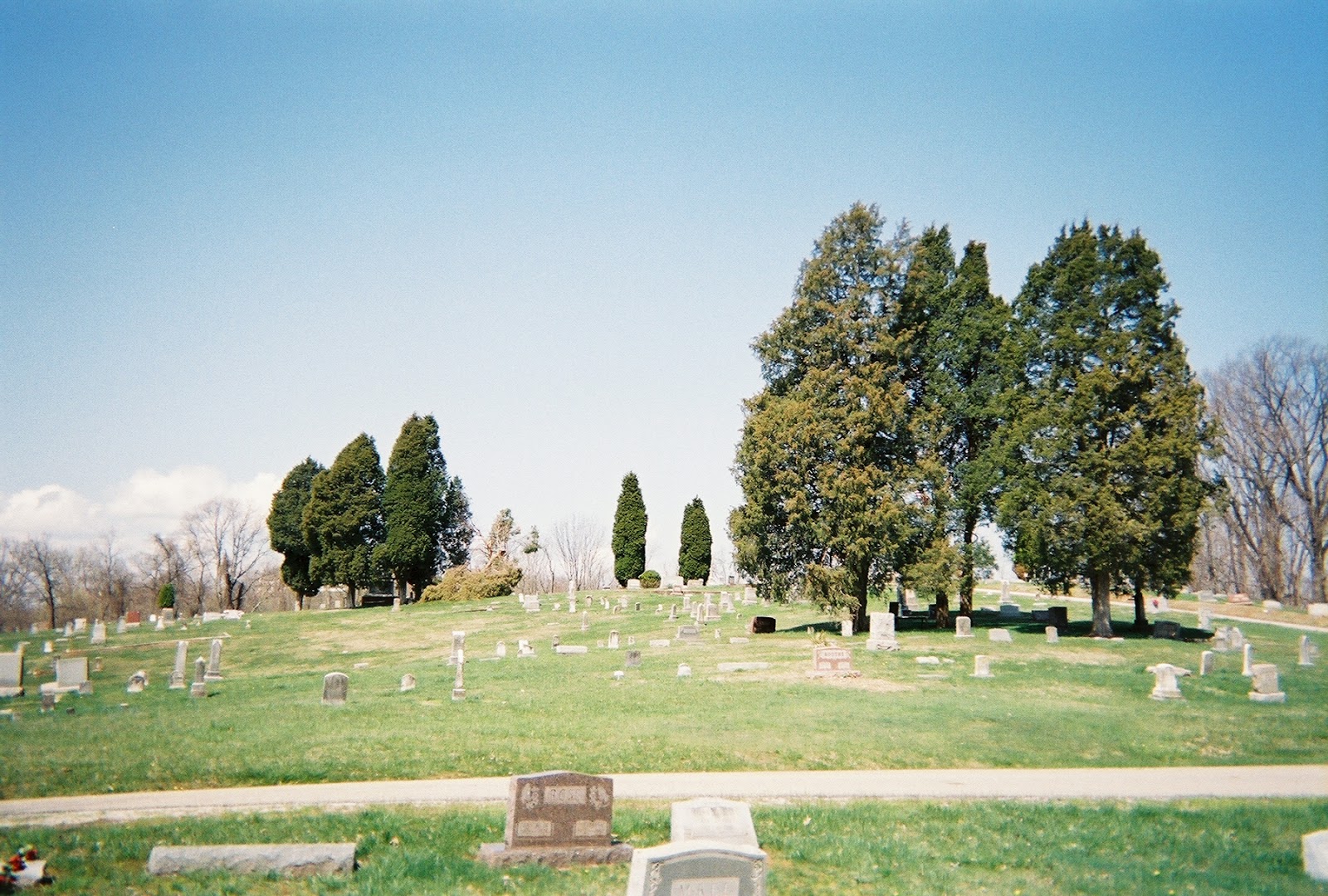
The first cemetery, I ever visited as a genealogist, was in Union Township, Lawrence County, OH about four years ago when I still thought I was a Spears. The story is worth telling because of several lessons that I learned.

Union Hill, like a lot of old cemeteries that you might visit in search of your ancestors, is very hard to find if you are not a local. I was lucky that I had been working with Ellen Gammon, a professional genealogist in Lawrence County, for several months before my trip. I introduced Ellen in my blog post of Oct 19, 2011. Before my husband, Bert, and I even left Georgia, Ellen sent us a detailed topographic map showing the location of Union Hill Cemetery. Because this cemetery, like so many others in rural parts of America, is so far off the beaten track, we could never have found it without this map.

 So, Cemetery Lesson # 1 -- to prevent frustrating and disappointing efforts to find remote family cemeteries, always try to find out as much as possible about the exact location before you begin your trip. Contact local libraries and county offices to inquire about maps. If you can find a US Geological Survey (USGS) map/webpage with longitude and latitude, you can use a Global Positioning System (GPS) device to help guide you. An example of this type of tool is the Union Hill USGS information webpage.

At-home preparation before your visit will pay off 1000%! You can do a Google search on the name of your cemetery. This may turn up maps, historical information, phone numbers, websites, and even, if you are very lucky, a list of people in the graveyeard. Findagrave and Interment.net are two websites that allow you to search for cemeteries across the US.

A hill view in Union Hill Cemetery taken by Bert Schuster, 2008
After trip preparations were complete, Bert and I hit the road. When we arrived at Union Hill, we found that we were the only ones there. The cemetery is located on several hills and is about 10 acres. There was no office. We had no map of the cemetery itself so we started walking up and down the hills, peering at gravestones.

Spears Plot taken by Bert Schuster, 2008
We hadn’t yet found any Spears graves when we saw a car drive up. I went up to say hello and the driver told me that there was a sexton living down the road who had a map of the cemetery! She even knew the man. When we said that we didn’t want to bother him, she said he was just sitting at home and would be glad to help us. Then she told my husband to follow her to the sexton’s house. Meanwhile I stayed behind to continue searching. By the time Bert returned with the map, I still hadn’t found the Spears plot. But sure enough, the map showed us right where it was!! 

Cemetery Lesson #2 – always talk to people you meet in a cemetery; especially in small, rural graveyards where the people who are visiting their loved ones are often locals who may have a wealth of information to share with you. They could even be related!

The third lesson came when Bert tried to take a picture of the Spears family plot. Our digital camera wouldn’t work! No problem, we thought. Bert would find a camera store in Ironton or a WalMart and pick up a new battery while I continued looking at the grave stones. What we didn’t count on was this is a small, non-urban area. No camera stores. WalMart carried regular batteries but not the special camera battery that we needed.
Cemetery Lesson #3 – always bring more than one camera with you. Disposable cameras cost very little and can mean that you actually bring home some photos if your real camera stops working. An extra memory card is also worth tucking in your camera case.

Once you are in the cemetery and actually locate an ancestor’s grave, new challenges may arise. You walk up to the grave with great anticipation. Is there a marker or stone? And, if you find a grave marker, what condition is it in? What material is it made from and if there are symbols carved on the stone, what do they mean? A brief, easy-to-follow guide to tombstone identification and cleaning is available from Everlife Memorials


Grave of David Spears, taken by Bert Schuster, 2008

An in-depth discussion of how to determine the type of stone and how to clean that stone is at The Association for GraveStone Studies. I wish that I had known about these information sites before I went to Union Hill Cemetery. I brought no cleaning supplies with me. My ancestor, David Spears' tombstone, was in poor condition.

Cemetery Lesson #4 – although you may want very much to “clean” a tombstone of the moss, lichen, dirt, and other materials that might be obstructing your view of the lettering beneath, remember to check to see the composition of the stone before you begin any debris removal procedure. And be sure to use the recommended cleaning substances and tools so as to minimize any damage to the stone.


Taken by Bert Schuster, 2008

Many of us have ancestors who lived in states far from where we live now. This makes regular maintanence visits difficult if not impossible. A tip that I learned from Union Hill Cemetery is to look for any signage that might be in the graveyard. Also don't forget to look at the target cemetery on-line for contact information.
You can send in a donation for cemetery upkeep.

Perhaps the most important lesson to learn when planning a cemetery visit is to be sure that you bring along a friend. Another person is good for safety purposes (in rural and in urban cemeteries) and as another pair of eyes/hands to help you as you travel the grounds searching for the graves of your ancestors.


Using a little cemetery savvy when you set out to find your ancestors’ graves will go a long way in helping you reach your goals and making sure that you leave the graveyard in the same or better condition than you found it.

Categories: research terms

Wednesday, October 19, 2011

When to Hire a Professional Researcher

Have you been wondering if it is time to look for some outside assistance in your genealogical research? Some people hesitate because they think hiring a consultant is a luxury that is beyond their budget. But in my experience this has not been the case. The time saved and the new information and contacts I have gained from working with consultants have more than made up for their very reasonable fees.   

There are many reasons that might propel a person into the world of working with paid consultants.

First, when you are doing out of state research, someone actually living in that area can be very helpful.  That person can visit archives or other record depositories to search for information. An in-person search is much faster than ordering records by mail. Not all records have been digitized or are available on the computer. And a local person may know of places to research in the area that you have not thought of.

The first time that I worked with an outside consultant was in 2007 when I needed some documents from the Briggs Lawrence County Public Library in Ironton, OH. By studying their webpage, I found that Briggs has microfilm of marriages in Lawrence County from 1817 - present. I was searching for the marriage record of George Washington Spears (b. 1858 in Fayette Township and married in 1887 to Frances Henrietta Allis). But I couldn’t physically get to Briggs at that time so I needed some on-site help.

I didn't know any researchers living in Lawrence County. But I knew that a good place to go for local genealogy information is always the local genealogical society.
I looked at the Lawrence County Genealogical Society web page for suggested researchers. This is where I found Ellen Gammon whom I first contacted by e-mail. And this was the beginning of a professional relationship that has been so valuable to me in my research in Ohio. Ms. Gammon goes far beyond “business as usual”. An example of her care, local knowledge and desire to be of help to family members seeking to know their Lawrence ancestors is this map that she sent me when I finally had the chance to arrange a trip to OH:

Without this map, I never could have found the Union Hill Cemetery in Union Township, Lawrence County, OH.
Photo taken by Bert Schuster 4/10/2008

About a month ago, a consultant found me just when I needed him. I recently picked up the trail of my great grandfather, Henry Kreis, living in Irvington, Essex, NJ in 1920. Until a few weeks ago, I had no knowledge of Henry’s whereabouts after his divorce from my great grandmother, Mary Carney, in 1906 in Chicago, IL. I discovered that Henry had married a second time in NJ to Henrietta Hausmann Williams – who happened to be a character witness at his divorce trial!

From Essex, NJ census records, I knew that John Kreis, Henry’s father, was also living in Newark with his daughter-in-law, Henrietta and his grandchildren. I was hoping to find more information on this branch of my family, so I put a message on the Essex County, NJ forum of genforum.com. The next day Tom Ankner, a local researcher from Newark, NJ, responded to my posting and offered his services. Not only was Tom able to search the state archives for me and find a death certificate for John Kreis, but he suggested another local contact that proved immensely valuable.

Tom had heard about a local genealogist, Mary Lish, who had “adopted” a cemetery where some of her ancestors were buried. In the last ten years, Mary has digitized many of the burial cards and headstone information from Woodland Cemetery in Newark. She holds an annual “Photo Day” when volunteers clean up parts of the graveyard. This cemetery, like many local graveyards, has little funding for physical maintenance let alone record keeping. Without people like Mary Lish, many burial records and gravestones would be lost to the damages of time.

Photo taken by Tom Ankner 8/2011
Mary was able to look at her spreadsheet and locate not only John Kreis but several other Hausmanns. I was in for a special surprise. On a burial card for the Kreis/Hausmann plot was a note that Henrietta Kreis was buried in Hollywood Cemetery! Now I needed Tom Ankner. He was able to visit Hollywood and take pictures for me.

In my opinion, no research plan is complete without the knowledge of when it’s time to hire an outside professional. Sometimes this decision will mean finding a piece of the puzzle of ancestor knowledge that you might otherwise have missed.

In my next post, I will address in more detail what to do after you decide you want to hire a professional researcher. This will include ideas about where to find lists of people offering their services and where to find information on the actual contractual process. How do you negotiate the fee? What will you get for what you pay?

Categories: genealogy professional