Pages

Showing posts with label Native American. Show all posts

Wednesday, December 19, 2018

Chicago Settlers: The Europeans, Métis and Americans


Two barriers to settlement of the near empty, muddy, swampy site called Chicago were removed between 1825 and 1833.  This removal caused a trickle of settlers to turn into an unstoppable torrent of humanity within a decade. The development of Chicago would mirror what had already happened on the east coast after. People came from Europe and settled the first area they found on the Atlantic coast, children were born and grew up. Then they looked for land. Go west, became the watchword. But mountains, swamps, and the indigenous peoples who already occupied the land were challenges to the westward movement.

By Chicago Lithographing Company, United States Library of 
Congress's Prints and Photographs division, 
digital ID pga.03605. 1867, Public Domain, 
https://commons.wikimedia.org/w/index.php?curid=44965951)

Two factors made it difficult for Americans east of Chicago to make the trip. First, the Indian population showed their objections to white settlers moving into their land by frequent raids. Second, no direct land or water route to Chicago existed. But these impediments were not to stand.

First, the US government made a two-pronged policy to discourage the Indian population from remaining in the area: soldiers were sent to raid the villages and treaties were made with promises of land west of the Mississippi. By the early 1830s, most of the Potowatami people were forced out. With the IndianRemoval Act of 1833, one barrier to new settlement of the Chicago area was now gone.

The next barrier to fall was the geographic difficulties facing those who wanted to settle in the area. Americans coming from New England, New York and New Jersey had no roads to travel overland to Chicago. They had to rely on water transportation, but there was not a direct unbroken route. Finally in 1825, the Erie Canal made it possible for travelers to come by boat from the East Coast to Chicago via the Great Lakes.  This new route to Chicago brought in many settlers although an additional canal and other improvements would be necessary to really open up the way.

As we noted in a previous post of February 16, 2017, Chicago in the 1820s to mid-1830s  was composed of just a few buildings, surrounded by nearly impassable, muddy swamp for much of the year. As you can see from the drawing below, by 1830 Chicago had not grown much in a decade:

Chicago 1830, Population 96,  Chicago in Early Days 1779 – 1857”, 1893, 
Kruz and Allison [Public domain], via Wikimedia Commons.
Before the mid-1830s, the inhabitants of the village of Chicago were mainly French and English men, engaged in the many aspects of the fur trade (many of the traders were of mixed ethnicity, after decades of intermarriage by Europeans, mainly French, with Native Americans, who were called Métis.) from the French “mixed blood”:
“The term Métis (MAY tee) refers to people of mixed ancestry, usually Native American and European. Historically, Métis people were important to Chicago and the Great Lakes region during the fur trade era, especially during the eighteenth and early nineteenth centuries. Fur traders from Europe, Canada, and the Atlantic colonies and states frequently married Native American women living in the communities with which they traded.”1

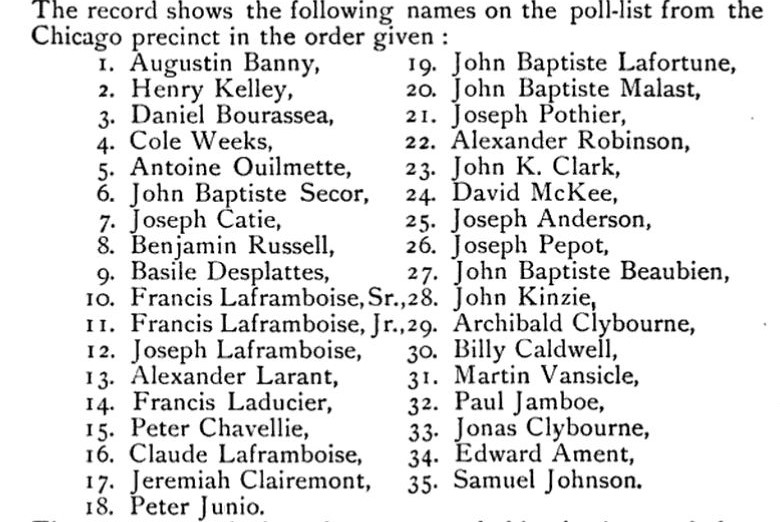
Just how many Metis lived in the Chicago village in 1826? We can infer the number of heads of households and the ethnic composition of the village in 1826 from the 35 names on the poll list  of the first official election (for Governor and Congressman) held there on August 7, 1826 2:


“Of the thirty-five names on the poll-list, twenty-one were French.”3 p.32
More evidence of the French/Metis presence comes from a petition requesting a priest that the early Catholic Chicagoans sent to the Archdiocese in St. Louis, MO in 1833:
“The following signed the petition, the figure after each individual's name indicating the number of persons in his family: Thomas J. V. Owen, 10; J. B. Beaubien, 14; Joseph Laf ramboise, 7; Jean Pothier, 5; Alexander Robinson, 8; Pierre Leclerc, 3; Alexis Laf ramboise, 4; Claude Laf ramboise, 4; Jacques Chassut, 5; Antoine Ouilmet; Leon Bourassa, 3; Charles Taylor, 2; J. Bt. Miranda and sisters, 3; Louis Chevalier and family, 3; Patrick Walsh, 2; John Mann, 4; B. Caldwell, 1; Dill Saver, 1; Mark Beaubien, 12; Dill Vaughn, 1; James Vaughn, 1; J. Bt. Kabbie, 1; J. Bt. Poulx; J. B. Tabeaux, 1; J. Bt. Durocher, 1; J. Bt. Brodeur, 1; Mathias Smith, 1; Antoine St. Ours, 1; Bazille Desplat, 1; Charles Monselle, 1; John Hondorf, 1; Dexter Apgood, 1; Nelson Peter Perry, 1; John S. C. Hogan, 1; Anson H. Taylor, 1; Louis Francheres, 1; a total of 122.4 
But the dominance of the French and Metis in early Chicago and the great fur trading empire was on the decline by the early 1830s:
“Numerous biracial fur trade families, including Métis, Indian, and Euro-American members, were among the first families of Chicago. Between the 1790s and 1812, Billy Caldwell, Alexander Robinson, and members of the Beaubien, Ouilmette, Chevalier, Bourassa, Mirandeau, and LaFramboise families established Chicago as a fur trade center along with the Anglo Kinzie family and the African American Jean Baptiste Point DuSable. After the War of 1812, however, English-speaking settlers from the eastern United States began to migrate into northern Illinois, and by the 1830s this stream of migration increased to the point where the old French-speaking Métis and other Creole residents became a minority in their own town.”5
And what caused this change in the Chicago economy from reliance on the fur trade?  The  emergence of farming and the concurrent deluge of new settlers from the Atlantic states (New York, New Jersey, Pennsylvania, Maryland and Virginia) combined with a multitude of  entrepreneurs eager to take advantage of Chicago’s geographic advantages brought a new vitality and money to Chicago.

Change was in the air in the village of Chicago. A land grab of huge proportions was just beginning. Enterprising persons with a view to the future saw the possibilities of the geographic position of Chicago both as a trading hub and a gateway to the west. There was money to be made! Speculators began buying up lots. Joining the fur traders and those who furnished them with lodging, liquor and supplies, surveyors, lawyers and speculators arrived to assist in mapping and selling land to eager buyers. More grocery stores opened and new clothing and building materials stores sprang up to serve the growing population. 

Evidence of the increase in population is seen in the first Chicago Census:
“The first census of Chicago was reported in the “Democrat” of November 25, 1835, showing 3,265 persons, 398 dwellings, 4 warehouses, 29 dry-goods stores, 19 grocery and provision stores, 5 hardware stores, 3 drug stores, 19 taverns, 26 groceries (probably liquor stores) and 17 lawyer's offices.” 6
As stated above, the increase in population correlated with a change in the ethnicity of the people of Chicago. Let’s look at some records to chart the changes in the ethnic make-up of this area from the 1820s to the 1830s.
The poll record of 1835 compared to the 1826 poll list shows a sharp movement from the few old Métis families to many, many American-headed households:


In conclusion, we see that Chicago underwent a huge increase in population from the mid-1820s to the mid-1830s. Along with this increase, we also see a change in the ethnic make-up of the people in the growing town. The era of the French and Métis fur traders was fast ending to be succeeded by Yankee businessmen and farmers with their families. What happened to the fur traders:
“A majority of those having French names (on the August 7, 1826 poll list) were employees of the American Fur Company, or hunted and traded for themselves. When Chicago was abandoned as a fur trading post, they went further into the frontier country, like Archibald Caldwell.”7 p. 16 
Notes
1 Métis, The Electronic Encyclopedia of Chicago, Chicago Historical Society, The Newberry Library, < http://www.encyclopedia.chicagohistory.org/pages/818.html>, downloaded 12 Dec 2018.
2 Fremont O. Bennett, compiled, Politics and Politicians of Chicago: Cook County, and Illinois. Memorial Volume, 1787-1887. A Complete Record of Municipal, County, State and National Politics from the Earliest Period to the Present Time. And an Account of the Haymarket Massacre of May 4, 1886, and the Anarchist Trials, (Chicago, IL, The Blakely Printing Company, 1886), p. 14.
3Bessie Louise Pierce, A History of Chicago The beginning of a City 1673-1848, Vol 1, (Chicago, IL, The University of Chicago Press, 1937), p. 32.
4 Joseph Garraghan Gilbert, The Catholic Church in Chicago, 1673-1871: An Historical Sketch, (Chicago, IL, Loyola University Press, 1921), pgs. 45-46.
6 Joseph Kirkland, The Story of Chicago, Vol. 1, (Chicago, IL, Dibble Publishing Company, 1892),  p. 152.
7 Bennett, Politics and Politicians of Chicago: Cook County, and Illinois. Memorial Volume, 1787-1887. A Complete Record of Municipal, County, State and National Politics from the Earliest Period to the Present Time. And an Account of the Haymarket Massacre of May 4, 1886, and the Anarchist Trials, p. 16.

Friday, May 24, 2013

Revelations Through Letters

We genealogists look at many different records in our search for information on our ancestors, including vital records, as well as court, land and military records. But some of the most intriguing documents, if you are lucky enough to find them, are first-person remembrances and interviews.

I used to think that only “famous” families had books written about them. But as I have pursued my own genealogy, I have found that ordinary families, too, have had a person or persons so interested in preserving their history that they have made a published record of their findings. The professional term for this historical record of a family is a genealogy.
I have not yet found any Spears genealogies pertaining to my line, but I have been fortunate to find interesting source material about my Johnson forebears. Sallie Atkins, whose husband’s DNA matches my brother’s, has been researching our shared Johnson, Shelton and Franklin cohorts for over thirty years.
Sallie introduced me to a collection of letters on our families between Hobart Oscar Franklin (b. 1915 Cabell County, WV) and Kenneth Charles Wilde (b. 1932).

Both men, who descend from the same Franklin ancestor, had spent years independently researching their family lines. Then in the 1980, they somehow came across each other (way before the internet made it easy to find people) and began corresponding for the next twenty years about the family lines they had in common. And what a boon for everyone who shares their ancestors! I have mentioned before in my blog post of September 19, 2011 of how you can really make leaps in your research through working with others.

 In their own research, they each had used a combination of first-person interviews with court and census records in their efforts to find out all they could about their early ancestors. Also, both men also were familiar with Fred Lambert, a family historian in the early years of this century who traveled all over West Virginia interviewing  people and recording their stories, and referred often to his work in their letters. During their correspondence, Wilde and Franklin were able to pool their information, check their theories, and see what their family sources had to say on the same topics.

Franklin had the advantage of being born earlier in the twentieth century. When he started delving into his family history, several living relatives, including his mother, Luverna McComas Franklin, (b. ca.1868 Lincoln County, WV) and aunt, Viola Franklin Midkiff (b. 1867), had been around long enough to either remember some of the early ancestors or to have heard stories from people who had actually known some of the forebears who had passed away before his birth. And lucky for us, they were willing to share this information! At least some were.

What were some of the themes that came up in the letters between the two family historians? As you might expect, one of the recurring subjects was tracking the migration patterns of the associated families. The Sheltons, Franklins, and Johnsons had moved across colonial Virginia through the counties of Lunenburg, Halifax, Pittsylvania, Amelia, Henry and Patrick Counties before going to Surry and Buncombe Counties, NC; they ended up in Cabell County, WV in the early 1800s. We genealogists always want to pinpoint the time and place that each of our ancestors lived and when, where and why they moved. 

Wilde and Franklin used the Virginia Court of Common Pleas records to track the migration of their ancestors by their court appearances. In colonial times, people went to court often to settle debts and to air other differences they had with neighbors (see my blog from January 28, 2013 for more details on the workings of American Colonial courts.) Wilde and Franklin also used County lists of Tithables, another type of court record, to place people and find out who their neighbors were.

The two researchers also used the US Federal Censuses, especially the 1790 and 1800 Virginia and North Carolina census documents, to aid them in placing ancestors and in tracing their movements during the decade between 1790 and 1800. Because of their meticulous study of the records, I was finally able to see how my families had crossed from Eastern Virginia to the southern part of the state and then into North Carolina.
County Map of Virginia, and North Carolina, 1860, Samuel Augustus Mitchell, Wikimedia, public domain.
A second recurring theme was the question of whether or not there were Native American ancestors in the family as was rumored over the years by various Franklin folk. When Hobart Franklin asked his father about this, he was met with stern silence. This is what he wrote to Wilde about the subject of ethnicity of the family: “I am so ignorant about our Indian ancestors. It was such a hush-hush in our family. Dad wouldn’t talk about his people…” (p. 559). But his Aunt Viola and mother both agreed that there was Indian blood in their family.

For his part, Kenneth Wilde wrote that he experienced the same “refusal to talk” or acknowledge the fact of Indian ethnicity in his branch of the Franklins.

Another aspect of the Native American heritage stories that Wilde and Franklin bounced back and forth was trying to “flush out” the details of a possible ancestor, Mary Franklin, (also known as Glumdalclitch, although no one knows why she was called this) who supposedly was all or part Native American and who may have married a Franklin or had a father who was a Franklin, according to which testimony you looked at. 

This quest to find out about a particular individual, in this case Mary Franklin, shows how family genealogy leads researchers to study history.  In a query to The Franklin Fireplace in April 1979, Wilde wrote that Mary “may have been one of the Cherokee women prisoners who were captured by General John Sevier of Tenn on a Cherokee Expedition sometime prior to 7/28/1781.” Perhaps this is the query that Hobart Franklin answered that began the long correspondence. As the two batted their information and theories on Mary Franklin back and forth through their letters, they were able to put together testimony they had gathered separately from different members of their families.

Another theme that recurs throughout the correspondence is the effort to untangle family relationships, as in “Who’s your daddy?”
Any genealogist who has been researching for any length of time recognizes this question. Franklin and Wilde were trying to find out who fathered the two sons of Mary Franklin, the Indian woman introduced above. They relied on family testimony as these births occurred in the late eighteenth century, too early for birth records. Also, they could find no marriage records for Mary, and they wondered if perhaps she never married. 

One of Mary's sons, William Duckworth Franklin Shelton (known as “Duck”, b. ca. 1798), was said to be fathered by Roderick Shelton as noted by the two researchers. But they found no documentation (and, to my knowledge, none has been found since) to confirm this contention. According to Hobart Franklin, some indirect evidence of Roderick’s possible parental relationship to Duck is that Roderick cared for and supported him. But Duck, according to Wilde, called himself “Franklin” after his mother.

Franklin and Wilde had both heard that Mary Franklin had a second son, George “Rock” Franklin (b. ca. 1801). Wilde said that Rock always contended that his father was Solomon Stanton. Again, no documentation has been found to corroborate this theory.

So, what have I learned from the discovery of the correspondence between Kenneth Wilde and Hobart Franklin? For years I have been reading stories about the Sheltons, Johnsons, and Franklins on rootsweb, genforum and other places on the web. But most of the writers of these stories list no sources. One of these stories was about Mary Franklin (Glumdalclitch) and her children. With the Wilde/Franklin Letters, I now know where these stories, that were showing up all over the internet, came from.

After seeing how the two researchers used their letters to try out theories, to check the accuracy of each other’s family stories and generally to further their life’s work, I am even more convinced of the value of being part of a community of genealogists.

  Genealogies, first person interviews and letters are wonderful additions to a genealogist’s record collection. Look for genealogies, manuscripts, and letters about your family lines. Search in the libraries in the counties where your people lived; use the on-line catalogs. And if you’re young enough to have older family members still living, don’t miss the opportunity to ask them to share their stories. Be sure to record them. And after you collect a whole lot of oral testimonies, you might consider combining this information with the results of your other research to write a genealogy of your family.

Marshall University, 2006, Youngamerican (talk), Creative Commons unported license
As I missed out on interviewing many living witnesses since I was born in 1945 and didn’t become interested in researching my family history until the late 1990s, I will be eternally grateful for the written legacy of Fred Lambert. He spent years traveling around West Virginia interviewing people about their families. He cared enough to preserve his findings about his and my ancestors by leaving his research to Morrow Library at Marshall University  in Huntington, WV. And of course I owe a huge debt of gratitude to Hobart Oscar Franklin and Kenneth Charles Wilde.

Categories: document types, research terms