Hello to all my readers! I wanted to wish you health, safety and well-being during these times of the pandemic and economic disruption. I have not been writing on my blog during the last year (July 2019 – August 2020) but I have been working on my Carney/Kearney and Duffy lines, trying to locate where they may have lived in Ireland. From this research, I have discovered several sources and information that may be helpful to others on this journey.
As preparation for my research into possible ancestral home places in Ireland, I studied the map of Ireland and started reading Irish history.
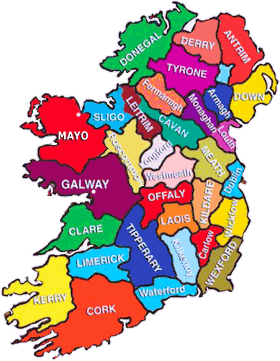
Ireland_map.gif, Created by George McFinnigan, 26 February
2006, Wikimedia.
I realized that I didn’t know anything about the movement of people within Ireland over the years. This knowledge would be critical in my quest to trace my lines in the country.
In my experience, when American scholars write about Irish history, they focus on their coming here and especially concentrate on the Great famine of 1845-1849. And this is to be expected as the American public wants to know about this time period because, according to the Library of Congress:
“Between 1820 and 1860, the Irish constituted over one third of all immigrants to the United States. In the 1840s, they comprised nearly half of all immigrants to this nation.”1

1884, LC-USZ62-60319 (b&w film copy neg.)
Also, humans are ethnocentric and naturally like to tell their stories from their point of view as this cover of Harper’s magazine shows: the people of Ireland are beseeching America for help:

With this said, when you want to find where in Ireland your ancestors came from, you need another focus. You want to learn about movement of people within Ireland rather than from Ireland. In other words, you are looking for internal migration. A basic question comes to mind: What factors caused people in Ireland to move to different parts of the country? The answer is the same for all humans throughout history. People move to gain better access to food and/or to escape war and violence.
A key contributing factor to the difficulty the Irish peasant faced in growing sufficient food over several centuries was the practice of various English monarchs (before them the Anglo-Saxons) of making large land grants in Ireland, called plantations, to favored followers.

In some cases, the government sought a policy of replacement/displacement where English farmers were brought in (or “planted”) to help in “Making Ireland British.” These newcomers pushed out the native Irish who often had to move to less fertile, more boggy land. In other cases and other times, the landowners remained in England and hired landlords in Ireland and overseers to supervise their Irish tenants. These middlemen, driven by a desire for high profits, would regularly raise the rent so that poorer tenants were displaced by those with more ability to pay.
Thus we see the causes of internal migration in Ireland, and we can find eye-witness accounts to this movement in the travelogues of Arthur Young who toured Ireland from 1776 to 1779.

Young was interested in how people lived in the countryside, how they made a living from the land. He noticed that the Irish tenant farmer had no qualms about how much his labor was worth and would “vote with his feet” when he believed that his landlord was not paying a proper or market rate:
“Whole families in that country will move from one place to another with freedom, fixing according to the demand for their labour, and the encouragement they receive to settle.”2
Now that we have outlined the reasons for the internal migration in Ireland, we need to understand some patterns or geographic directions of this movement in order for this information to help us see how our ancestors may have moved through the country at different times over centuries. I turned to a seminal work on Irish migration by Patrick Fitzgerald and Brian Lambkin, Migration in Irish History, 1607-2007.

For our purposes, we need just an idea of the general direction of movement within the country or internal migration. One of the fundamental patterns of internal migration is most countries, including Ireland, since the Industrial Revolution is people moving from rural areas to larger towns and cities. From the early 1800s onward tenant farmers saw new opportunities in factories and in the service sectors that grew up to meet the needs of the more prosperous urban inhabitants.

in a factory at Balbriggan, Ireland. Ireland, 1903. [Photograph]
Retrieved from the Library of Congress, https://www.loc.gov/item/2020681993/.
An important note for genealogists about this pull of the city is that country migrants would mostly travel to the nearest town or city and would usually remain in the same county. (end note: Fitzgerald p. 138 and 155.) How will this knowledge affect my research in Ireland? To start with, let’s see what I have accomplished so far.
Before I began thinking about the movement of people within Ireland, I was concentrating all my efforts in Ulster and adjoinng counties for reasons that I discussed in my post of August 13, 2018, I noted how I used Dr. Tyrone Bowes’ surname distribution map, Griffith’sValuation and the 1911 Irish Census to place Carney and cohort families in the Irish counties of Leitrim and Fermanagh. I was now ready to look more widely at Irish counties.
I was scouring the internet for Irish genealogical sources during the early days of the Coronavirus Pandemic, when I came across the National Archives of Ireland (NAI.)

CC BY 3.0, https://en.wikipedia.org/w/index.php?curid=23958509)
Because the building was closed to the public due to the virus, the Archives was offering a special opportunity: researchers could send them an inquiry for free (as of my checking on the site on September 11, 2020, the Archives is now open on a limited basis.) I was so excited. This was a chance to canvas all the counties of Ireland. I submitted a list of individuals that had immigrated from Ireland and ended up in Chicago by the mid-1800s who were associated with my great, great grandparents, John Carney/Kearney and Mary Duffy.
Some weeks later, I was excited to hear back from the NAI with this information:

This one record contains so much new information. In addition to identifying a couple of the same names and similar ages to my great great grandparents, the record presents a whole new county to research -- Sligo. I will take up the analysis of this new information in my next post.

Source data: Ordnance Survey of Ireland: Baronies 2011
(OSI), author: XrysD, 21 July 2018.
As tantalizing as it is to think this couple from Sligo are my ancestors, as every genealogist knows, this could be just a coincidence. In the response to my inquiry, NAI staffer suggested that:
“We should not jump to conclusions that this is definitely your ancestors but rather should seek to prove or disprove this record.”
A second suggestion from the NAI was to look at US records. Oh, how hard I have tried to find some! I will discuss what US sources I have rigorously studied over the past twenty years in my next post as well.
In conclusion, Americans who study their Irish roots often encounter source material focused on the Great Famine of 1845-1849 and its effect on immigration to America. But if you wish to investigate where your Irish ancestors came from in the centuries before and up to the Famine, you need to focus on internal migration in Ireland over the centuries.
1https://www.loc.gov/classroom-materials/immigration/irish/irish-catholic-immigration-to-america/#:~:text=Between%201820%20and%201860%2C%20the,all%20immigrants%20to%20this%20nation.
2Young, Arthur, 1741-1820, John Parker Anderson, and Arthur Wollaston Hutton. Arthur Young's Tour In Ireland (1776-1779). London: G. Bell & Sons, 1892. Vol. 2, p. 119.


