Pages

Showing posts with label Chicago. Show all posts

Wednesday, December 19, 2018

Chicago Settlers: The Europeans, Métis and Americans


Two barriers to settlement of the near empty, muddy, swampy site called Chicago were removed between 1825 and 1833.  This removal caused a trickle of settlers to turn into an unstoppable torrent of humanity within a decade. The development of Chicago would mirror what had already happened on the east coast after. People came from Europe and settled the first area they found on the Atlantic coast, children were born and grew up. Then they looked for land. Go west, became the watchword. But mountains, swamps, and the indigenous peoples who already occupied the land were challenges to the westward movement.

By Chicago Lithographing Company, United States Library of 
Congress's Prints and Photographs division, 
digital ID pga.03605. 1867, Public Domain, 
https://commons.wikimedia.org/w/index.php?curid=44965951)

Two factors made it difficult for Americans east of Chicago to make the trip. First, the Indian population showed their objections to white settlers moving into their land by frequent raids. Second, no direct land or water route to Chicago existed. But these impediments were not to stand.

First, the US government made a two-pronged policy to discourage the Indian population from remaining in the area: soldiers were sent to raid the villages and treaties were made with promises of land west of the Mississippi. By the early 1830s, most of the Potowatami people were forced out. With the IndianRemoval Act of 1833, one barrier to new settlement of the Chicago area was now gone.

The next barrier to fall was the geographic difficulties facing those who wanted to settle in the area. Americans coming from New England, New York and New Jersey had no roads to travel overland to Chicago. They had to rely on water transportation, but there was not a direct unbroken route. Finally in 1825, the Erie Canal made it possible for travelers to come by boat from the East Coast to Chicago via the Great Lakes.  This new route to Chicago brought in many settlers although an additional canal and other improvements would be necessary to really open up the way.

As we noted in a previous post of February 16, 2017, Chicago in the 1820s to mid-1830s  was composed of just a few buildings, surrounded by nearly impassable, muddy swamp for much of the year. As you can see from the drawing below, by 1830 Chicago had not grown much in a decade:

Chicago 1830, Population 96,  Chicago in Early Days 1779 – 1857”, 1893
Kruz and Allison [Public domain], via Wikimedia Commons.
Before the mid-1830s, the inhabitants of the village of Chicago were mainly French and English men, engaged in the many aspects of the fur trade (many of the traders were of mixed ethnicity, after decades of intermarriage by Europeans, mainly French, with Native Americans, who were called Métis.) from the French “mixed blood”:
“The term Métis (MAY tee) refers to people of mixed ancestry, usually Native American and European. Historically, Métis people were important to Chicago and the Great Lakes region during the fur trade era, especially during the eighteenth and early nineteenth centuries. Fur traders from Europe, Canada, and the Atlantic colonies and states frequently married Native American women living in the communities with which they traded.”1

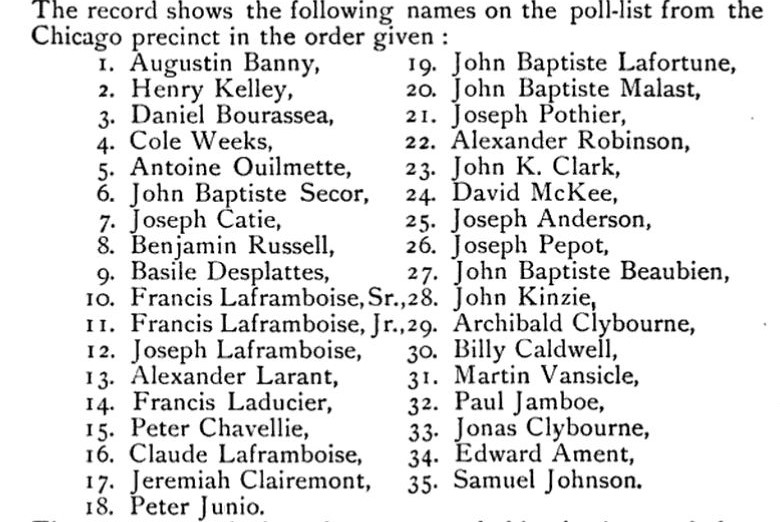
Just how many Metis lived in the Chicago village in 1826? We can infer the number of heads of households and the ethnic composition of the village in 1826 from the 35 names on the poll list  of the first official election (for Governor and Congressman) held there on August 7, 1826 2:


“Of the thirty-five names on the poll-list, twenty-one were French.”3 p.32
More evidence of the French/Metis presence comes from a petition requesting a priest that the early Catholic Chicagoans sent to the Archdiocese in St. Louis, MO in 1833:
“The following signed the petition, the figure after each individual's name indicating the number of persons in his family: Thomas J. V. Owen, 10; J. B. Beaubien, 14; Joseph Laf ramboise, 7; Jean Pothier, 5; Alexander Robinson, 8; Pierre Leclerc, 3; Alexis Laf ramboise, 4; Claude Laf ramboise, 4; Jacques Chassut, 5; Antoine Ouilmet; Leon Bourassa, 3; Charles Taylor, 2; J. Bt. Miranda and sisters, 3; Louis Chevalier and family, 3; Patrick Walsh, 2; John Mann, 4; B. Caldwell, 1; Dill Saver, 1; Mark Beaubien, 12; Dill Vaughn, 1; James Vaughn, 1; J. Bt. Kabbie, 1; J. Bt. Poulx; J. B. Tabeaux, 1; J. Bt. Durocher, 1; J. Bt. Brodeur, 1; Mathias Smith, 1; Antoine St. Ours, 1; Bazille Desplat, 1; Charles Monselle, 1; John Hondorf, 1; Dexter Apgood, 1; Nelson Peter Perry, 1; John S. C. Hogan, 1; Anson H. Taylor, 1; Louis Francheres, 1; a total of 122.4 
But the dominance of the French and Metis in early Chicago and the great fur trading empire was on the decline by the early 1830s:
“Numerous biracial fur trade families, including Métis, Indian, and Euro-American members, were among the first families of Chicago. Between the 1790s and 1812, Billy Caldwell, Alexander Robinson, and members of the Beaubien, Ouilmette, Chevalier, Bourassa, Mirandeau, and LaFramboise families established Chicago as a fur trade center along with the Anglo Kinzie family and the African American Jean Baptiste Point DuSable. After the War of 1812, however, English-speaking settlers from the eastern United States began to migrate into northern Illinois, and by the 1830s this stream of migration increased to the point where the old French-speaking Métis and other Creole residents became a minority in their own town.”5
And what caused this change in the Chicago economy from reliance on the fur trade?  The  emergence of farming and the concurrent deluge of new settlers from the Atlantic states (New York, New Jersey, Pennsylvania, Maryland and Virginia) combined with a multitude of  entrepreneurs eager to take advantage of Chicago’s geographic advantages brought a new vitality and money to Chicago.

Change was in the air in the village of Chicago. A land grab of huge proportions was just beginning. Enterprising persons with a view to the future saw the possibilities of the geographic position of Chicago both as a trading hub and a gateway to the west. There was money to be made! Speculators began buying up lots. Joining the fur traders and those who furnished them with lodging, liquor and supplies, surveyors, lawyers and speculators arrived to assist in mapping and selling land to eager buyers. More grocery stores opened and new clothing and building materials stores sprang up to serve the growing population. 

Evidence of the increase in population is seen in the first Chicago Census:
“The first census of Chicago was reported in the “Democrat” of November 25, 1835, showing 3,265 persons, 398 dwellings, 4 warehouses, 29 dry-goods stores, 19 grocery and provision stores, 5 hardware stores, 3 drug stores, 19 taverns, 26 groceries (probably liquor stores) and 17 lawyer's offices.” 6
As stated above, the increase in population correlated with a change in the ethnicity of the people of Chicago. Let’s look at some records to chart the changes in the ethnic make-up of this area from the 1820s to the 1830s.
The poll record of 1835 compared to the 1826 poll list shows a sharp movement from the few old Métis families to many, many American-headed households:


In conclusion, we see that Chicago underwent a huge increase in population from the mid-1820s to the mid-1830s. Along with this increase, we also see a change in the ethnic make-up of the people in the growing town. The era of the French and Métis fur traders was fast ending to be succeeded by Yankee businessmen and farmers with their families. What happened to the fur traders:
“A majority of those having French names (on the August 7, 1826 poll list) were employees of the American Fur Company, or hunted and traded for themselves. When Chicago was abandoned as a fur trading post, they went further into the frontier country, like Archibald Caldwell.”7 p. 16 
Notes
1 Métis, The Electronic Encyclopedia of Chicago, Chicago Historical Society, The Newberry Library, < http://www.encyclopedia.chicagohistory.org/pages/818.html>, downloaded 12 Dec 2018.
2 Fremont O. Bennett, compiled, Politics and Politicians of Chicago: Cook County, and Illinois. Memorial Volume, 1787-1887. A Complete Record of Municipal, County, State and National Politics from the Earliest Period to the Present Time. And an Account of the Haymarket Massacre of May 4, 1886, and the Anarchist Trials, (Chicago, IL, The Blakely Printing Company, 1886), p. 14.
3Bessie Louise Pierce, A History of Chicago The beginning of a City 1673-1848, Vol 1, (Chicago, IL, The University of Chicago Press, 1937), p. 32.
4 Joseph Garraghan Gilbert, The Catholic Church in Chicago, 1673-1871: An Historical Sketch, (Chicago, IL, Loyola University Press, 1921), pgs. 45-46.
6 Joseph Kirkland, The Story of Chicago, Vol. 1, (Chicago, IL, Dibble Publishing Company, 1892),  p. 152.
7 Bennett, Politics and Politicians of Chicago: Cook County, and Illinois. Memorial Volume, 1787-1887. A Complete Record of Municipal, County, State and National Politics from the Earliest Period to the Present Time. And an Account of the Haymarket Massacre of May 4, 1886, and the Anarchist Trials, p. 16.

Tuesday, November 6, 2018

The First Peoples of Chicago

To get an idea of how Chicago began, we need to understand the settlement of the  North American continent and how the area we know as our great city fits into this history.

The earliest peoples who came to the American continent arrived and lived here long before the first Europeans came in the early 16th century. In fact, according to Simon Worrall in an article for the National Geographic:
“Right now we can solidly say that people were across the Americas by 15,000 years ago. But that means people were probably already well in place by then; and there’s enough evidence to suggest humans were widespread 20,000 years ago.”  
To clearly see how populated this area of the future America was, please see the map below showing where the numerous tribes lived:

Gallatin, Albert, and American Antiquarian Society.
Map of the Indian tribes of North America,
aboutA.D. along the Atlantic, & about 1800 A.D.
westwardly
. [Washington, D.C.: The Society, 1836],
The Library of Congress, <www.loc.gov/item/2002622260/>.

About 7,000 years ago, these early inhabitants of America were the first to discover and make use of the place we now call Chicago (at the heart of the portage system created by the proximity of the Des Plaines River, Mud Lake, the Chicago River and Lake Michigan):

“…this system of trails and waterways was first utilized by prehistoric man. Over 7000 years ago southern Indians met with those from the north to trade for copper, and later by Indians traversing the Midwest in hunting, trapping, trading and war parties.” 1

Map of the Chicago Portage, showing Mud Lake, photograph
 of a sign at Chicago Portage National Historic Site, 25 March 2012,
Roger Deschner, https://upload.wikimedia.org/wikipedia/commons/0/01/
Map_of_Chicago_Portage.JPG  

As noted above, the indigenous peoples were in the Chicago area using the portage as part of an extensive trading system in about 5,400BC, long before and Europeans were aware of this continent. The French arrived in the “New World” in the early sixteenth century. In my post of June 17, 2017, I wrote about the fur trade in North America and how it influenced Chicago. In this post, I mentioned the French practice of intermarrying with the Native American population. This practice had a great influence on the population of early nineteenth century Chicago.

The English came to North America early in the seventeenth century and soon established a fur trading empire on the Atlantic Coast of what is now Canada. The French fur trade operated in the interior of Canada and down to the Great Lakes and even areas south. But it wasn’t long before tensions between the two countries in Europe over land erupted in North America; both countries wanted its riches and to claim to it as their own.

To get a clearer idea of which areas of the North American continent were controlled by the  French and which the English, the map below shows each area of influence in the early 18th century:

By Pinpin [GFDL (http://www.gnu.org/copyleft/fdl.html)
 or CC BY-SA 3.0  (https://creativecommons.org/
licenses/by-sa/3.0)], via Wikimedia Commons

Both colonial powers began building forts to “protect” their areas of interest in the upper Ohio River valley, claimed by both countries in the early to mid 1700s. Isolated skirmishes broke out and a full-fledged war began in 1754 which ended in an English victory. From that time on, the French influence in the North American fur trade diminished.

However, the French practice of intermarriage with their native trading partner communities produced a major impact on subsequent generations in this area of the US and Canada, including the Illinois territory. The children of these unions were some of the earliest settlers of Chicago as we will see in our next post.
So now we come to the early eighteenth century in the Chicago area. What has happened to the fur trade since the English defeated the French in 1754?  “English and Scottish merchants, now settled in Montreal, took over control of the fur trade and allied themselves with the remaining French traders.”2   But the new country of America wanted to extend its territory and get in on the lucrative fur trade. Many far sighted American leaders recognized the potential of the Chicago portage.  
At this time there was no actual community in the territory of Chicago. But this was about to change as the nineteenth century dawned. The US government established the first permanent settlement, Fort Dearborn, in 1803 as a foothold in this area.

By J Seymour Currey - The Story of Old Fort Dearborn
 p. 27 ([1]) after a drawing of a model by Albert L. Van den Berghenin
 1898 that appeared in the Chicago Daily Tribune
on March 5, 1899. Public Domain,
 https://commons.wikimedia.org/w/index.php?curid=14934632

With the building of this fort, US soldiers were the first Americans to occupy the area. But by 1804 the soldiers had company, “A Scots-Irish fur trader from Quebec, John Kinzie, arrived in Chicago in 1804, and rapidly became the civilian leader of the small settlement that grew around the fort."1

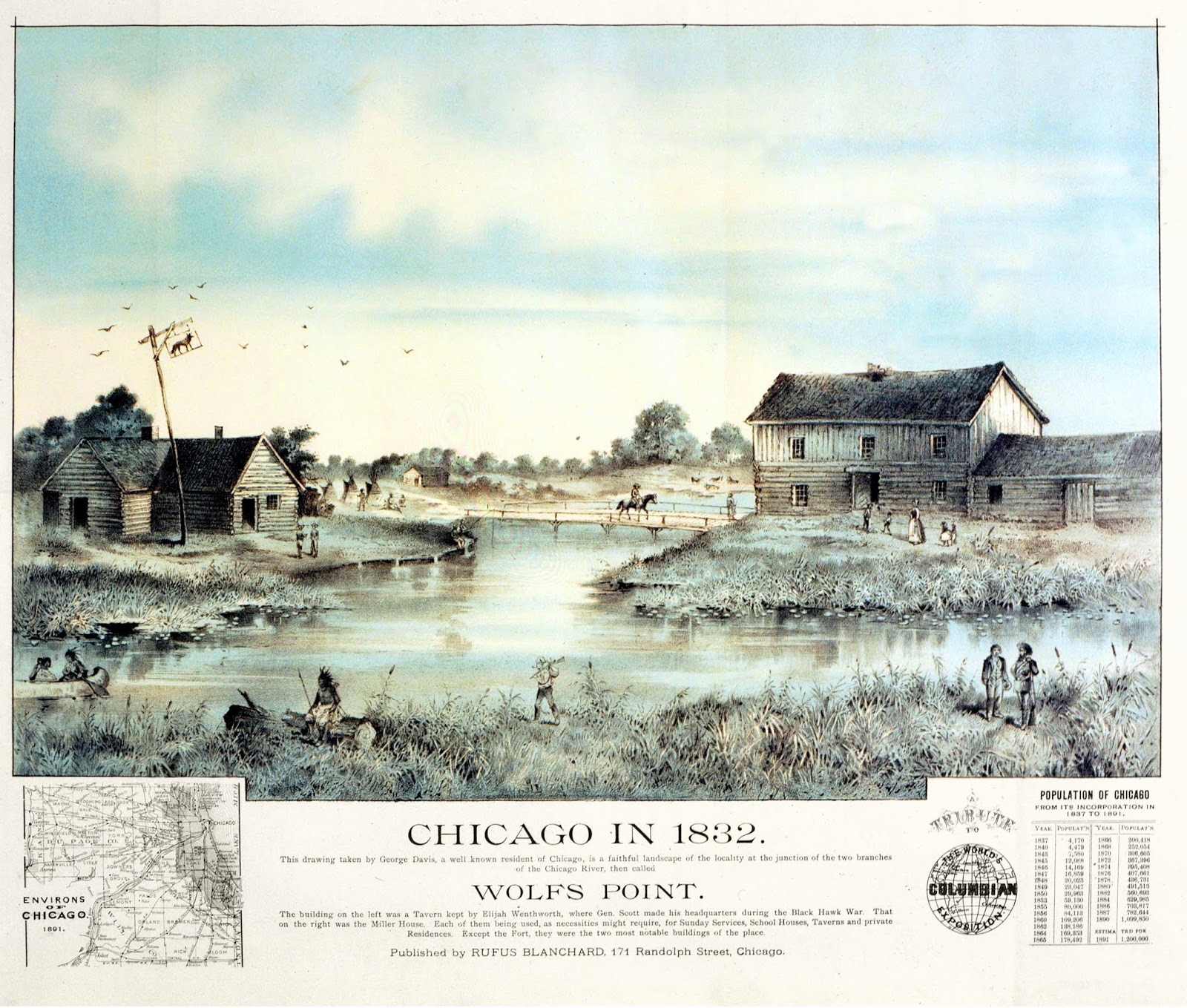
Another reason for the building of Fort Dearborn was the presence of the Native Americans, mainly members of the Potowatami tribe. The American attitude toward the land on this continent was that all of it was open to settlement without regard to any earlier inhabitants. In these early days of the seventeenth century, the number of settlers was small due to the difficult swampy and muddy terrain around Chicago which made it almost inaccessible much of the year. But advances in transportation, including planned canals, promised to open the flood gates to more American pioneers. The US government was looking ahead and this posed problems for the original peoples who had long occupied this land. Before long, tensions erupted and skirmishes broke out that culminated in 1812 with the Potowatamis burning Fort Dearborn

This attack was the beginning of the end for the tribes living in this area. President Andrew Jackson signed the Indian Removal Act in 1830 which legalized the driving of Indians to reservations west of the Mississippi. A steady stream of settlers would soon be coming to start building a village out of the mud.

By Rufus Blanchard, from drawing
by George Davis http://publications.newberry.org/
frontiertoheartland/items/show/155, Public Domain,
 https://commons.wikimedia.org/w/index.php?curid=50827303
This time in American history, the 1820s and 1830s is when the Chicago area started its journey to become a magnet to entrepreneurs who were drawn to the promise of this village with its geographic position as a transportation hub that made it the center of the Midwest economy for many years.  We will cover this period in the next post – “The Early Europeans and Americans who Settled the Chicago Area.”

Notes
The Chicago Portage and Laughton Trading Post Area, "The Waterway West", June 1975, online, http://drupal.library.cmu.edu/chicago/node/132
2 Encyclopedia of Chicago, “Fur Trade,” online, http://www.encyclopedia.chicagohistory.org/pages/492.html 

Monday, August 13, 2018

Locating an Ancestral Homeland in Ireland

In an early Chicago history from 1912, Josiah Seymour Currey mentions James Carney as one of the earliest Irish settlers in the muddy, swampy area that was to become Chicago. He joined with other intrepid and enterprising people (including Native Americans, French Canadians, the offspring of the unions between French and Native Americans, and Americans from other established cities and towns) to build a village that would become a great metropolis in a few decades.

Fort Dearborn & Chicago in 1831.jpg,
probably engraved from a sketch by Juliette Kinzie, wikimedia

James Carney is listed in the Robert Fergus’ Chicago Directory, 1830 as having a “grocery and provision store, 133 Lake Street.” p. 9 A Patrick Timoney is listed as a laborer, boarding with James Carney. p. 33.

As mentioned in a previous post, this James Carney was a merchant, grocer, and finally a brewer in the 1830s-1850s in Chicago. He belonged to a stellar group of early businessmen who laid the economic foundations for the young city. But who was this Irish Chicagoan? Where did he come from in Ireland? Or did he come from Northern Ireland? On the map below, Northern Ireland is at the top right and the rest of the country is Ireland.

https://upload.wikimedia.org/wikipedia/
commons/archive/d/d7/20070313214912%21Ireland.svg

Where did he learn the trading, marketing, operating, brewing skills that brought him such success in Chicago? With whom did he associate in Chicago? This became my challenge – learning as much as I could about James’ life in Chicago from available records and maybe getting some clues as to where in Ireland James Carney was born and lived until his emigration to America. In a later post I will explore possible connections between James and John Carney, my great great grandfather.

If you have done any research on your Irish American ancestors, you have probably faced this obstacle: a minimal number of records both here and across the Atlantic. If you’re lucky, you might have a family bible, oral histories, photos, or maybe an heirloom or two. In my case I had none of the above about James Carney. Despite the scarcity of official records, the fact that James participated in local politics and joined in some social groups earned him a mention or two in some local histories of Chicago. Let’s start there.

James Carney was an early Irish immigrant and successful merchant who recognized that participation in local politics could be an entry into acceptance as an “American.” In 1840 he ran for alderman of Chicago’s second ward and was elected as noted  on p. 102 in M.L. Ahern’s Political History of Chicago: 1837-1887.

In addition to his work as a businessman and his political service, James also showed a passion for the independence of his birth country. In the 1844 Chicago City Directory, reprinted in 1902 by Ellis and Fergus, he is listed as the treasurer for The Chicago Repeal Association. This group’s mission, as was of the original group in Ireland, was to advocate for the repeal of the 1800 Acts of Union that joined England and Ireland into United Kingdom of Great Britain.

James was also active in the intellectual life of his Catholic parish of Old St. Mary’s. The photo below is the third structure of the church which was built on Madison and Wabash in 1842.

St. Mary's Cathedral of Chicago, from Robert N.
Dennis collection of stereoscopic views.jpg;
NY Public Library, digital ID G90F170_001F

The 1844 City Directory lists him as the treasurer of the Catholic Library Society (p. 68) I could find no information about this society after a google search and an inquiry to the Archdiocese ofChicago. But the name of the society, the fact that it met in the basement of Old St. Mary’s Church, and the time of its existence (1840s) provide some clues. At this time in Chicago’s early history, public libraries were non-existent. It wasn’t until after the Great Fire of1871 that a public library system was created. Religious, civic-minded businessmen with an interest in both local, national and world affairs would require a comfortable and private place to read/discuss both Catholic and secular newspapers, magazines, and books.

We now have some knowledge of James Carney’s business, civic, and social footprint in early Chicago, but where did he come from in Ireland? To begin to answer this question, we need to re-visit that research technique called “cluster genealogy” that I discussed in my blog post  Immigrants to America tended to travel from the old country in groups of people known to each other. This historical phenomenon is known as "network migration."  (p. 83-84.) Once in America, they lived near the same people and others from their country of origin. Since we don’t know where James Carney lived in Ireland, maybe we can find out some answers from the people he lived with, worked with, and worshiped with. Who were James Carney’s associates? 

The 1850 Chicago, Cook, IL federal census provides a detailed look at James Carney’s household; we see who worked for him in the brewery and lived in his household: Patrick Timoney, Daniel McElroy, John O’Neill and Mary McGillen. But how long had these families been in community? Let's start with US records.

The earliest documents in Chicago of James Carney and allied families are in the marriage records from Old St. Mary’s Catholic Church in its second structure at Michigan and Madison.

Chicago History Museum, ICHi-37096.
J.H. Murphy, photographer
As early as 1836, James Carney and several Timoney family members are witnesses for weddings:

  • 10-01-1836 Marriage of Joseph Brown & Elsie Donnelly; Witnesses: Patrick Kelly, James Carney p. 8
  • 07-06-1837 Marriage of Denis McCarty & Marguerite McCloghart; Witnesses: Francis M. Crogha, Esther Timoney p. 9
  • 12-26-1837 Marriage of Lawrence Dorsey &Jane Strickland; Witnesses: William Dorsey, Catherine Timoney p. 10
  • 09-18-1839 Marriage of James Summer & Elleanor Summers; Witnesses: Patrick Duffy, Catherine Timoney p. 13

A researcher, who wishes to be anonymous, on the O’Neill and McGillen lines, found baptism records at St. Mary of the Assumption, (Old St. Mary’s on Wabash,) that reveal more connections among the families:
  • 1 Jan 1850 - Marriage of John O'Neill and Ann McGillen; Witnesses: Daniel McElroy & Bridget Carney
  • 15 Dec 1850 - Baptism of James Edward O'Neill; Sponsors: Daniel McElroy & Mary Timoney
  • 12 Nov 1852 - Baptism of Mary Anne (Mollie) Victoria O'Neill; Sponsors: James Carney & Ann Carney
  • 19 May 1854 - Baptism of Alice (Sr. Cornelia) O'Neill; Sponsors: Patrick Timoney & Margaret O'Kane

A pivotal point in the web of familial relationships is James Carney’s kinship to the McGillen line; he was the grand uncle of Edward McGillen, a fact that I found in a 1909 history of Chicago:
“Edward McGillen…came to Chicago (from Ireland) in the early 1830s when he was only eight years old. He was brought here by a grand uncle, James Carney, who was a merchant and traded with the Indians in Fort Dearborn days of Chicago history.” p. 712.

A geographic anchoring for Edward McGillen comes from a death certificate for his son, John McGillen, dated 01 March 1924 in Chicago, IL., stating that he was born in Fermanagh County, Northern Ireland.

Wikimedia, GNU Free Documentation
License, Fermanagh_Ulster.png 2007
(Fermanagh is in red, NI in bright green)


Thus we have established a family foothold in Ulster for James Carney’s grandnephew, our first placing of a cohort across the ocean.

The aforementioned researcher also shared with me that some of her McGillen ancestors lived in Leitrim County, Ireland in the townland of Kiltyclogher near the Fermanagh border. In the 1911 Ireland Census, a Bessie McGillen, age 74, is listed as mother of Patrick McGillen, age 39. Bessie’s birthdate puts the family in County Leitrim prior to 1837.

By Island_of_Ireland_location_map.svg:
Maximilian Dörrbecker (Chumwa)derivative work:
Rannpháirtí anaithnid (talk)derivative work: Mabuska
 (Island_of_Ireland_location_map.svg)
 [CC BY-SA 3.0  (https://creativecommons.
org/licenses/by-sa/3.0)],
via Wikimedia Commons
(County Leitrim is dark green)

What about the rest of the cohort families: McElroy, O’Neill, and Timoney? Did they originally hail from Northern Ireland, around Fermanagh near Leitrim or Tyrone? Dr. Tyrone Bowes has created a tool that was just right for me to use to begin my search. He made a geographical distribution of surnames in Ireland/Northern Ireland and plotted them on a map, and it is available for purchase on the website. 

To spread out this large map and see the names of your target families jump out at you is truly an awesome experience. Three names (McCarney, McElroy, and O’Neill) appear in the Northern Irish county of Tyrone (bordering on Fermanagh to the north) and the name Timoney is shown just across the northwestern border of Fermanagh with County Donegal.

With this information from Bowes site to orient me, I moved on to Griffith’s Valuation which is like a census in that it recorded where people lived and what property they owned in mid-nineteenth century Ireland. This record is arranged according to the levels of administrative units in Ireland/Northern Ireland: townland (village,) civil parish, religious parish, Poor Law Union (based on neighboring townlands around a central market town,) barony, and county. A civil parish often included more than one barony or county. The website Ask About Ireland provides free access to those who want to search Griffith’s Valuation. 

Where to begin my search in the database? I thought the best place would be the important clue we have: County Leitrim, near Kiltyclogher by the Fermanagh border, where the McGillens once lived. From here we might see if any of the families were in nearby Fermanagh also.

When we look name distribution in County Leitrim near Kiltyclogher and the Fermanagh border, we see an interesting picture. Members of the Carney family are found in two townlands in Leitrim County in the barony of Drumhaire. The first townland is Manorhamilton, in the Civil Parish of Cloonclare, which is 7 miles from the second townland of Cashel, in the Civil Parish of Killanummery. Members of the three of the four associated families all lived in the same barony between 5-9 miles of one of these townlands. One family lived in the barony of Roscloger which is only 6 miles from Manorhamilton. This can be shown more clearly on the map below. 

Map data @Google 2018

When we turn to the locations of Carney and associated families in County Fermanagh, we also find an intriguing picture. Carney family members settled in the townlands of Culky and Laragh, about five miles from the large market townland of Enniskillen. The other families all lived within 8-13 miles of Culky. As can be seen on the map below, Enniskillen is about 15 miles from the County Leitrim border.

Map data @Google 2018


The results of my search were no surprise; members of the five different families were scattered in, around and between the townlands of Kiltyclogher (County Leitrim, bordering Fermanagh) and Enniskillen in County Fermanagh near the Leitrim border.

I started this project with two goals:

  • To find out if the four families that lived in the Carney household in Chicago in the 1850 Federal Census might be known to each other before they came to the US
  • To find out where in Ireland/Northern Ireland James Carney was born and lived before his emigration to America.
I am very happy with how far I have come in my effort to find the homeplace of James Carney and his associated families in Northern Ireland. I have used Irish records to show that the five families did indeed live near each other in Northern Ireland along both sides of the border of County Leitrim near Kiltyclogher and up to Enniskillen in County Fermanagh. However, more research is needed to try to identify more exactly the Carney townland/village. In a subsequent post, I will explore the possible connections between James Carney and my great great grandfather, John Carney.


Labels: Irish, immigrants, Chicago, Ireland, Northern Ireland, Carney/Kearney, Chicago city directories, cluster genealogy, cohort, collateral families

Saturday, June 17, 2017

Chicago’s Earliest Industry – the Fur Trade

You never know where you will end up when you start researching some aspect of Chicago history, but it will certainly surprise you. This phenomenon happened to me when I was researching James Carney, a possible early Chicago (1820s-50s) Irish ancestor. I saw a listing in the 1839 ChicagoDirectory for James Carney, grocery and provision store. I wanted to find out what early grocery stores carried and what determined their choice of inventory.
 
In order to understand what kind of goods a merchant in early Chicago offered, one must first understand what his customers needed and wanted. And who were these customers? The Indians, living in the northeastern part of what was to become America and Canada, had long been trading furs and other items with each other.  The French were the first Europeans to enter the fur trade in the New World in the early 16th century and the Indians became their trading partners.

The trappers camp-fire. A friendly visitor,  
Published by Currier & Ives, 152 Nassau St., c1866,  
Library of Congress Prints and Photographs Division
Washington, D.C. 20540 USApga.00935/ 

The French traders realized that in order to gain access to the knowledge and the experience of the natives and to gain access to the fruit of their hunting grounds, they had to earn their trust.  Part of their outreach was for some of them to join the Native American community through marriage. 

Another reason for marrying into the Native American culture was that Indian women were used to life on the frontier unlike European women.When the English came into the fur trade after the French, some English traders also married Indian wives for the same reasons.

Since there were few Europeans other than traders and a native population eager to trade in northeastern Illinois and eastern Canada, the Indians formed the customer base of early trading posts and small grocery and provision stores.  It was the traders who started these stores as they knew the Indian through business and social connections. Most likely James Carney began his grocery with the Indian trade.

Fur trading with Indians,  By William Faden -
 Library and Archives Canada - originally from: Cartouche
 from William Faden, "A map of the Inhabited Part of Canada
 from the French Surveys; with the Frontiers of New York
 and New England", 1777, Public Domain,
We know that the Indian was the main customer for the early grocery stores, but what made him a very good trading partner?  To find out the details of the fur trade in and all around Chicago, I consulted four scholarly texts. The original source was one Alfred H. Meyer, who provided the first in chain of citations:


Dr. Meyer made an exhaustive study of the history of northeastern Indiana and northwestern Illinois from the time of the Native American through pioneer settlement in 1850, gives more detail on the Indian customer:
“Indians were the most profitable customers prior to 1840, for many of the white settlers ran accounts which some of them were slow to pay or sought to default. The Indians, on the other hand, most of whom were Potawatomi, periodically brought in large quantities of cranberries and bundles of furs which they traded for articles of food, clothing, or ornaments.”2
I now had some general idea of what the Indian customer desired when he came to trade.  But Dr. Meyer goes on to list the inventory of the “leading store (he doesn’t give us the name) in Chicago, at the corner of West Lake and West Water”:3


Three challenges appear with this inventory list. First, the large number of items in the inventory (108) makes it necessary to organize them in some way. I came across another inventory of the North West [Fur]Company in Grand Portage, MI from 1797 in a publication by Dr. Bruce White. The items were divided by function/material according in these categories: “Adornment, Alcohol, Ammunition, Amusement, Animals, Blankets, Cloth, Clothing, Food, Garden, Guns, Medicine, Powder, Tobacco, Tools, Utensils, and Writing.”4

The second challenge to the inventory list is the number of items that are unfamiliar to most modern readers. I researched each item and made a chart of definitions:


The third challenge to this list of inventory is locating the original source. Where did the list come from? My research path led me through the chain of citations, starting with Dr. Meyer. When I reached Charles Cleaver's research, I struck gold:
“After crossing the bridge,” [the bridge across the Chicago River at Lake Street called Lake Street Bridge] “at the corner of West Lake and West Water Streets, Bob [Robert A.] Kinzie …kept the largest store in town, though chiefly filled with goods for the Indian trade. There was beside Kinzie’s on the West-Side, but that would be about all, some three or four small groceries where liquor was retailed.” 12
I had now identified the owner of the large grocery store. I still had another challenge – locating the original source of the inventory list.
By the time I found Hurlbut’s research, I was worried that I might never find the source of the list.  On p. 28 Hurlbut began a section called “TheAmerican Fur Company” where he discusses how some old records (including account books) of this company now held at the Chicago History Museum.)

American Fur Cos. buildings. Fond du Lac (back view), 
1827, Library of Congress Washington, D.C. 
20540 US Am LC-USZ62-2087

Hurlbut  quotes several items from these records and at the end of the section, he prefaces the inventory with these words:
 “We will close this article by giving a catalogue of goods furnished for the trade of the Chicago country, fifty-three years ago." (Hurlbut wrote this in 1875, so 53 years past would have been 1822.)13
But Hurlbut gave no specific source within the American Fur Company documents. The closest that I could get to the actual source was an inventory of these records written for the Chicago Historical Museum by Robert D. Kozlow, American Fur Company records, 1816-1947. A search was done for me in the records at the Chicago History Museum but nothing came up except a similar inventory from another trading post, Lac du Flambeau of the North West Company in Wisconsin. More on-site search of the records must be done.

I have been very intrigued by the tastes of the Native American consumers at the early trading posts ever since I came upon the inventory for Robert Kinzie’s store in Chicago in 1833-34. Remember my ancestor James Carney had a grocery just a few years after (1839) in the same commercial area.

You can learn about the needs/wants of a people (a subject of great interest today to all the online retailers who track our purchases with cookies) by looking at what they purchase. How did the Indian traders prioritize the items they bartered for? According to E.E. Rich (see section “The fur trade and economic anthropology”) noted scholar on the fur trade in the Americas wrote:
“…the Indian would always supply himself first with powder and shot. After that would come what the trader would call ‘necessaries’ and what we would call luxuries—tobacco, spirits, gay cloth of different kinds, beads and caps with articles such as ice-chisels, snow-glasses, and hatches varying in  priority.”14
By Unknown artist from 1800 According to Getty Images - 
Historic image from the Hulton Archive, 

There has been much research and discussion of the effect of alcohol on the Indian tribes. In many sources one reads of how the fur traders took advantage of the Indian customer by plying him with alcohol. But this has been questioned by other sources:
“Perhaps surprising, given the emphasis that has been placed on it in the historical literature, was the comparatively small role of alcohol in the trade. At York Factory, Native traders received in 1740 a total of 494 gallons of brandy and “strong water,” which had a value of 1,976 made-beaver. More than twice this amount was spent on tobacco in that year, nearly five times was spent on firearms, twice was spent on cloth, and more was spent on blankets and kettles than on alcohol. Thus, brandy, although a significant item of trade, was by no means a dominant one. In addition, alcohol could hardly have created serious social problems during this period. The amount received would have allowed for no more than ten two-ounce drinks per year for the adult Native population living in the region.”15
Professor Rich mentions the difference between European perspective and values and those of the Native American throughout the article. Much of the tension between the fur trader who wanted more furs and the Indian (who was usually not the hunter but the middleman) who provided them came about because of a difference in culture. The Indian was interested in the here and now and would only bring sufficient furs to satisfy current needs, a prevailing view of the Europeans involved in the fur trade and expressed by Andrew Graham, who began working for the Hudson’s Bay Company in 1749:
“…the Indian annually could get hold of between seventy and a hundred made-beaver in furs without effort. For seventy made-beaver he could fully satisfy all the wants which he would anticipate before he next came down to trade  and the other thirty for waste and dissipation were all that he had time to spend before he had to leave the plantation and begin his journey inland again. ”16  
From this research project to find the source of the inventory list, I learned how ethnocentrism can cloud even scholars’ eyes as they analyze records and draw conclusions about different cultures. I was fortunate to find Dr. Rich’s study on how the Native American culture differed from the European and how this influenced the trade between them.

I also learned how much the fur trade played in the economic beginnings of northeastern Illinois (including Chicago,) northwestern Indiana and Canada. Before the railroads, the meat packing industry and the factories built the Chicago we know today, there was the fur trade that laid the foundation for the future economic blossoming of the city.

By Arthur Heming  

National Archives of Canada,

C5746http://www.canadianheritage.org/
images/large/20061.jpg, Public Domain, 

Thirdly, I learned about a pitfall of research and citation. It is very important for a writer to include the original source of a record that he/she cites. In his 1881 publication, Henry Hurlbut gave the original source of the Chicago store inventory as part of the American Fur Company accounts. But researchers that came after him did not include the provenance of the inventory in their publications.

Finally, from the inventory list, I learned what my possible grocer ancestor James Carney may have carried in his store around 1839. But he wasn’t in the grocery business for the long haul. In 1840 he opened a brewery, one of the earliest Chicagoans to do so. He probably faced two facts in making this decision: 
  1. the fur trade with its profitable and reliable Indian customer base was coming to an end
  2. beer was a popular product with the growing number of European immigrants and American-born persons flocking to Chicago 

Endnotes
1A.Gottfred,  “Art. II. Femmes du Pays: Women of the Fur Trade, 1774-1821” (Northwest Journal, http://www.northwestjournal.ca/XIII2.htm) p. 12
2 Solon Robinson, Solon Robinson, Pioneer and Agriculturalist; Selected Writings, ed. By H.A. Kellar, 2 vols. (Indiana Historical Bureau, 1936) quoted in Alfred H. Meyer, “Circulation and Settlement Patterns of the Calumet Region of Northwest Indiana and Northeast Illinois: The Second Stage of Occupance – Pioneer Settler and Subsistence Economy, 1830-1850.” Annals of the Association of Geographers 46 (3): 312-356, 1956, p. 349.
3 Alfred H. Meyer, “Circulation and Settlement Patterns of the Calumet Region of Northwest Indiana and Northeast Illinois: The Second Stage of Occupance – Pioneer Settler and Subsistence Economy, 1830-1850.” Annals of the Association of Geographers 46 (3): 312-356, 1956, p. 349.
4Bruce M. White, “Grand Portage National Monument Historic Documents Study,” (Turnstone Historical Research, March, 2004), pgs. 83-101.
5John Splinter Stavorinus, Voyages to the East Indies, 3 volumes, (London. G.G. and J. Robinson, Pater-Noster- Row, 1798) I: 519 (books.google.com)
6The Compact Edition of the Oxford English Dictionary: Complete Text Reproduced Micrographically. Oxford [England: Oxford University Press, 1971. Print. 1:1833)  (http://bit.ly/2rdgfza)
7Ibid., 1:1230
8Ibid., 1:334
9Ibid., 1:1178
10"Appendices to 'The History of Fort Langley, 1827-96, Canadian Historic Sites No. 20, Appendix E, 1973, Mary Cullen, Parks Canada, Dept. of Indian and Northern Affairs, Ontario, Canada, p. 72
11Carolyn Podruchny, Making the Voyageur World: Travelers and Traders in the North American Fur Trade, (Lincoln, NE, University of NE Press, 2006), p. 124.
12Dena Evelyn Shapiro, dissertation “Indian Tribes and Trails of the Chicago Region: A Preliminary Study of the Influence of the Indian on Early White Settlement” (Master of Arts dissertation, The University of Chicago, March, 1929), p. 53.
13Charles Cleaver, Early Chicago Reminiscences, 1833 (Chicago, Fergus Printing Company, 1882) p. 27.
14Henry Higgins Hurlbut, Chicago Antiquities: comprising original items and relations, letters, extracts, and notes, pertaining to early Chicago (Chicago, IL, privately printed, 1881) p. 36.
15E.E. Rich, “Trade Habits and Economic Motivation Among the Indians of North America” The Canadian Journal of Economics and Political Science, Vol. 26, No. 1 (Feb., 1960), pp. 35-53 (Ottawa, ON, Canadian Economics Association) p. 45.
 16 Ibid., p. 53
 17Carlos, Ann and Frank Lewis. “Fur Trade (1670-1870)”. EH.Net Encyclopedia, edited by Robert Whaples. March 16, 2008. URL http://eh.net/encyclopedia/the-economic-history-of-the-fur-trade-1670-to-1870/


Thursday, May 12, 2016

1909 Greektown Chicago -- You are There

One of my most fervent wishes is to get as close to my ancestors as possible. I yearn to look into their apartment windows, listen to their dinner conversation, or shadow them as they go about their daily work. Perhaps what I want most is to sit with them and ask questions:  what made you leave your birth country, where did you settle in the US, what were your communities like in America, and what did you do for entertainment?

I came closer to my ancestors than ever before when I discovered a journal article on JSTOR by Grace Abbott, “A Study of the Greeks in Chicago,”

Grace Abbott, 1878-1939, 1930 Nov. 17, 
LC-USZ62-73282, 
Library of Congress Prints and
 Photographs
 Division Washington, D.C. 
20540 USA

published in 1909. (Note: for more information on JSTOR, please see my post of Sept 30, 2014) Not only did Ms. Abbott live in Chicago during the times my Greek ancestors were there, but she studied Hull House census data gathered from the Greek community and then wrote about her findings. As I read her piece, I found answers to some of my questions about the lives of the Greek immigrants to Chicago, including my great grandfather Peter Flessouras, who came to America in the late 19th and early 20th centuries.

From my research, I know that Peter Flessouras came from Pigadakia, a small village south of Tripoli in the Peloponnese area of Greece. (Please see my post of Nov 16, 2015 to see maps of Peter’s Greek homeland.) 

But I didn’t know until I read Abbott’s Study that:
 “Most of the Greeks who come to the United States (were) from the Peloponnesus.” (p. 380) 
This area of Greece has so much rocky terrain that farming is difficult. When my husband and I visited the Peloponnese in September of 2015, we saw this challenging terrain.

View of terraced land once used for
farming in Vatheia, taken
by Bert Schuster, Sept 2015

With agriculture as the principle means of livelihood at that time, the lack of good crop land led to a larger migration from the Peloponnese than from other parts of Greece where the soil was more conducive to farming. This small piece of geographical information partially answered my question to my great grandfather: why did you leave Greece?

Ms. Abbott also reveals an interesting behavior of Greek immigrants: 
“All of them talk of ‘the Athens’ as though it had been their home, but although it belongs to them in a very intimate sort of way, very few of them have ever seen it. For example, out of 424 who live within a few blocks of Hull House 205 came from Sparta, 102 from Tripolis, and 5 from Athens. Moreover, most of those who say they came from Sparta and Tripolis, have not really lived in those towns but in the country villages nearby.” (p. 380)
I can see why my great grandfather might say he was from Tripolis as no one outside of his community would have heard of Pigadakia, 15miles south of there. 

Ms. Abbott provides a fact about the life of my ancestors in Greece that I did not know: 
“There is peasant proprietorship of land in the Peloponnesus and most of those who emigrate have lived on small farms which they owned and worked for themselves.” (p. 385) 
So, my Greek ancestors were not tenant farmers as my Irish and Swiss forebears likely were. 

Perhaps this experience working for themselves helped steer the Greeks into areas of the American economy that would allow them to be more independent than if they went to work in factories.

I have heard from talking with Greek Americans that an entry-level job for Greek immigrants, as for many other ethnic groups who came to America, was working on the railroad. Ms. Abbott confirms this:
 “Like other foreigners most of the Greeks must first serve an apprenticeship in the gangs that do the railroad and general construction work for the country.” (p. 386) 
Steam shovel doing construction work for the Western
 Pacific Railroad, Thompson, P. J., 1906, LC-USZ62-29487,
  Library of Congress Prints and Photographs Division
 Washington, D.C. 20540 USA.

But the fierce desire for independence and an entrepreneurial spirit which the Greeks brought from home combined to make their time on the railroad
 “…shorter than with most nationalities.” (p. 386) Within a short while “…he has learned some English and has accumulated enough money to venture on a small commercial enterprise for himself. He becomes a peddler, perhaps later owns a fruit-stand and finally an ice-cream parlor.” (p. 386)
Since there were no farms in early 20th century Chicago, Greek farmers adapted to their new conditions by peddling food instead of growing it. Some photographs from the Library of Congress’ Prints and Photographs Division show how peddling foods was not unfamiliar to Greeks. (Note: I came across these photos on the internet but did not know their source. I sought the help of Maureen Taylor who is known as "the photo detective" for her skills in photo identification. Thank you, Maureen, for identifying the source of the following two photos.)


Poultry pedlar in Greek costume, Athens, Greece, c1895,
 LC-USZ62-65904, Library of Congress Prints and Photographs
 Division Washington, D.C. 20540 USA.

Areopagus and Theseion, N.W. form Athens, toward sacred way to
 Eleusis, c1907 Jan. 31, LC-USZ62-66122, Library of Congress
 Prints and Photographs Division Washington, D.C. 20540 USA.

Peter Flessouras described himself as a peddler and huckster on several birth records of his children and on the 1910 Chicago, Cook, IL federal census. However, unlike many of his cousins, he did not progress to become the owner of a grocery, a candy store or a restaurant. Here is a photo that could have been my great grandfather:

Street peddler pushing his cart past Kentron Cafe and Mouzakiotis
 Music Store on Halsted St., courtesy of the
National Hellenic Museum, Chicago, Illinois

Another question that tugs at my mind: what kinds of institutions did the Greeks build in their new American communities? Again, Ms. Abbott provides an answer:
 “The largest settlement of Chicago Greeks is in the nineteenth ward, north and west of Hull House. Here is the Greek Orthodox Church, a school supervised by the priest in which about thirty children are taught a little English, some Greek, much of the achievements of Hellas…here too, is the combination Greek bank, steamship ticket office, notary public, and employment agency, and the coffee-houses, where the men drink black Greek coffee, play cards, speculate on the outcome of the next Greek lottery, and in the evening sing to the accompaniment of the Greek bagpipes or -- evidence of their Americanization -- listen to the phonograph.” (p. 380)
As part of the Hull House papers, period photos were taken that add to the data collected from door-to-door interviews conducted by census collectors trained by Hull House. Fortunately, some photos from the Hull HouseYearbooks of the early decades of the twentieth century are online, thanks to the University of Illinois at Chicago. These add to Ms. Abbott’s description of the activities that the Greeks pursued after hours:

A Group of Greek Wrestlers – Hull House Gymnasium,
6375.JPG, Hull House Yearbook, 1927, p. 39,

Hull House Yearbook, 1910, p. 24, 
http://collections.carli.illinois.edu/cdm/ref/collection/uic_hull/id/275

In conclusion, genealogists seek ways to connect with their ancestors. Since we are physically unable to talk with those who have passed away, one tool that enables us to “visit” the times our ancestors lived is through contemporary written and photographic materials. Journals from our target time period can be very useful in building a picture of vanished lives. JSTOR provides a way to access many such journals.