Pages

Saturday, September 19, 2020

Irish on the Move

 Hello to all my readers! I wanted to wish you health, safety and well-being during these times of the pandemic and economic disruption. I have not been writing on my blog during the last year (July 2019 – August 2020) but I have been working on my Carney/Kearney and Duffy lines, trying to locate where they may have lived in Ireland. From this research, I have discovered several sources and information that may be helpful to others on this journey.

As preparation for my research into possible ancestral home places in Ireland, I studied the map of Ireland and started reading Irish history.
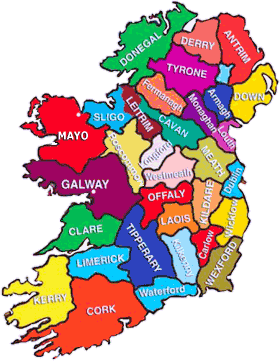
Ireland_map.gif, Created by George McFinnigan, 26 February 2006, Wikimedia.

I realized that I didn’t know anything about the movement of people within Ireland over the years. This knowledge would be critical in my quest to trace my lines in the country.

In my experience, when American scholars write about Irish history, they focus on their coming here and especially concentrate on the Great famine of 1845-1849. And this is to be expected as the American public wants to know about this time period because, according to the Library of Congress:

 “Between 1820 and 1860, the Irish constituted over one third of all immigrants to the United States. In the 1840s, they comprised nearly half of all immigrants to this nation.”1 


On board an emigrant ship - the breakfast bell immigrants on ship deck, 
1884, LC-USZ62-60319 (b&w film copy neg.) 
Library of Congress Prints and Photographs.

Also, humans are ethnocentric and naturally like to tell their stories from their point of view as this cover of Harper’s magazine shows: the people of Ireland are beseeching America for help:

Nast, Thomas, Artist. The Herald of relief from America / 
Th. Nast. Ireland, 1880. Photograph

With this said, when you want to find where in Ireland your ancestors came from, you need another focus. You want to learn about movement of people within Ireland rather than from Ireland. In other words, you are looking for internal migration. A basic question comes to mind: What factors caused people in Ireland to move to different parts of the country? The answer is the same for all humans throughout history. People move to gain better access to food and/or to escape war and violence.

A key contributing factor to the difficulty the Irish peasant faced in growing sufficient food over several centuries was the practice of various English monarchs (before them the Anglo-Saxons) of  making large land grants in Ireland, called plantations, to favored followers. 

Wikimedia Commons contributors, "File:Flight of the Earls.jpg," 
Wikimedia Commons, the free media repository,  
title=File:Flight_of_the_Earls.jpg&oldid=444543400
 (accessed September 19, 2020).

In some cases, the government sought a policy of replacement/displacement where English farmers were brought in (or “planted”)  to help in “Making Ireland British.” These newcomers pushed out the native Irish who often had to move to less fertile, more boggy land. In other cases and other times, the landowners remained in England and hired landlords in Ireland and overseers to supervise their Irish tenants. These middlemen, driven by a desire for high profits, would regularly raise the rent so that poorer tenants were displaced by those with more ability to pay.

Thus we see the causes of internal migration in Ireland, and we can find eye-witness accounts to this movement in the travelogues of Arthur Young who toured Ireland from 1776 to 1779. 

Portrait of Arthur Young (1741-1820) British economist 
and man of letters, by John Russell, 1794, 
National Portrait Gallery, Wikimedia.org

Young was interested in how people lived in the countryside, how they made a living from the land. He noticed that the Irish tenant farmer had no qualms about how much his labor was worth and would “vote with his feet” when he believed that his landlord was not paying a proper or market rate:

“Whole families in that country will move from one place to another with freedom, fixing according to the demand for their labour, and the encouragement they receive to settle.”2   

Now that we have outlined the reasons for the internal migration in Ireland, we need to understand some patterns or geographic directions of this movement in order for this information to help us see how our ancestors may have moved through the country at different times over centuries. I turned to a seminal work on Irish migration by Patrick Fitzgerald and Brian Lambkin, Migration in Irish History, 1607-2007. 


Migration in Irish History, 1607-2007 by Patrick Fitzgerald,
goodreads.com, spring.com, google images

Fitzgerald divides the period from 1607 to 2007 into fifty year chunks and for each he discusses what happened in each of the three types of migration: immigration, internal migration and emigration.

For our purposes, we need just an idea of the general direction of movement within the country or internal migration. One of the fundamental patterns of internal migration is most countries, including Ireland, since the Industrial Revolution is people moving from rural areas to larger towns and cities. From the early 1800s onward tenant farmers saw new opportunities in factories and in the service sectors that grew up to meet the needs of the more prosperous urban inhabitants.

Underwood & Underwood, P. (1903) Modern Looms for fine texture hosiery
 in a factory at Balbriggan, Ireland. Ireland, 1903. [Photograph]
 Retrieved from the Library of Congress, https://www.loc.gov/item/2020681993/.

 An important note for genealogists about this pull of the city is that country migrants would mostly travel to the nearest town or city and would usually remain in the same county. (end note: Fitzgerald p. 138 and 155.) How will this knowledge affect my research in Ireland? To start with, let’s see what I have accomplished so far.

Before I began thinking about the movement of people within Ireland, I was concentrating all my efforts in Ulster and adjoinng counties for reasons that I discussed in  my post of August 13, 2018, I noted how I used Dr. Tyrone Bowes’ surname distribution map, Griffith’sValuation and the 1911 Irish Census to place Carney and cohort families in the Irish counties of Leitrim  and Fermanagh. I was now ready to look more widely at Irish counties.

I was scouring the internet for Irish genealogical sources during the early days of the Coronavirus Pandemic, when I came across the National Archives of Ireland (NAI.)

CC BY 3.0, https://en.wikipedia.org/w/index.php?curid=23958509) 

  Because the building was closed to the public due to the virus, the Archives was offering a special opportunity:  researchers could send them an inquiry for free (as of my checking on the site on September 11, 2020, the Archives is now open on a limited basis.) I was so excited. This was a chance to canvas all the counties of Ireland. I submitted a list of individuals that had immigrated from Ireland and ended up in Chicago by the mid-1800s who were associated with my great, great grandparents, John Carney/Kearney and Mary Duffy.

Some weeks later, I was excited to hear back from the NAI with this information:

Civil marriage record from www.rootsireland.ie , found by NAI, April 2020.

This one record contains so much new information. In addition to identifying a couple of the same names and similar ages to my great great grandparents, the record presents a whole new county to research -- Sligo. I will take up the analysis of this new information in my next post. 


Map of the Baronies of Ireland in 1846. 
Source data: Ordnance Survey of Ireland: Baronies 2011 
(OSI), author: XrysD, 21 July 2018.

As tantalizing as it is to think this couple from Sligo are my ancestors, as every genealogist knows, this could be just a coincidence. In the response to my inquiry, NAI staffer suggested that:

 “We should not jump to conclusions that this is definitely your ancestors but rather should seek to prove or disprove this record.”

A second suggestion from the NAI was to look at US records. Oh, how hard I have tried to find some! I will discuss what US sources I have rigorously studied over the past twenty years in my next post as well.

In conclusion, Americans who study their Irish roots often encounter source material focused on the Great Famine of 1845-1849 and its effect on immigration to America. But if you wish to investigate where your Irish ancestors came from in the centuries before and up to the Famine, you need to focus on internal migration in Ireland over the centuries.

1https://www.loc.gov/classroom-materials/immigration/irish/irish-catholic-immigration-to-america/#:~:text=Between%201820%20and%201860%2C%20the,all%20immigrants%20to%20this%20nation.

2Young, Arthur, 1741-1820, John Parker Anderson, and Arthur Wollaston Hutton. Arthur Young's Tour In Ireland (1776-1779). London: G. Bell & Sons, 1892. Vol. 2, p. 119.


Friday, July 12, 2019

Immigration to America

Immigration is a world-wide issue today, but it is not new. Throughout human history, people have been migrating to other places. This movement of people has always fascinated me. One particular migration of people has been of most interest to me, and that is across the Atlantic to America that began long before 1776 when this country was founded. As a descendant of a passenger on the Mayflower on the paternal side and the granddaughter of a Czechoslovakian-born naturalized citizen on the maternal side, I am the proud and appreciative product of immigration. And I am not alone. Most Americans today are descendants of immigrants who withstood brutal conditions as they crossed the Atlantic.

On board an emigrant ship - 
the breakfast bell immigrants on ship deck, 
1884, Library of Congress Prints and 
Photographs Division Washington, D.C. 20540 
USA, LC-USZ62-60319

I believe America owes much to the millions of immigrants who have come to this country. They have given their raw labor to build the infrastructure that is the foundation of our nation: the canals, the railroads, the roads. Although the jobs available to new arrivals have changed through the decades and the centuries, the contributions of immigrants have always been essential to the strength of America. Let’s take a look at what conditions cause immigration. Why did Europeans, starting in the 1600s, emigrate to the Americas? 

From reading Marcus L. Hansen’s book The Atlantic Migration  and from ideas formed over years of reading about immigration to America, I have reached several conclusions. The reasons for emigration were mainly economic (worsened by population growth), but people also left their birth countries seeking to avoid religious persecution and forced conscription. I discussed the “push” and “pull” factors that influence the movement of people in my post of April 19,2014.

“Descriptive portraiture of Europe in storm and calm….,”  
Edward King, 1886, C.A. Nichols, 
Springfield, MA, https://www.flickr.com/photos/
internetarchivebookimages/14595849259/ 

The economic push factors first centered around agriculture. For much of the time that humans have been on this earth, raising crops has been the main way of survival. And anyone who has tried to grow a garden can attest to the effect weather has on the harvest. For thousands of years, people have been at the mercy of the elements as they try to grow enough food to pay the landlord and feed their own families. Droughts, floods, insect infestations, worn-out soil and other natural events have brought devastation and starvation and driven people to seek new land.

It was not until the 18th century with the dawn of the Industrial Revolution in England that the majority of the population would become less dependent on farming for their livelihood. The Industrial Revolution caused a shift in the economic paths people took to sustain their families. Although agriculture remained paramount to the sustenance of most people, small cottagers benefited from advances in transportation to increase markets for their hand crafts (spinning, weaving, knitting) to supplement what they could raise on their small parcels of land.

Irish spinner and spinning wheel.
County Galway, Ireland,
between 1890 and 1900,
Library of Congress, Prints and Photographs Division, 
Washington, D.C. 20540 USA, hdl.loc.gov/loc.pnp/pp.print

Mechanization slowly developed and factories began pulling people from their homes.
Walton, Perry, The Story of Textiles, 1912,
 J.S. Lawrence, Boston, MA, p. 166-A
The movement of poor peasants to factory work did not relieve their poverty (due to low wages) and overcrowding in urban areas led to the spread of disease. The health and life expectancy of the new factory workers suffered from conditions brought about by mechanization, including exposure in enclosed spaces to air full of toxins from textile production and injuries from machines. As we have seen, poor economic conditions played a big part in the urge for people to look for opportunities somewhere else. 

From the early 1600s through the early 1900s, the “New World” (as it seemed to the Europeans) functioned as a safety valve for people from Europe who were fleeing the situations caused by the events mentioned above. Other things also “pushed” people to leave their birth countries. These include the intermittent warring between European countries that made daily living for people precarious: food shortages, more taxes to pay for military activity, and forced conscription were factors that encouraged emigration.

“Descriptive portraiture of Europe
in storm and calm….,”
  Edward King, 1886, C.A. Nichols,
Springfield, MA, https://www.flickr.com/photos/
internetarchivebookimages/14595830779/

The lack of religious freedom was one other push factor that led people to leave Europe and sail across the Atlantic to America. 

This discussion of push and pull factors leads us to ponder how emigration affects both the sending (home) country and the receiving  (destination) country. The effects of immigration (economic, cultural, social) on America is right now and historically has been the cause of heated debate and sometimes violent protests all the way back to colonial times. In a post from July 9, 2014, I discussed the anti-immigrant movement symbolized by the Know Nothing Party  which was born and became popular at a time of high immigration of poor, unskilled Catholics from Ireland.

 How American-born or even many naturalized citizens feel about new immigrants often stems from fear of the outsider: will our language/culture be lost, will our society be taken over by foreigners, will our jobs be lost?  What never seems to enter the equation are two factors. First, history has shown that the children of immigrants nearly always embrace this country with its language, culture and government as their own. Second, the immigrant generation provides labor for jobs that many native Americans do not want.

Know-nothingism in Brooklyn, 1881, Illus. in: Frank Leslie's illustrated newspaper,
 vol. 51 (1881 Jan. 15), p. 340, 
Library of Congress Prints and Photographs 
Division Washington, D.C. 20540 USA

America has been eager to accept immigrant labor for more than three centuries, but many Americans have not been as willing to welcome them into the fabric of our society. Joseph Connor wrote an excellent article in "American History Magazine,"1 chronicling American sentiment toward immigrants since our nation began. Connor shows that the American people’s vacillating  relationship with immigration often coincides with economic shifts in the economy. This view is corroborated by Eytan Meyers in his study2 of immigration policy, where he states that laws restricting immigration were passed during the recession of 1882-1885 and again during the depression of 1891-1897.

Politicians and others have long tried to understand and sway public opinion. And one of the best ways to grab the public’s attention is through images. With the advent of newspapers and magazines, would-be movers and shapers of popular belief found a successful tool in the art of political cartooning. The political cartoon also functions on the back end to capture the prevailing mood of the citizenry, actually responding to the public’s attitude to many things, including immigration, at different points in our history.

Joseph Connor included two political cartoons in his piece that clearly show how public opinion on immigration parallels economic downturns. One can ask several questions of these cartoons. Do they convey just the opinions of the artist? Does the artist attempt to capture the widespread feelings/fears/beliefs of the day? Is the artist conveying the opinions of one political party or another? Is the artist simply portraying the feeling of the publication paid for his/her work?

The title of the first cartoon, “Columbia's Unwelcome Guests” gives us a big clue as to the sentiment behind the drawing. Frank Beard was the illustrator, and the cartoon was published in 1885 by Judge Magazine at the tail end of a four year recession. In the drawing, Mr. Beard depicts multitudes of immigrants from the sewers of Germany, Russia, and Italy pouring across the Atlantic and breaching our shores. As you can see from the labels he places on the newcomers, (Socialists, Communists, Anarchists, Dynamiters) Beard shows them threatening the law and order of America.

'Columbia's Unwelcome Guests.' American cartoon by Frank Beard, 
1885, showing unrestricted U.S. immigration policies
 encouraging the arrival of anarchists, socialists, 
and the Mafia from the sewers of Italy, Russia, 
and Germany; used by permission under  2019 

The title of the second cartoon, “Where the Blame Lies” by Grant T. Hamilton is a not-so-subtle condemnation of immigrants also. It was published in 1891, (the beginning of a seven-year depression) in Judge Magazine. Hamilton goes a bit further in his name-calling as he links political movements, crime and poverty to certain nationalities: German Socialist, Russian Anarchist, Italian Vagabond, English Convict, and Irish Pauper. Perhaps the saddest part of the cartoon is the Statue of Liberty is pictured in the background.

Hamilton, Grant E., Artist. Where the blame lies / Hamilton. 
Castle Clinton New York United States, 1891. 
New York: Sackett & Wilhelms Litho. Co., 
April 4. Photograph. https://www.loc.gov/item/97515495/.

In conclusion, humans have been on the move for centuries. Many reasons spur this movement, and we have mentioned some of the major ones in this post in our discussion of immigration to this country. Throughout its history, America has been the beneficiary of the labor and the many other contributions that newcomers bring. Let us never forget this.

Wednesday, December 19, 2018

Chicago Settlers: The Europeans, Métis and Americans


Two barriers to settlement of the near empty, muddy, swampy site called Chicago were removed between 1825 and 1833.  This removal caused a trickle of settlers to turn into an unstoppable torrent of humanity within a decade. The development of Chicago would mirror what had already happened on the east coast after. People came from Europe and settled the first area they found on the Atlantic coast, children were born and grew up. Then they looked for land. Go west, became the watchword. But mountains, swamps, and the indigenous peoples who already occupied the land were challenges to the westward movement.

By Chicago Lithographing Company, United States Library of 
Congress's Prints and Photographs division, 
digital ID pga.03605. 1867, Public Domain, 
https://commons.wikimedia.org/w/index.php?curid=44965951)

Two factors made it difficult for Americans east of Chicago to make the trip. First, the Indian population showed their objections to white settlers moving into their land by frequent raids. Second, no direct land or water route to Chicago existed. But these impediments were not to stand.

First, the US government made a two-pronged policy to discourage the Indian population from remaining in the area: soldiers were sent to raid the villages and treaties were made with promises of land west of the Mississippi. By the early 1830s, most of the Potowatami people were forced out. With the IndianRemoval Act of 1833, one barrier to new settlement of the Chicago area was now gone.

The next barrier to fall was the geographic difficulties facing those who wanted to settle in the area. Americans coming from New England, New York and New Jersey had no roads to travel overland to Chicago. They had to rely on water transportation, but there was not a direct unbroken route. Finally in 1825, the Erie Canal made it possible for travelers to come by boat from the East Coast to Chicago via the Great Lakes.  This new route to Chicago brought in many settlers although an additional canal and other improvements would be necessary to really open up the way.

As we noted in a previous post of February 16, 2017, Chicago in the 1820s to mid-1830s  was composed of just a few buildings, surrounded by nearly impassable, muddy swamp for much of the year. As you can see from the drawing below, by 1830 Chicago had not grown much in a decade:

Chicago 1830, Population 96,  Chicago in Early Days 1779 – 1857”, 1893, 
Kruz and Allison [Public domain], via Wikimedia Commons.
Before the mid-1830s, the inhabitants of the village of Chicago were mainly French and English men, engaged in the many aspects of the fur trade (many of the traders were of mixed ethnicity, after decades of intermarriage by Europeans, mainly French, with Native Americans, who were called Métis.) from the French “mixed blood”:
“The term Métis (MAY tee) refers to people of mixed ancestry, usually Native American and European. Historically, Métis people were important to Chicago and the Great Lakes region during the fur trade era, especially during the eighteenth and early nineteenth centuries. Fur traders from Europe, Canada, and the Atlantic colonies and states frequently married Native American women living in the communities with which they traded.”1

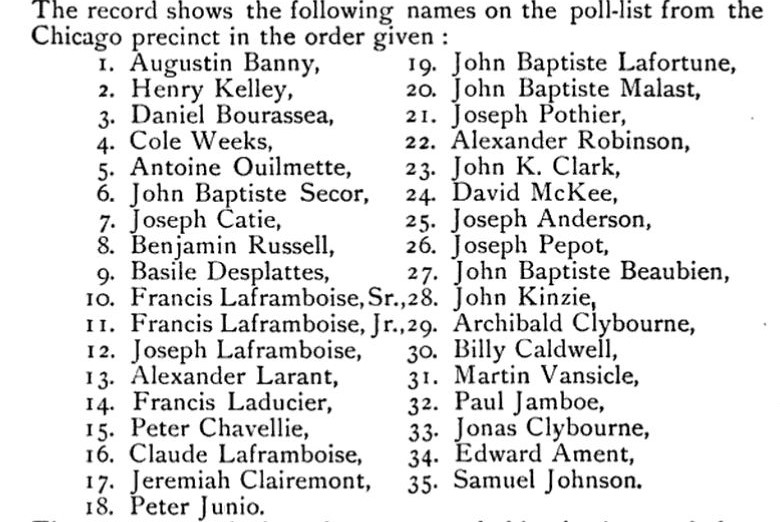
Just how many Metis lived in the Chicago village in 1826? We can infer the number of heads of households and the ethnic composition of the village in 1826 from the 35 names on the poll list  of the first official election (for Governor and Congressman) held there on August 7, 1826 2:


“Of the thirty-five names on the poll-list, twenty-one were French.”3 p.32
More evidence of the French/Metis presence comes from a petition requesting a priest that the early Catholic Chicagoans sent to the Archdiocese in St. Louis, MO in 1833:
“The following signed the petition, the figure after each individual's name indicating the number of persons in his family: Thomas J. V. Owen, 10; J. B. Beaubien, 14; Joseph Laf ramboise, 7; Jean Pothier, 5; Alexander Robinson, 8; Pierre Leclerc, 3; Alexis Laf ramboise, 4; Claude Laf ramboise, 4; Jacques Chassut, 5; Antoine Ouilmet; Leon Bourassa, 3; Charles Taylor, 2; J. Bt. Miranda and sisters, 3; Louis Chevalier and family, 3; Patrick Walsh, 2; John Mann, 4; B. Caldwell, 1; Dill Saver, 1; Mark Beaubien, 12; Dill Vaughn, 1; James Vaughn, 1; J. Bt. Kabbie, 1; J. Bt. Poulx; J. B. Tabeaux, 1; J. Bt. Durocher, 1; J. Bt. Brodeur, 1; Mathias Smith, 1; Antoine St. Ours, 1; Bazille Desplat, 1; Charles Monselle, 1; John Hondorf, 1; Dexter Apgood, 1; Nelson Peter Perry, 1; John S. C. Hogan, 1; Anson H. Taylor, 1; Louis Francheres, 1; a total of 122.4 
But the dominance of the French and Metis in early Chicago and the great fur trading empire was on the decline by the early 1830s:
“Numerous biracial fur trade families, including Métis, Indian, and Euro-American members, were among the first families of Chicago. Between the 1790s and 1812, Billy Caldwell, Alexander Robinson, and members of the Beaubien, Ouilmette, Chevalier, Bourassa, Mirandeau, and LaFramboise families established Chicago as a fur trade center along with the Anglo Kinzie family and the African American Jean Baptiste Point DuSable. After the War of 1812, however, English-speaking settlers from the eastern United States began to migrate into northern Illinois, and by the 1830s this stream of migration increased to the point where the old French-speaking Métis and other Creole residents became a minority in their own town.”5
And what caused this change in the Chicago economy from reliance on the fur trade?  The  emergence of farming and the concurrent deluge of new settlers from the Atlantic states (New York, New Jersey, Pennsylvania, Maryland and Virginia) combined with a multitude of  entrepreneurs eager to take advantage of Chicago’s geographic advantages brought a new vitality and money to Chicago.

Change was in the air in the village of Chicago. A land grab of huge proportions was just beginning. Enterprising persons with a view to the future saw the possibilities of the geographic position of Chicago both as a trading hub and a gateway to the west. There was money to be made! Speculators began buying up lots. Joining the fur traders and those who furnished them with lodging, liquor and supplies, surveyors, lawyers and speculators arrived to assist in mapping and selling land to eager buyers. More grocery stores opened and new clothing and building materials stores sprang up to serve the growing population. 

Evidence of the increase in population is seen in the first Chicago Census:
“The first census of Chicago was reported in the “Democrat” of November 25, 1835, showing 3,265 persons, 398 dwellings, 4 warehouses, 29 dry-goods stores, 19 grocery and provision stores, 5 hardware stores, 3 drug stores, 19 taverns, 26 groceries (probably liquor stores) and 17 lawyer's offices.” 6
As stated above, the increase in population correlated with a change in the ethnicity of the people of Chicago. Let’s look at some records to chart the changes in the ethnic make-up of this area from the 1820s to the 1830s.
The poll record of 1835 compared to the 1826 poll list shows a sharp movement from the few old Métis families to many, many American-headed households:


In conclusion, we see that Chicago underwent a huge increase in population from the mid-1820s to the mid-1830s. Along with this increase, we also see a change in the ethnic make-up of the people in the growing town. The era of the French and Métis fur traders was fast ending to be succeeded by Yankee businessmen and farmers with their families. What happened to the fur traders:
“A majority of those having French names (on the August 7, 1826 poll list) were employees of the American Fur Company, or hunted and traded for themselves. When Chicago was abandoned as a fur trading post, they went further into the frontier country, like Archibald Caldwell.”7 p. 16 
Notes
1 Métis, The Electronic Encyclopedia of Chicago, Chicago Historical Society, The Newberry Library, < http://www.encyclopedia.chicagohistory.org/pages/818.html>, downloaded 12 Dec 2018.
2 Fremont O. Bennett, compiled, Politics and Politicians of Chicago: Cook County, and Illinois. Memorial Volume, 1787-1887. A Complete Record of Municipal, County, State and National Politics from the Earliest Period to the Present Time. And an Account of the Haymarket Massacre of May 4, 1886, and the Anarchist Trials, (Chicago, IL, The Blakely Printing Company, 1886), p. 14.
3Bessie Louise Pierce, A History of Chicago The beginning of a City 1673-1848, Vol 1, (Chicago, IL, The University of Chicago Press, 1937), p. 32.
4 Joseph Garraghan Gilbert, The Catholic Church in Chicago, 1673-1871: An Historical Sketch, (Chicago, IL, Loyola University Press, 1921), pgs. 45-46.
6 Joseph Kirkland, The Story of Chicago, Vol. 1, (Chicago, IL, Dibble Publishing Company, 1892),  p. 152.
7 Bennett, Politics and Politicians of Chicago: Cook County, and Illinois. Memorial Volume, 1787-1887. A Complete Record of Municipal, County, State and National Politics from the Earliest Period to the Present Time. And an Account of the Haymarket Massacre of May 4, 1886, and the Anarchist Trials, p. 16.